Feeds:
Posts
Comments

Archive for the ‘Emily Bronte’ Category

witmisSOUNDTRACK: NEIL HALSTED-“Wittgenstein’s Arm” (2012).

neil-halstead-palindrome-hunches-450Halsted was a founder of the band Slowdive, who I knew somewhat.  I don’t know anything of his solo work, although his name rang a little familiar.

This is a very pretty, slow acoustic ballad.  Halsted’s voice is whispery and with proper folk inflections. The chorus has a very catchy melody.  And yet the lyrics are really dark and sad.

And while there is a mention of an arm in the song, there’s no mention of Wittgenstein.

You can check out the video here:

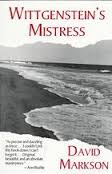
[READ: November 3, 2013] Wittgenstein’s Mistress p. 181-end

This peculiar book draws to a close in much the same way that it started. There are a few interesting revelations or, if not revelations, then perhaps ponderables as to the nature of just what our narrator (who is apparently named Helen) is doing.

As this last section opens, she is revisiting some more of the things that have been on her mind for the book—the waterlogged atlas that lies flat on the shelf and that blasted arthritic should/ankle  .

I have been wondering about her constant references to her period.  In addition to simply being something that happens to her which she is recording, I have to wonder if it is a nod to her fertility and the fact that since she is the last person alive she will never bear children.  On a slightly related note, I also have to wonder if her focus on rape means she was once raped.  It’s not necessarily the case of course, but there is a lot of it in the book, like this next mention: (more…)

Read Full Post »

witmis4SOUNDTRACK: PANIC-Requiem for Martin Heidegger (1978).

13+LP+Hoes++VoorkantPanic was a Dutch punk band.  Their album 13 came out in 1978 and “Requiem for Martin Heidegger” was the final track.  I love the album cover (and no I had never heard of this band either).

The lyrics are wonderfully simple (and no you won’t learn a thing about the man) with the completely singable chorus of “Hi-Degger, Hi-Degger, Hi-Degger, Hi-Degger, Hi!”

There are some other lyrics (including ein, zwei, drei, vier) and “Is he in heaven, is he in hell, where has he gone?  no one can tell.”

There’s some introductory chatter which I think is in German, but may be in Dutch.  But that’s all irrelevant, because this is three minutes of classic 70s punk.  And the video is a hoot too.

[READ: October 30, 2013] Wittgenstein’s Mistress p. 120-180

Although I read the first half of this book rather quickly, I took some time off before reading this section.  The good news is that this book does not require constant attention.  The bad news is that because there are so many details in the book (whether “relevant” or not) it’s easy to forget if she has talked about the different pieces before.  And that is kind of the point from her a well, since she constantly questions whether she has talked about something or not.

I’m breaking from my normal summary for a minute because I wanted to bring up something that struck me as I was reading this.  Several times throughout the book I found myself searching the web for ideas and facts that she mentions.  And it struck me that, while yes, in her world, the internet wouldn’t be working anyhow—there’s no electricity even—but she would not even have the concept of being able answer her questions with a few clicks.  This book wasn’t written that long ago, but when it was, the internet as we know it didn’t exist.  So our narrator does not know that she could have answered all of her questions in just seconds.  If this book was written now, it might even be seen as a “point” that the world no longer has such easy access to information.  But that is not an issue in this book.  Rather, our narrator simply knows that unless she is willing to dig through boxes or really wrack her brain to be able to remember where she found the information (and we know that’s not going to be successful), she simply won’t “know” what she knows.  And it’s interesting to imagine what it was like to read this book back in the 1980s without being able to quickly confirm  that indeed Wittgenstein said this or Heidegger said that or even that any of the artists she mentions really did what she says.   And I find that really fascinating.

Vaguely connected to this idea is her wondering about some details of the Savona soccer jerseys and then saying “One is scarcely about to return to Savona to check on this, however.” (122). (more…)

Read Full Post »

witmis3SOUNDTRACK: TOULOUSE LAUTREC-“Yesman” (2013).

heroesToulouse Lautrec are an alternative rock band from Romania.  Once again, I would not have ever heard of them had I not looked fora song about Lautrec (since he is mentioned in this section of the reading).

Toulouse Lautrec have two albums out, Heroes and their new one Extraordinar. They sing in both Romanian and English and this song (which is the first thing that came up on my search) is entirely in English.

It starts out with some very cool guitar riffs (very math rock–I actually considered it might be an instrumental).  Even the bass is doing something interesting behind the guitars.  Then about 50 seconds in the vocals begin.  And the singer has an almost American twang to him.

The chorus is a simple one, with ooh hoo hoo hoos.  But the real fun is at the end of each verse–the I say no I Say no and I say yes I say yes.

I listened to this song a few times and really liked it a lot.  It’s simple but solid alt-rock.  Then I found their website and watched a few more of their videos.  I really like the sound that they get–kind of buzzy guitars but otherwise very clean.

Check out the video for Yesman

and their site (which is in Romanian, but Google Translate will help you navigate)

[READ: October 20, 2013] Wittgenstein’s Mistress p. 61-120

This book is proving to be far less daunting and far more loose and fun than I anticipated.  As you can see by my “read” date, I finished this almost two weeks ahead of time.  In part it’s easy because unless I am gravely mistaken, there’s nothing really to “remember” about the story.  There are details and I think they are ponderable, but there’s nothing that seems to really impact the story. It’s more a series of ideas.

It’s really quite an audacious piece of writing.

Wittgenstein gets his first mention on page 61

“Once Bertrand Russell took his pupil Ludwig Wittgenstein to watch Alfred North Whitehead row, at Cambridge.  Wittgenstein became very angry with Bertrand Russell for having wasted his day” [61].

There are some meaty existential issues brought up like

“Surely one cannot type a sentence saying that one is not thinking about something without thinking about he very thing that one says one in not thinking about” [63]. (more…)

Read Full Post »

SOUNDTRACK: TARKIO-Sea Songs for Landlocked Sailors (1999).

Tarkio was Colin Meloy’s band before he formed the Decemberists.  My first reaction to the name Tarkio was that it sounded like Tarkus, the album by Emerson lake and Palmer.  And, since I heard about it during The Decemberists’ The Crane Wife album, which is proggy, I assumed Tarkio would be a prog rock band.  Little did I know that the real name of Tarkio comes from a train stop in Montana and that the real (at least to me) forerunner for this album is Tarkio by folkies Brewer & Shipley which featured the song “One Toke Over the Line.”

All of Tarkio’s music was collected in 1995 on the album OmnibusOmnibus contains their album I Guess I was Hoping for Something More, this EP, and various other unreleased tracks.

This EP actually came out after Tarkio’s debut album (when I decided to write this first I assumed it came first).  It seems especially surprising to me because the opening song sounds very different from anything on the LP.  Not worse, just like a direction they chose not to go in.  His voice is kind of processed and sounds, yes, funny.  Although I have to admit I rather like it—it’s much more alt sounding than the rest of the disc, which has a more folkie charm.  This disc was self released.  And I cannot believe that there are no images of it online anywhere.  Decemberists fans are crazy intense and no one has a copy of this CD?  Weird.

So as I said, the first song, “Devil’s Elbow” is full of vibrato and sounds like an alt rock song circa the mid 90s.  The solo sounds like it could be done by Robert Smith.  “Weight of the World” sounds more alt-folkie, big guitars and whatnot.  And the chorus sounds very much like a Decemberists song.  And check out these lyrics: “we hear the homeless philharmonic singing all the Charlies Angels to their heavenly convergence in the sky.” Pure Colin.

If you had any doubt that this was Colin Meloy’s band (which you wouldn’t, but if you did), this song title will tell you all you need: “My Mother Was a Chinese Trapeze Artist.”  Lyrically it is pure Meloy, although musically it’s more spare.  Decemberists fans will recognize this song from Castaways and Cutouts (that version is over a minute longer).  The Tarkio version has louder guitars as the song progresses, although the Decemberists’ version has more interesting instrumentation.  “Mountains of Mourne,” is a sad ballad played mostly on banjo.  “Never Will Marry” is a slow dirgelike song–very traditionally folk-sounding.

I really don’t know much about why Tarkio broke up.  This EP shows a band experimenting with their more ballad-y side.  Probably not destined to be a big seller, it works as a nice companion to their debut.

[READ: May 26, 2012] “The Region of Unlikeness”

This was the last short story I found by Galchen and I was really excited to read it.  It starts off a little oddly—it’s one of those stories where there are two characters spoken about and they are inseparable and it’s not always clear which is which.  Especially when the opening is as peculiar as this, “Ilan used to call Jacob ‘my cousin from Outer Swabia’”  Originally the narrator thinks it a joke, but she later decides it’s a sort of a clue.  She met the two of them by chance.  They were talking loudly and boisterously about Wuthering Heights in a coffee shop.  And that intrigued her to no end.  So she chimed in, and the three of them ended up talking for a while.  The crazy thing about them was that Jacob had a daughter. He seemed so carefree and like he had no responsibilities.   She never met the daughter, he barely mentioned his family, and yet she was always there in the back of his mind.

And she fell hard for Ilan—he seemed antiquated and resourceful like “fancy coffee and bright-colored smutty flyers.”  Of course all of her friends found the two of them arrogant and pathetic, but the narrator could not be drawn away from them.  Although really she was drawn to Ilan, who was generous with praise, while Jacob was kind of sulky and dark and was “jealous of Ilan’s easy pleasures.”  The narrator felt Jacob was pedantic.  All of this makes it surprising that the bulk of the story is about the narrator and Jacob.

And then she stopped seeing them.  Literally, they were nowhere to be found. (more…)

Read Full Post »