 SOUNDTRACK: COLIN STETSON-New History Warfare, Vol. 2: Judges [CST075] (2011).
 When you learn that Stetson played saxophone for Tom Waits, it makes perfect sense. The middle of the second song, “Judges” sounds like the instrumental break for any of Waits’ newer songs. Of course, once Stetson starts really wailing you realize that Stetson doesn’t need Waits’ lyrics to tell a story. With just one big-assed bass saxophone, Steston can say quite a lot. He plays with circular breathing, meaning that he doesn’t have to stop to take a breath, he breathes in through his nose and out through his mouth at the same time (this is of course impossible). The bass saxophone weighs some 20 pounds and is massive and Stetson makes it sound like everything from an oil tanker to a field of runaway horses. Oh, and he also has pretty melodies and songs that sound longing.
This disc is part two of a trilogy, but this is the first of his records that I bought (thanks to a release via the folks at Constellation–I wonder if they will redistribute Pt 1). There is a story that runs through these discs, although honestly, I’m not entirely sure what it is. But that doesn’t matter to me, what matters is Steston’s amazing skills.
There are evidently a couple of overdubs on this disc, but for the most part it is just him and his saxophone (and 24 microphones). The microphones were placed all over the room, on the instrument itself (to pick up the clacking of the keys) and even on his throat (when he makes those “voices muffled by a pillow” sound, that’s the throat mike picking up voice–singing while he is playing (which is impossible)).
The album features a couple of spoken word sections by Laurie Anderson, whose clipped, non-inflected voice gives this otherworldy music an even more otherworldy feel. And there’s two songs sung by Shara Worden. Other than that, it’s just the man himself.
Prepare to be amazed by this man’s talent. But also prepare to be a little frightened by what you hear. This is not timid music by any stretch. There’s some scary stuff on this record, especially if you listen in the dark. More especially if you listen loud (which you absolutely must do to hear all the nuances). On first listen, this may sound like a noisy jazz record, but the more you get into it, the more amazing it becomes.
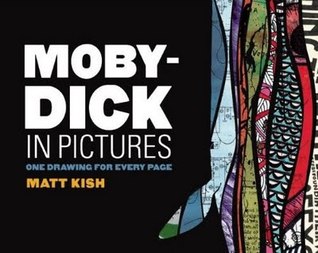
[READ: October 11, 2011] Moby Dick-in Pictures
Matt Kish has accomplished an amazing thing. He has drawn a picture a day (more or less) to accompany every page of the 552 page paperback version of Moby-Dick. He takes a small passage from each page and renders an image for it. One thing this book is not is an illustrated version of Moby-Dick. It doesn’t purport to be. You won’t get the whole story from this book. It’s not a cheat sheet for high school students. If you haven’t readMoby-Dick, this will give you a taste for the story–almost like a preview for a movie. And hopefully it will compel people to read the original. If you have read Moby-Dick, this is a wonderful companion. Not only will the pictures give you fascinating insights into the story (and into Kish, of course), but seeing sentences excised from the book to stand alone makes you aware of the book in ways you just aren’t when you’re reading it as a novel.
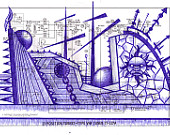 Kish admits he is not an artist, which while not false modesty, is certainly selling himself short. He has an awesome style of illustration. I am especially excited by his vast pictures with small details (lots of pages where there are small circles with lines in them or, for instance, the details on Queequeg’s face) and when he uses bold lines to create vast, weighty iconic pictures. Here’s one example of his awesome use of multiple straight lines. I mean, it’s gorgeous.
 But I also love the whole conceit that an artistic shortcoming for him has turned out to be an absolute boon. Kish says he cannot render the human form and so he made the conscious decision to make the seamen more like avatars than people. It’s daring and a little odd, but it works wonders. I admit that I was a little less than excited by the very first page of the book–I was disconcerted by Ishmael and his utter lack of features. (I actually like the way he is rendered later in the book better–call it an artistic growth). But by the time her gets to Queequeg, or the gorgeous Tashtego it’s obvious that his decision was genius. Just take a look at the marvel that is is Ahab (left). First off, the colors are amazing. As are the details of the whale in the corners. But look at him–he’s a metal machine–shiny and tough–part ship, part whale. Look at the awesome shading and detailing of the blue “coat” that he’s wearing. He’s even got the badge of Moby-Dick on his belt! And then there’s the pegleg–the most beautifully drawn pegleg ever. It’s really stunning.
Now you’re also noticing that there’s all kinds of diagrams behind Ahab. Kish used to work at a bookstore and he hated seeing old pages of books thrown away (he has since become a librarian, which makes sense–although as I librarian I learned that librarians are actually quite cavalier about throwing away old books once they are beyond use). So he brought these pages home. And, given the density of the layers of meaning in Moby-Dick, he decided to draw his pictures on these old pages. So on virtually every page you can see something in the background. Most of the time they are these circuital diagrams, which are wonderful. But there are several drawings where the found pages are pages of text from books. And I have to say if these were serendipitous findings then he has amazing fortune. Some of the pages tie in so perfectly it is wonderful.
Like the page that is headed “Cetology” and is from what, a textbook on whales? Or several other pages that I wish I had taken notes on, because they were really wonderfully chosen. He even has a drawing on a title page of Moby-Dick. I have to ask, did he really find that or did he buy it for the project? (more…)

 I Just Read About That...