 SOUNDTRACK: CALLmeKAT-Tiny Desk Concert #152 (August 29, 2011).
 Katrine Ottosen is CALLmeKAT and she is from Copenhagen. I’m unclear what her sound normally is–if it’s fuller than it is here–but for this show, it’s her on a couple of synths and a drummer.
I like the interesting synth sound she gets in the beginning of “Tigerhead,” but, despite the two synths, the whole song feels a little thin to me. Nevertheless, she hits some admirable high notes.
She wrote the second song, “Going Home” at Newark airport—she says always miserable there, it’s “so depressing” (no argument there). She samples herself on a tiny keyboard (Bob asks her what she’s doing singing into the tiny Casio–this has to have been before everyone was looping everything). The song is very pretty but feels very slight again–even more so because there is no percussion.
The third song, “Glass Walls” also has a sample of her voice–the sample is just an “ooooooh” note. She says she wrote this one in the Copenhagen airport (which must be nicer than Newark) This song is a bit more robust.
I liked her voice but the whole show I wanted a bit more oomph, which is not a typical reaction from a Tiny Desk where I know things are usually stripped down somewhat.
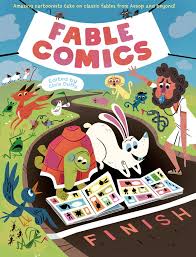
[READ: February 15, 2016] Fable Comics
Following up on First Second’s 2011 collection of Nursery Rhyme Comics, comes this new collection of Fable Comics, also edited by Chris Duffy.
Duffy says that for this collection they wanted to use mostly Aesop’s fables (because they are the most widely knows). But the book also includes a sampling from other traditions. He says that cartoonist were allowed to embellish the stories but we asked that the lesson remained.
And so there are 28 fables and the artists are pretty much a who’s who of contemporary comics. I’ve broken down the Fables by their creators:
Aesop
The Fox and the Grapes-James Kochalka modernizes this a bit with a jet pack, which is hilarious.
The Town Mouse and the Country Mouse-Tom Gauld is back, and it’s great to see his work as he keeps the story fairly traditional
Hermes and the Man Who Was Bitten by an Ant ; Hermes and the Woodsman ; The Frogs Who Desired a King ; Hermes and the Sculptor. George O’Connor is responsible for the First Second Olympians series, so it’s no surprise that he tackles these stories about Hermes. He remains faithful to the original and keeps up his very cool drawing style.
The Belly and the Body Members–Charise Harper has a wonderfully stylized look for this story about how the body parts need to work together or it can’t do anything.
Lion +Mouse–R. Sikoryak’s Mad Magazine style works very well for this familiar story about a mouse helping a lion (he has modified it somewhat of course).
Fox and Crow-Jennifer L. Meyer’s style is gorgeous. This fable has a fantastic look to it with pale colors and circles of details. I could look at it for hours.
The Old Man and Death–Eleanor Davis’s art is boxey and stark. It works very well with this dark and Communist-looking story.
The Boy Who Cried Wolf–Jaime Hernandez. I love when Hernandez does kids’ stoires because his characters are so perfectly cartoon and his colors are bright and fun. His telling of this story is very good.
The Crow and the Pitcher–Simone Lia I didn’t know this fable. And I don’t really know how the beginning sets up the end. It shows crow as being very smart for others but the end has the crow being extremely smart for himself. It’s a weird fable although it rings rather true.
The Dog and His Reflection–Graham Chafee does an awesome job of showing greed in others and leaving the dog’s story to be un-narrated. He witnesses greed and acts accordingly.
The Dolphins, The Whales and the Sprat–Maris Wicks. I was completely unfamiliar with this fable. I’m also curious about how much Wicks has added. I love that she adds some very funny factual details like that dolphins are actually a type of whale and that there are detailed asides about all of the animals throughout this story. The moral is that they’d rather die than take advice from a sprat. Still true today.
The Milkmaid and Her Pail–Israel Sanchez This fable was also unfamiliar. Sanchez’ drawings are stark and work well to tell this story of greed.
The Great Weasel War–Ulises Farinas. This comes from a longer fable called The Mice and the Weasels. I love Farinas’ art in this story. The colors are spectacular and the creatures are great And I love the moral is that they build these giant machines that cannot fight against nature.
The Sun and the Wind–R.O. Blechman. This fable was in Ava and Pip, so its funny to read it there and then see it here. Blechman’s simple drawings complement the story well.
The Hare and the Tortoise–Graham Annable’s art is great for this. The tortoise is so crabby looking. I’m unfamiliar with the deus ex machina that happens though. It’s funny how many of these fables we may know without knowing them in total.
The Grasshopper and the Ants–John Kerschbaum’s art is so busy and full of detail, it’s really wonderful. I’m unfamiliar with the ants asking the grasshopper to play for them at the end of the story tough.
The Thief and the Watchdog–Braden Lamb & Shelli Paroline. I really enjoyed the way these two created this fable. The art is great–angular and simple but really powerful. Having the dog explain why giving him meat won’t work is a great idea.
Demandes and His Fable–Roger Langridge. I love Langridge’s clear lines and distinctive colors. He tries to get people’s attention and only succeeds by telling them a fable about Demandes. I’m intrigued that his fable gets interrupted by himself.
The rest of the fables’ origins are mentions in parentheses after the title:
Leopard Drums Up Dinner (Angolan Fable)–Sophie Goldstein makes a fun visual of this story about animals trying to capture others with music. I wonder how closely this aligns to the original, as its pretty crazy.
The Hare and the Pig (Indian Fable)–Vera Brosgol. I didn’t know this fable at all. Rabbit and Pig are arguing about who is best. Leave it to fox to make the declaration.
The Demon, The Thief and the Hermit (Bidpai)–Keny Widjaja illustrates this amusing tale of a thief trying to join with a demon to rob a hermit
The Elephant in Favor (by Ivan Krilov)–Corinne Mucha. I love that Corine modernizes the fable (the lion says Dude). This is all about how everyone talks about the elephant. He works slow but gets a raise. What makes him so great? All the other animals speculate. But it turns out that his ears are the real reason–for reasons other than the obvious. This may be my favorite fable of all.
The Mouse Council (medieval European fable)–Liniers. This is the story of putting a bell on a cat and how no one wants to risk their life for the good of all. Liniers’ art is spectacular. I love the subtle shading of his drawings and then the rough drawings by the mice.
Man and Wart (Ambrose Bierce)–Mark Newgarden. I love Ambrose Bierce but had no idea he wrote fables. This one about people’s need for privacy and not belonging to a club is pretty strange.
The Hen and the Mountain Turtle (Chinese Fable)–Gregory Benton. I was unfamiliar with this story about a wise turtle saving a farm.
These collections of short pieces are quite wonderful. I wonder what genre First Second will tackle next. #10yearsof01
Read Full Post »
 SOUNDTRACK: JOE HENRY-Tiny Desk Concert #176 (November 21, 2011).
 I had never heard of Joe Henry, so imagine my surprise to find out that he was releasing his 12th album in 2011. For this Tiny Desk, it’s just him at a stool playing his guitar. He has a very easy vibe, telling stories between songs and playing them with very little fuss.


 I Just Read About That...