 [READ: June 1, 2022] The New Manifesto
So I received this book at work and it was my job to catalog it (it has yet to be cataloged by anyone else). But there was a problem.
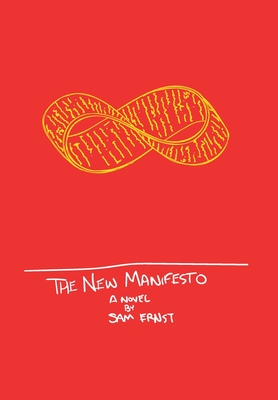
The cover of the book says The New Manifesto a novel by Sam Ernst. But you never trust the cover for the actual title of a book, you trust the title page. And the title page says The New Manifesto or The Slow Eroding of Time Arthur B. Johnson edited by Sam Ernst.
Now the cover also has an about the author of Sam Ernst (with an author photo of the back of his head). And the list of books by Arthur B. Johnson don’t seem to exist. So, clearly, the author is Sam Ernest and Arthur B. Johnson is fictional, But from a cataloging standpoint, Johnson needs to be acknowledged in some way. Which is a pain.
Anyway, I decided to see if this book was worth all of the trouble.
I’m not quite sure.
It opens with a Foreword by Dr James L. Vanderworthy of Bradford College (also fictional). He says that The New Manifesto is the novel that resonates with him more than any other. The editors preface is from Ernst, he says he had a copy editing position at Smith Ralston Excelsior which led him to meet and befriend Arthur B. (“Artie”) Johnson. It was this that inspired him to edit Artie’s words in the way we see here. The Publisher says they didn’t really know what to do with the book, but they thank Ernst for his tireless work on it.
The book is presented in nine parts. Many are short, but some (like part 2 An Assemblage) are nearly 100 pages.
Part 1 the Prelude is a series of 25 numbered paragraphs
1. He sat down to write
4. He was writing a book. A book he never finished. This is a story of failure.
18. Given the book’s title, he was finding it surprising how little manifesting was being done.
Part 2 is written in several much longer sections. Each one is a hilarious account of the narrator’s life as he does remarkable things and then moves on.
He averts a war between two countries. He speaks neither language but found a letter from one kingdom to the other. Had the message not gotten through, war was inevitable. But he rowed for days across the sea to bring the message to the beacon he saw. He walks to a war torn country and is taken for a doctor (he is not). Because of a book he had just read, he is able to diagnose a seemingly dying patient, and as he leaves the area he inadvertently participates and wins the 1984 Sarajevo Ski Jump Competition.
After a few more adventures, including one aboard a ship, he gets a job at Brookhaven National Laboratory, where he uncovers a brilliant scientific schema because of the box elder bugs that swarm his office window.
Eventually he settles down and enters the Monastery of Christ in the Desert. where he became an expert bread baker.
Part Three is An Interlude which is done in a series of paragraphs. These are unnumbered but, rather, are given a hand drawn symbol. These are also in third person
- He checked his page count and felt the blood drain from his head as if his brain were being juiced “Six pages? That’s all I have to show for years of toil?”
- To write, he simply imagined famous actors saying his lines.
- He was fascinated by blank white expanses. He hoped to leave several in his book like this (followed by a blank page).
Part Four is called A Scrap Heap
It is a story about the Impact–the meteor impact that was about to hit the earth. And the effects it had on people before it hit and after it hit: “The Impact threw us all out of our normal routines.” After listing all of the terrible things that happened, he notes “it’s probably neither popular nor kosher to talk about the ‘benefits’ of murderous, havoc-wreaking meteor impacts. But I’ll leave tact to the ethicists.” The end of the section suggests that it was written in May of 2146.
Part 5 A Coda. More unnumbered paragraphs
He spent the morning laboring to transcribe his dreams. … Everything had seemed so fully formed while he was asleep, but each waking moment brought further dissolution. At 7:48am he gripped his pen and let the words flow. By 8:30am, he was mourning the loss of his best ideas yet. Novel #3 was stillborn. And he hadn’t even finished Novel #1.
Part 6: A Question
This section is about Annabelle Laetner and how when she awoke from her coma she was able to recount her dreams. He decides to remix her dreams into a more coherent story.
Part 7: Is There Something After a Coda?
Good writers don’t write, they wrote. The verb tense being the defining characteristic. He finally hands in his book to the editor whose notes were: “More. Different. Better.”
Part 8: An Answer
Is a choose your own adventure story that runs to the end of the book (almost). It’s a pretty exciting story about running back into a building to retrieve your bag with the manuscript while a riot is going on on the streets below. The author has a lot of fun with the possibilities of the choose your own adventure.
Part 9: A Double Coda is just one paragraph explaining how the novel received its subtitle.
The Appendixes include a biography of Arthur Johnson and a letter from Johnson to Ernst.
This novel was delightfully weird. Some parts were tedious–usually the longer sections. Part Four was particularly tedious. But the crazy ideas and various lives that the author led were pretty fun.
I wonder if Ernst will write another book anytime soon.

 I Just Read About That...
Leave a comment