 SOUNDTRACK: MOUNT EERIE-Tiny Desk Concert #945 (February 12, 2020).
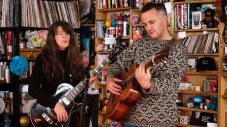 I’ve heard of Mount Eerie, but I didn’t really know that much about them. And when I say them, I really mean him, Phil Elverum.
Phil Elverum’s songs come full circle, swooping down like vultures and floating up like ashes from flames. Throughout his work in Mount Eerie and The Microphones, idealism comes up against realism, existence entangles with impermanence and love discovers new forms. So when he sings, “Let’s get out the romance,” in close harmony with Julie Doiron at the Tiny Desk, there’s a history going back nearly two decades to an isolated cabin in Norway where he first wrote the phrase.
I have never really enjoyed quiet, sad music. It’s just not my thing. So this Tiny Desk is definitely not my favorite. Although I can appreciate the intensity of his lyrics and the beautiful way his and Julie’s voices combine.
They recorded an album, Lost Wisdom Pt. 2, last year.
the sparsely decorated, deeply felt album meditates on a heart still breaking and mutating, but also gently reckons with a younger version of himself. That refrain on “Belief” is performed here with only an electric guitar and a nylon-string acoustic bought in Stockholm during that Scandinavian trip many years ago.
“Belief” opens with quiet acoustic guitar and then the two of them singing together. And it’s pretty intense:
Elverum remembers himself as a young man who begged “the sky for some calamity to challenge my foundation.” We then become the Greek chorus, witness to the unfolding tragedy: first, the death of his wife and mother to their child, the musician and illustrator Geneviève Castrée, in 2016; then the marriage to actor Michelle Williams in 2018 and their divorce less than a year later. “‘The world always goes on,'” Doiron sings in answer, quoting a Joanne Kyger poem, “‘Breaking us with its changes / Until our form, exhausted, runs true.'”
Doiron’s guitar contributions are so minimal, she doesn’t play for most of the song. The song runs almost seven minutes and does seem to end mid-sentence.
When “Belief” suddenly ends, seemingly in the middle of a thought, Elverum’s eyes search the room. The audience responds with applause, but a version of this dynamic plays out everywhere he’s performed for the last three years — long silences broken up by tentative claps, nervous laughs struck by grief and absurdity.
The second song, “Enduring The Waves” is only three minutes long. He begins it by speak/singing “Reading about Buddhism” and I wasn’t sure if it was a lyric or an introduction. It’s a lyric. This song features Julie and Phil singing seemingly disparate lines over each other until their final lines match up perfectly The construction of this song is really wonderful even if it is still a pretty slow sad song,
“Love Without Possession” Julie sings the first verse and after her verse, Phil starts strumming his guitar in what can only be described as a really catchy sort of way. They harmonize together and Doiron includes minimal electric guitar notes. This is my favorite song of the bunch.
[READ: March 13, 2020] “My High-School Commute”
Colin Jost is one of the presenters on Saturday Night Live‘s Weekend Update. I think he’s very funny and has a great sarcastic tone. Although, I have to agree with the title of his new memoir: A Very Punchable Face.
This is an amusing essay about his daily commute to high school, in which he took “a journey by land, sea and underground rocket toilet.”
His grandfather always told him about the value of an education–protect your brain! was his constant refrain.
It was his brain that got him out of Staten Island. It got him into a Catholic high school called Regis* *Regis Philbin was named after my high school but went to Cardinal Hayes High School which was full of kids who beat the shit out of kids who went to Regis.
Regis is one of the best schools in the country and it is free–tens of thousands of kids apply for 120 spots.
But it was in Manhattan. And it took him an hour a half each way to get there.
I took a bus, then a ferry, then a subway–which, when you type it into Google Maps, looks like you’re emigrating from China to San Francisco in the eighteen-forties.
His parents were worried about their fourteen year old commuting into New York City: “My freshman photo is a real ‘Come and get it!’ to subway pedophiles.”
And yet, there was an amazing sense of freedom. Some of his friends did actual fun things, like taking Ecstasy and sneaking into clubs like the Limelight. Jost was too afraid to take risks, so he went to David Lynch movies not showing on Staten Island
Whatever they did they would hang out for hours after school because no one wanted to go home. It was like a slightly more grown up version of The Goonies. Only our treasure? Was knowledge.
You could do your homework on the subway or engage in dangerous behavior like seeing who could run across all four subway tracks to the platform on the other side without “touching the third rail” and “dying.”
Not everything was peachy of course–older kids followed them and robbed them. He once saw someone get hit by a bus “and his body basically exploded in front of me.”
And then there was the boat portion of my trip, which is always a funny element to sprinkle into a commute No one has ever transferred from a city bus to the subway and thought, “There should be a boat ride in between.”
Then there was the bus ride, where everyone seemed to be thinking, “We live in a place full of cars, yet we’re riding a bus. Let us ever speak of this to anyone.”
This essay made me laugh a lot and I would absolutely read his memoir.

 I Just Read About That...
Leave a comment