 SOUNDTRACK: BLACK UHURU-Tiny Desk Concert #917 (November 29, 2019).
 I don’t have a very good overall feeling about reggae. As a person who listens to a lot of music that people have said “all sounds the same,” I can’t help but admit that to me all reggae sounds the same.
Or, perhaps all of Bob Marley’s reggae sounds the same and that’s the only reggae I’ve really been exposed to.
Because this Black Uhuru concert is clearly reggae, but it sounds new and exciting to me (even if the band has been around for 40 years).
I’ve been aware of Black Uhuru forever–they always seemed to be in the Columbia House 20 albums for a penny ads back in the day (along with Boz Scaggs, another artist I’ve heard of since I was a kid but have never actually heard a note from).
Considering the state of global politics, there’s never been a better time to get reacquainted with the righteousness of Black Uhuru. The iconic reggae band, whose name means “Black Freedom” in Swahili, is still going strong after more than 40 years, and they brought their much-needed songs of solidarity to the Tiny Desk. Fittingly, the set begins with “Here Comes Black Uhuru,” a telling and literal re-introduction to the group’s legacy for audiences that may be unfamiliar with their extensive catalogue.
This song is clearly one that I needed, as I didn’t know anything about their music.
While most-known for their late-’70s and early-’80s classics — years defined by a game of musical chairs within the group as played by founding members and/or collaborators Michael Rose, Garth Dennis, Don Carlos, Sandra “Puma” Jones, Sly Dunbar, Robbie Shakespeare and even Junior Reid — this incarnation of Black Uhuru, with frontman and co-lead Andrew Bees, has been touring and recording since about 1997 or so, longer than any of the configurations that precede it.
“Here Comes Black Uhuru” has some groovy bass from Daniel “Axemon” Thomson (who plays a white five-string Steinberger). The verses feature some cool synth sounds from Horace “King Hopeton” Campbell and the drums are chock full of fun percussion from Rolando “Phanso” Wilson. The biggest surprise to me was the ripping guitar sound from Frank Stepanek.
The vocals are shared between Derrick “Duckie” Simpson and Andrew Bees, with additional backing vocals from Elsa Marie Green.
This song has simple but catchy riff and it ends with a big powerful rocking sound.
“As The World Turns” comes from their new album of the same name. “As The World Turns, is an album that was mired in issues around its master recordings, was finally released in 2018 — six years after it was recorded — and earned a Grammy nomination for best reggae album.” The song opens with the stereotypical Egyptian riff while Duckie and Elsa Marie Green sing the main verses. I love that there’s spacey effects from the keys and Stepanek plays a blistering solo (twice).
“I See You,” is a love song “led by Derrick “Duckie” Simpson, a co-founder and the only steady member of the group since its beginnings in the early ’70s.” It has the most conventional reggae sound and I like the way Andrew Bees works as a kind of hype man in this song,
“What Is Life” is their most well-known song. It
explores the hopelessness endemic to those who are economically and socially disadvantaged, and explores the complexities of the human experience — what life could be, versus what it is. Despite being written and recorded in 1984, you can probably recognize the endurance of its themes.
Andrew Bees sings lead which adds a very different tone to the song.
While I really liked the first two songs, the second two weren’t quite as exciting to me. Maybe I don’t need more reggae in my life, but I’m glad that there are different style out there.
[READ: February 1, 2020] DPR Korea Tour
I was really surprised to see this book at work. I didn’t realize that North Korea sent propaganda to English-speaking countries I assume this isn’t meant for American eyes specifically, more likely to European eyes, but who knows.
The book is written in English, Chinese and Cyrillic, but the writing is all just captions for the photos.
And I have to say that the landscape of North Korea is absolutely gorgeous. I had no idea their land was so lovely.
Mt Paektu shrouded in clouds is striking. And Lake Chon underneath the mountain is crystal clear and beautiful. Taehwa Peak on Masikryong Pass has chair lifts that look like they are thousands of feet in the air (no people on them in the picture though). It is a large skiing mountain–I didn’t know they skied there.
There are also wondrous waterfalls like the Hyongje Falls at Mt Paektu and the Rimyongsu Falls with a mansion atop them. Isonnam Falls is peaceful and serene while the Saja Falls are roaring (its hard to get a sense of scale though). I’m also very impressed by Kuryong Pool and Eight Pools Under It.
Meanwhile Lagoon Samil is a beautiful body of water and the coast of Chongsokjong is forbidding and very cool looking–excellent films could be shot here.
Nongbu Rock has beautiful striated rocks not unlike Red Rocks and Kamgson Gate is simply breathtaking. Can it actually be a naturally occurring archway like that? There’s a similar gate in Sea Chilbo called Tal Gate. I honestly cant tell from these pictures if they are natural or man made
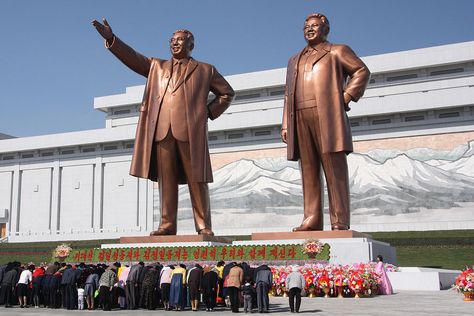
Their architecture is also very impressive. The Kumsusan Palace of the Sun is a striking building surrounded by tulips. The Grand Monument on Mansu Hall is one of the few pictures I’m familiar with with its two massive bronze statues of the leaders (see above and notice how tiny the people are in the picture). The fact that they could get a picture of this location with absolutely no people in it is an intimidating thought. A later picture pulls back and shows all of Pyonyang–statues and huge high rises–again with no people present.
I’m very curious what the International Friendship Exhibition House holds. And since nothing can be un-propaganzised, the war museum is called the Victorious Fatherland Liberation War Museum with battle photos and aces to military ships.
The Songdowon International Children’s Camp looks like a lot of fun with some really cool pools and water slides. The children in the picture are certainly international with some of the boys wearing shirts with English writing on them. The Mangyondae Schoolchildren’s Palace is massive. It looks crazy institutionalized. Changgwang Kindergarten is also impressively institutional, although it is colored pink, at least.
I don’t know what they worship in North Korea. The Pohyon Temple is out in the open and the Tangun Temple is in a cave under rocks.
Some of the monuments are fascinating propaganda as well. The Samjiyon Grand Monument shows a huge bronze Kim Il Sun and a vast number of people worshiping/praising him. The worshipers alone appear to be about 20 feet high and the Emperor must be close to 50 feet. The Sculpture of the Bugler of Advance is not unlike Imo Joma photo, but much bigger and with dozens of soldiers all about 12 feet tall. The detailed work on the soldiers is amazing. The crasftpeople in North Korea are very impressive.
There a monument with the poem “Shining Star” written to Kim Jon Il. And also a “historic monument inscribed with President Kim Il Sung’s signature.”
I also got a kick out of the two pages of flowers. The “Immortal flower Kimilsungia” and “Immortal flower Kimjongilia.”
There are some lovely statues/monuments that are just cool looking. Like the Arch of Triumph, the Statue of Cholima and the cool Monument to Three Charters for National Reunification. I was curious what that’s about (apparently It was opened in August 2001 to commemorate Korean reunification proposals put forward by Kim Il-sung–I had no idea that was on the table and I wish them all good luck).
Then there’s the Monument to Party Founding–a rather classic intense sculpture of the hammer, sickle and calligraphy brush which symbolize the workers, farmers and intellectuals. The element is 50 meters high to symbolize the 50-year anniversary of the founding of the Workers’ Party of Korea.
One thing the surprised me in this book is when there are pictures of crowd. Some of these crowds have clearly Western people in them. I assume they are European as I didn’t think Americans were allowed in North Korea. But there is a pretty surprising diversity among the tourists. In most of the pictures the tourists are suitably impressed with what they see–pointing, mouths agape, staring in wonderment. Or in one picture looking kind of fat and stupefied.
The funniest one though is the Surfing Tour in which a dude in the front is standing in the classic surfing pose, long blond hair, giving the hang loose sign while the folks around him (Korean and otherwise) all smile.
There’s not a lot of day to day activity in these photos although the picture of two people making glutinous rice cakes is pretty funny.
North Korea is known for being very strict (hence no people out and about, but their strictness does allow for some impressive displays, like the Grand torch-lit procession in which hundreds, if not thousands, of people walk in formation of Korean letters. It’s an impressive picture from the air.
I have to wonder if the average North Korean citizen is allowed to go to the Runga Dolphinarioum or if that is just for the elite and tourists or the massive Munsu Water Park. The Central Zoo is pretty massive and the opening has you walking through a giant tiger’s mouth.
And finally, the thing that really made my head spin was the Pyongyang Taesonggang Beer Festival! Beer Festivals in North Korea?
It’s unclear when this book came out but there are pictures that show a foot race from 2016, so we’ll assume it’s around then. Although some of the pictures look like they could be from the 80s or 90s.
I’m not sure what this book is meant to make the average person think about North Korea. But I came away from it with a much better impression of the country overall.
However, probably opposite of what they intended, I also thought It’s a shame the country is so oppressive and cruel because they have so much to offer the world that they should really let the rest of the world see their natural beauty and the skill of their workers.

 I Just Read About That...
Leave a comment