 SOUNDTRACK: JOYCE DiDONATO-Tiny Desk Concert #933 (January 15, 2020).
 I was sure that Joyce DiDonato had performed a Tiny Desk Concert before, but I actually knew her from a gorgeous NPR Field Recording from 2015.
the last time we filmed the down-to-earth diva, she insisted on singing an opera aria at the Stonewall Inn, the iconic gay tavern in Greenwich Village.
DiDonato is an opera singer and her voice is amazing–she can soar and growl and everything in between. But this Tiny Desk is not what you’d expect. For although DiDonato sings in her beautiful operatic voice, the music the band is playing is anything but.
When opera star Joyce DiDonato told us she wanted to sing centuries-old Italian love songs at the Tiny Desk we weren’t surprised. But when she said she was bringing a jazz band to back her up, we did a double take. But that’s Joyce, always taking risks. On paper, the idea of jazzing up old classical songs seems iffy. At the least it could come across as mannered and at worst, an anachronistic muddle. But DiDonato somehow makes it all sound indispensable, with her blend of rigor, wit and a sense of spontaneity.
The first song is by Alessandro Parisotti. “Se tu m’ami” sets the stage for what this show is going to be like. Gorgeous jazz with DiDonato’s impressive voice.
The musical formula for these unorthodox arrangements makes room for typical jazz solos while DiDonato molds her phrases to the flexible rhythms and inserts old-school trills and flamboyant roulades.
A cool trumpet solo from Charlie Porter takes a cool trumpet solo while DiDonato admires his skill.
After three minutes they segue seamlessly into Salvator Rosa’s “Star vicino.” This one features a piano solo from Craig Terry which he begins with a line from “Twinkle Twinkle Little Star.” The song also features a muted trumpet solo with a few drum breaks for Jason Haaheim
My favorite moment in the set comes just before 6 minutes where she sings a beautiful lilting melody and then hits a growly note that I was sure was the trumpet until Porter played the same note on his muted trumpet. It was very cool and kind funny. Especially when she says
there’s no soprano in the world who could get away with that
Less than a minute later she runs through her enormous vocal range from low to very high to soaring. It’s amazing.
She says that in the classical world, the standard is perfection–rarely achieved. Young singers try so hard to get it perfect that they lose the “grease” as the jazz players say. So this project was designed to put the swing back in these old love songs.
The third song she says is by anonymous, but it is credited to Giuseppe Torelli. “Tu lo sai” is a love song that says, “you have no idea how much I love you. No matter how much you scorn me, I still love you,” She says they giving this the Chet Baker treatment. I’m not exactly sure what that means, but there is some wonderful trumpet work in this song.
It has a slow opening with piano and voice. The other instruments slowly come in and there is a wonderful moment during Porter’s trumpet solo where she picks up the note from him and runs with it.
Bassist Chuck Israels (who has played with everyone from Billie Holiday to the Kronos Quartet) never solos but he keeps the whole enterprise running perfectly.
For the final song Francesco Conti’s “Quella fiamma” they bring out Antoine Plante on the bandoneon. She says, “Yea we’re going to South America in a minute.”
Porter uses a different kind of mute which creates a unique sound. Then the bandoneon comes in and the South American flair is complete. There’s an incredible moment at the end of the song where Joyce just trills away–showcasing so much of what she can do.
As the blurb says, despite how great the band is
the star of the show is the continually amazing DiDonato, whose voice is certainly one of the great wonders of her generation. The flexibility of the instrument, the colors she conjures and her fine-tuned dynamic range are a few of the reasons she’s still at the peak of her powers. She looks and sounds like she’s having the time of her life.
I see that she sings in Princeton pretty often. Next time she;s in town I will make sure to check her out.
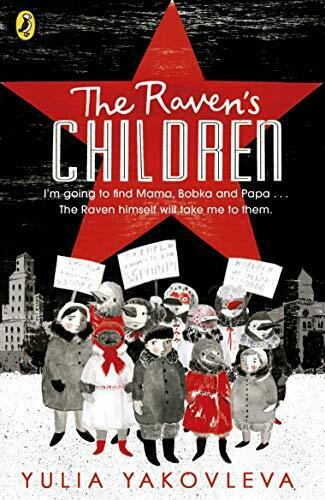
[READ: December 20, 2019] The Raven’s Children
This story was fascinating in the way it started as a very real story, suddenly added magical realism and then turned into an utterly fantastical story. And yet it all works perfectly well as an allegory of the oppressive regime under Stalin.
Not bad for a book with talking animals.
This book was translated by Ruth Ahmedzai Kemp and she brings this story to life.
Shura is a young boy living in Leningrad. He lives with his mama and papa as well as his older sister and a little brother. They live in an apartment building and he and his sister are lucky enough to have a room to themselves. The amusing set up is that they have to walk through a wardrobe that their father set up to separate the rooms (he removed the back but you can’t tell from the front). This weird construction actually saves them later in the story.
Shura’s friend is named Valya. His parents don’t want him hanging out with Valya, but they like to do the same things, so he disobeys. Today they are putting pennies on a railroad track. They had been doing this for long enough that they can tell how heavy a train is by the way the resulting items come out.
On this occasion the train that went by seemed to be full of people. People crammed into each car. As it sailed past, a piece of paper sailed out. Valya grabbed it. Neither of the boys could read very well but they could see some numbers on it. Shura was sure that the paper was important and he desperately wanted it. But he didn’t know how to get it from Valya without making him want it more.
They walked home and by the time they got to Shura’s place, they were physically fighting. Shura manged to snatch the paper and Valya threw a rock at him. The rock smashed a window of an older lady’s apartment in their building. Shura knew he was in trouble for the window. But it was Valya’s fault. Of course, he wasn’t supposed to be playing with Valya.
Shura didn’t want to give up his precious paper but eventually he gave it to his father who read:
Tell them … 5 Sadovaya Street … taken to Kolyma Gulag
They wanted to know where he got it from, but he was afraid to say.
In the end, he was punished by being grounded from the huge parade tomorrow. The parade was in honor of Ivan Papanin. (I had never heard of him so I had to look him up: [Ivan Dmitrievich Papanin (Russian: Иван Дмитриевич Папанин, 26 November [O.S. 14 November] 1894 – 30 January 1986) was a Soviet polar explorer, scientist, Counter Admiral, and twice Hero of the Soviet Union, who was awarded nine Orders of Lenin].
The parade was very exciting and marched down the main street of Leningrad. It seemed that everyone was there. There was no way he would miss it. Since his parents wouldn’t know if he left the house or not, he sneaked out and went to the parade. The crowd was excited and jostling about. Shura tried to sneak up to the line, but was elbowed by an older boy causing his nose to bleed. While he was hunched over Papanin himself rode by and Shura missed him.
A man saw what had happened and took pity on him. He offered to buy him an Eskimo–the brand new ice cream just released. Shura refused, knowing he should not take anything from strangers. But he was so excited to try this new ice cream that he accepted. The man spoke to him for a little while.
The man said some things that upset Shura. He commented:
What have we got to be proud of? Building some kind of miraculous ice-breaker? Meanwhile their coats are in tatters and most of them left home without any breakfast.
The man laughed and said he was joking, then he handed Shura the other Eskimo ad walked away. That’s when his sister caught him. Her name was Tanya and she was nine. She liked to get him in trouble and told him he was in for it.
She couldn’t imagine how he would have gotten money for that ice cream. When he said a stranger gave it to him, she didn’t believe him. And it sounded absurd. When he told her what the stranger said, her tone changed. She feared he might be a spy and was trying to poison him.
She agreed to take him back home and cure him which meant he had to throw up all the ice cream that he had just eaten. I wasn’t sure if she was making fun of him or if she with serious about this but she gave him some medicine to make them throw up and put him in bed for the rest of the night. The Eskimos weren’t as good coming back up.
The next morning, his papa was not here. His mama told him papa was on a business trip. But he overheard his busybody neighbor say “the black raven took our neighbor last night.”
The next day, his mama and baby Bobka were also missing. The only reason Shura and Tanya weren’t discovered was because of the wardrobe. Shura was certain he heard someone say “Black Raven” in the middle of the night,
They went out in the hallway and a neighbor gave them a package and said their mother told them to go to their aunt’s house. In the package was a lot of money.
They went outside with the money but they were very hungry so they decided to get breakfast before heading over to their Aunt Vera’s house. Shura kept talking about the black raven, so finally they agreed to ask a policeman. When Shura said to the policeman, “O, excuse me you will find this very funny but my father was taken away by the black raven,” the policeman’s face immediately went from friendly to angry and he called out to stop them. A chase ensued as they ran throughout the square hiding in a park. They were terrified and didn;t know what to do.
Shura was still going on about the Black Raven so she told him to ask some birds in the park about the black raven. So they saw some crows and addressed them, “Most esteemed comrade crows if you would please excuse us for bothering you, we would be grateful if you would kindly and graciously allow us to ask a question.” The crows looked at each other and just as Shura was about to laugh at Tanya for talking such nonsense, one of the crows looked at her and said, “Yes can I help you?”
After they got over the shock, they had to ask if the crows knew anything about the black raven. They both said that of course they did but they wouldn’t help them because their intellect was considerably inferior to their own. The crows concluded, “You are of little interest to us.”
They ran through the park trying to get answers from the birds but they were all too uppity. Finally the children found a place to rest for the night.
Shura knew he needed to get his parents had his baby brother home and he knew the only way to do that was to get caught by the Black Raven himself so the next morning he locked his sister in a closet and ran outside as soon as he saw the Black Raven’s car driving around.
The car pulled over and took him to a Gray building. His head is shaved and he is given gray pajamas. He looks like all of the otehr children there–identical, genderless, sedate. The place is an institutional facility for children of criminals. It becomes clear that they are putting sedatives in the food. He is able to talk to some of the children but he soon says something that offends all of his new friends.
He doesn’t know how long he is there–he thinks it’s really not so bad. Then one meal, someone steals his food and he starts to wake up from the drugs. He knows he has to get out.
As he tries to figure out how to escape, he meets a rat and the rat talks to him and shows him how to get away. While they were speaking, Shura notices that there are eyes and ears in the walls that were following him. And as soon as he is spotted, the alarms sound.
The rat helps him escape and he soon spots people lined up waiting to talk to the Black Raven. He met a woman who said that she had written a letter saying that her husband was not really a criminal, that it was a mistake. He learns that everyone waiting online believes that the are wrongly accused. Shura believes that they are all liars. But he knows that his family is innocent. Shura soon sees that bags of letters just like the one that the lady had written were being incinerated to make fuel for the building.
Shura doesn’t know what to do next and is walking around in a daze when he realizes that nobody seems to be able to see him. In fact people are literally walking right through him. Is he dead? Is this a dream? He throws a rock at a person and it sails right through him. Then he throws a rock at a boy. It hits him and he gets really angry until they both realize that they can see each other. The boy says his name is King of the Street,
The King says that they are invisible because people don’t want to see them. He is able to go anywhere and do anything–steal food, sleep anywhere, because the world doesn’t acknowledge him. He teaches Shura how to survive on the streets.
This new situation is kind of fun, but also a little lonely. And Shura knows he has to find his family.
The book is a children’s story, but it is rather frightening–especially if you put yourself in Shura’s shoes. What makes it even more frightening is that in the afterword, Yakovlena explains that all of this is actually quite real to the author.
The events from the story were inspired by true events from her past. Her great grandfather was arrested and executed under Stalin’s regime. His wife succumbed to illness and then death after having struggled to survive under the extreme stigmatization that followed her husband’s sentence. Consequently her grandfather and his three siblings were taken to an orphanage for children born to enemies of the state. He escaped and Yulia believes he became part of an underground gang. Her grandfather eventually found his siblings scattered across different orphanages and reunited with them before becoming head of the family. However he never spoke about any of these events directly and refused to answer any questions. He died leaving many questions unanswered. But it wasn’t just her grandfather’s story that was silenced. Her mother’s grandfather spent ten years in a labor camp somewhere near the polar circle and only survived due to his expertise in growing tropical plants which kept him in good favor with the camp’s chef who needed fresh vegetables. h also refused to talk about it.
Many Russian families had live with the silence from those who lived through traumatic and horrific times discussed. She hopes this book will fill in these gaps and create a voice that will break the silence and encourage others to share their experiences.
That’s pretty intense for a book with talking rats and crows. But the surrealistic images make the story even more horrible.

 I Just Read About That...
Leave a comment