 SOUNDTRACK: BRITTANY HOWARD-Tiny Desk Concert #901 (October 15, 2019).
 I don’t really like Alabama Shakes because I don’t really like blues rock.
But I have really enjoyed a lot of the Brittany Howard solo songs that I’ve heard (which might make me appreciate the Shakes’ music a bit more).
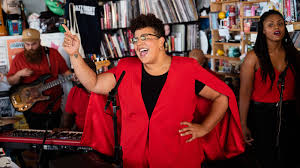
This Tiny Desk Concert is pretty outstanding and Howard is a terrific frontwoman full of passion and fire.
From the moment Brittany Howard walked into the NPR offices, I could sense her intense commitment and passion. Her eight-piece backing band, all decked out in red and black, played with a soulful subtlety that bolstered Brittany Howard’s tender songs about her family — stories of a mixed-race child growing up in Alabama.
She plays four songs.
All the songs performed at the Tiny Desk come from Jaime, an album Brittany Howard dedicated to her sister who died at the age of 13 from a rare form of eye cancer, the same disease that has left Brittany Howard partially blind in one eye.
I have heard a few songs form this album, but the one I know the best is “Stay High.” This pretty song starts with Lloyd Buchanan playing a kind of bell melody on the keys. There’s also gentle acoustic guitars from Alex Chakour (whom she calls the crown jewel). As the image fades in, some simple bass from Zac Cockrell is added and then some drums from the amazing Nate Smith. And then it’s all about Brittany. She lives these songs as she sings them. When you add in the pretty backing vocals from Shanay Johnson and Karita Law the songs sounds even more amazing than on the record.
On these songs (and in particular at this Tiny Desk Concert), there is more nuance than I’ve heard in Brittany’s past projects, including her work with Alabama Shakes and Thunderbitch.
It’s this more complex music that I find so appealing about these new songs. But also that Howard seems to be having a really good time singing them.
After the first song she says, To all them people on YouTube I’ll let you know its hot in here. All the bands about to go on… know to dress light.
Up next is “Georgia.” The blurb says:
The music has a sense of wonder and playfulness, even when the subject is heavy, as in “Georgia.” She tells the audience that it’s a tale of “a little young, black, gay girl having a crush on an older black girl and not knowing what to say and how I was feeling.”
This is a song where it’s nice that Nate Smith is visible because his playing is dynamic, including the rumbling crashes he adds (electronically) throughout the verses. Buchanan plays church-sounding organ while washes of keys from Paul Horton (Brittany’s cousin) fill in behind the song. There’s also a buzzing guitar solo from Brad Allen Williams as the song builds and builds. This is a powerful song that really brings you right into the words.
Britanny says she’s wanted to write songs like this since she picked up a guitar when she was 11 years old.
Brittany Howard knows how to tell a story, to foster empathy and understanding and, in this intimate setting, the songs feel at home. The connection with the audience felt visceral … even a small child in the arms of their parent screamed at the appropriate moment during the climax of Brittany’s song, “Baby.” It gave us all a good laugh just when the weight of the words felt the heaviest.
She introduces “Baby” as “a love song. Love. Doesn’t it just give you chills. But sometimes love is not 100%. Sometimes you got that 80/20 split and you’re on the bad side.” This song starts quietly but builds and builds to a huge moment as Brittany and the backing vocalists sing “Baby!” The song hits a full pause and you hear a child scream. She points at the child, smiles and says “Now pick that shit back up” as the band rocks out some more. As the song nears the end, she says, “Fool me once. Fool me twice. Fool three times? (the band plays two hits) not three times (hit hit) as the song ends.
She says, “Thanks to the little one for hitting the right notes at the right time–I gave him a record before we came out.”
The final song is “Goat Head” a shocking song of growing up as an interracial child. It’s amazing she can dance to it when there are lyrics like:
And cotton is white
My heroes are black
So why God got blue eyes?
My grandmama’s a maid
My mama was brave
To take me outside
‘Cause mama is white
And daddy is black
When I first got made
Guess I made these folks mad
See, I know my colors, see
But what I wanna know is
I guess I wasn’t supposed to know that, too bad
I guess I’m not supposed to mind ’cause I’m brown, I’m not black
But who said that?
See, I’m black, I’m not white
But I’m that, nah, nah, I’m this, right?
I’m one drop of three-fifths, right?
But the introductory guitar riff is really catchy. When the main verse starts the music is menacing and pretty at the same time.
It’s a short song bt very powerful. And its a fantastic ending to this Concert.
[READ: November 16, 2019] “The Final Frontier”
I haven’t read a lot by Michael Chabon, but what I have read, I have enjoyed.
This is an essay about his dying father and their connection through Star Trek. Specifically, he tells his father, “I love Mr. Spock because he reminds me of you.”
Although this essay was lovely and heart-felt, perhaps the most mind-blowing (or mind-melding) moment for me was learning that Chabon is a writer, producer and showrunner of the upcoming Star Trek: Picard. Since I’m a TNG fan more than an Original Series fan, I’m pretty exited about this.
As a kid Chabon had written stories that were like Sherlock Holmes or Robert E. Howard or Larry Niven or even Edgar Rice Burroughs. But never Trek. He didn’t have the means or the chutzpah to do it until now.
The essay begins with a paragraph that he is working on for the series in which Ensign Spock is a young half-Vulcan science officer fresh out of Starfleet Academy. He is in an elevator with a young Human known as Number One. Number One observes that people are reluctant to talk in elevators. Spock concedes this, but Chabon wonders if this will still be true in the twenty-third century.
His father was unconscious. His kidneys were failing and it was decided that it was time to let go.
He tells his father about the first time he saw Star Trek–September 15, 1967. He was four years old and woke up in the middle of the night while his father was watching the “Amok Time” episode (he has since leaned which episode it was from reruns, of course).
His father had a list of the five best Star Trek episodes (the later series didn’t count):
- The City on the Edge of Forever
- Amok Time
- Space Seed [Ricardo Montalban]
- Devil in the Dark [The Horta]
- Mirror Mirror [Spock with a goatee]
- occasionally the list might include “The Doomsday Machine”
- or “Balance of Terror” [a submarine movie set in a starship].
Chabon says he has a hard time putting “City” as No. 1. He says it is considered the Citizen Kane of Star Trek (written by Harlan Ellison!). But Chabon’s problem with saying it is the best Star Trek episode is because it is time travel set in Depression-era New York. Could the series’ most anomalous webisode be its best?
People always wondered about Spock’s sexuality–his heritage, his childhood and his sexuality. Fanfic impulse was rewarded when the show released “Amok Time.” This connection to the audience is why the show has endured.
He tells us that the original Trek pilot “The Cage” was rejected for being too cerebral. It features Captain Pike in command of the Enterprise with Number one played by Majel Barrett and Spock as science officer. NBC brass rejected the idea of a woman as second-in-command in 2266, so Spock became the emotionless cool Number On and Majel Barrett became the innocuous Nurse Chapel.
Swaths of this episode were used in “The Menagerie” as flashback scenes. Spock was the only character from the rejected pilot who made it to the serie and the “The Cage” was used as a kind of prequel.
He ends the essay saying he put his hand on his fathers head, maybe trying a mind-meld. He remembered the episode with the Horta, a homicidal creature that looked like “an ambulatory slice of Stouffer’s French-bread pizza” which mind-melds with Spock. The Star Trek franchise tried to emphasize that “Where there was consciousness, there could be communication, and that even a rock, if sentient, had the right to life, liberty and the pursuit of happiness.”
Although the family sat at the hospital while Chabon was dying, it was only when no one was around that he finally breathed his last. Someone later told Chabon told him that “the dying, even when completely unconscious, often seem to choose a moment when they have been left alone to set out for the final frontier.”
He dealt with his grief by writing more episodes. Although he admits that he has been grieving his father for forty-four years because his father left them when he was 12.
But they had Spock in common.

 I Just Read About That...
Leave a comment