 SOUNDTRACK: MOLLY SARLÉ-Tiny Desk Concert #898 (October 4, 2019).
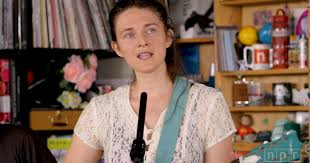 Molly Sarlé was recently on a Tiny Desk Concert with Mountain Man (who I heard but didn’t really see at Newport Folk Festival).
During the Mounatin Man songs, Molly tends to have the high harmonies. In this session, she doesn’t sing especially high–although her voice is quite delicate. It’s hard to believe she was a back up vocalist for Feist, not because her voice isn’t lovely–it is!–but because she doesn’t seem to be a very powerful singer.
The first Mountain Man album came out in 2010. The second Mountain man album came out in 2018. This is Molly’s first solo album. During the intervening years, she did a number of things (like sing backup for Feist), but was apparently never sure if music was her calling. And yet her songs are personal and powerful.
The songs Molly Sarlé performed at the Tiny Desk are all from her debut solo album, Karaoke Angel. These songs aren’t frivolous–at the heart of Molly Sarlé’s songs are stories. Sometimes they feel like dreamy inner thoughts loosely connected.
She opens with “Human,” a song I knew from a different Mountain Man show on NPR (Tiny Desk Family Hour).
It may simply be a breakup song; but its wisdom is in recognizing our individual flaws, being OK with them and even finding pleasure in being imperfect beings.
Although interestingly at the Family Hour, she said it’s about how “unfortunately easy it is to talk to god like he’s a man.”
The song is fairly simple–a pretty melody and a steady one-two snare/hi-hat (Austin Vaughn). In the Family Hour, the song was just her and her gently strummed guitar with backing harmonies. It’s really lovely. This version has an absolutely wonderful bass line (from Brian Betancourt) that runs through it. It doesn’t detract form the beautiful simplicity of the song, it adds a nice counterbalance and I can’t really tell which version I like better.
Bob also says, “She’s a captivating performer who sings as much with her eyes as she does her voice.” That is so very true. She looks out at the audience throughout the song, with a possibly inquisitive look. He blue eyes piercing through the lovely melody.
It’s weird just how funny Molly is–she seems fairly serious, and her delivery is quite slow, and yet she has a great (or wicked) sense of humor.
Before “Karaoke Angel” she starts looking at the tchotchkes on the shelves. She
began her fascination with the multitude of objects shelved behind the Tiny Desk back when she sang with Mountain Man earlier this year. This time, with her own band, those objects left by others inspired a tale of a sweaty towel, an old lover and more.
The item, labeled “Betty’s Boob Sweat” leads to a funny story of dating a ember of Feist’s band and the sad aftermath when she could feel somewhat jealous of a sweat rag.
After telling this story she ends with this amusing non-sequitur: “No one should have to see their ex-boyfriend’s sweat rag on an other woman’s clutch. Life is painful and this song is called Karaoke Angel.”
Molly plays the main guitar chords (so gently) while Adam Brisbin plays a quiet wavery slide guitar part. The song sways gently and Molly’s voice is just beautiful–unadorned and clear and very pure sounding.
For all the quietness of the song, the lyrics are pretty amusing too:
I walked into a bar and gave my heart away to the first stranger I met who could remember my name.
I got up on the stage and sang at the top of my lungs Its so easy so easy to fall in love.
Each subsequent verse is about a man in the bar
Mike walked over / he was picking up what I was putting down / he said honey I am only gonna disappoint you somehow / oh Mike quit talking to me like you’re saying something I didn’t already know / I can tell by the beauty / of the furrow in your brow / you’ve been anointed by disappointment / and it might even be something you like.
Before the final song “Almost Free,” Molly tells the shockingly sad origin of the song, but has to laugh, because what else can you do
Molly cleared her throat and said this song is “about my dad wanting to talk to me about committing suicide — and it turns out writing a song about your dad talking to you about wanting to commit suicide is a great way to shift the conversation, because now we just talk about this song.” Molly Sarlé laughed a bit about the absurdity and truth of it all and, with what I sense as holding back a tear, sang a powerful, personal song in an awkward, open office space.
It starts out with just Molly strumming her guitar and singing. It seems so stark and exposed, that when the rest of the band comes in and the song almost rocks a bit (sounding like a jam band song) that it’s comes as a relief.
This is a quietly powerful Tiny Desk and really shows off how beautiful Molly’s voice is.
[READ: Summer 2019 and October 29, 2019] The Helios Disaster
This is a weird book, to be sure. It was written by the then wife (now ex-wife) of Karl Ove Knausgaard. But it is absolutely nothing like his books. Linda has her own style and perspective that makes these authors miles apart. This book was translated from the Norwegian by Rachel Willson-Broyles.
It opens like this:
I am born of a father. I split his head. … You are my father, I tell him with my eyes. My father. The person in front of me, standing in the blood on the floor, is my father. …The blood sinks into the worn wooden floor and I think, his eyes are green like mine.
How at my birth, do I know that? That my eyes are green like the sea.
He looks at me. At my shining armour. He lifts his hand. Touches my cheek with it. And I lift my hand and close it around his. I want nothing but to stand like this with my father and feel his warmth, listen to the beating of his heart. I have a father. I am my father’s daughter. These words ring through me like bells in that instant.
Then he screams.
His scream tears everything apart. I will never again be close to him.
She removes her armor, puts down her lance and flees the building. The neighbor, Greta, says she will help the girl, while the police come and investigate the commotion. When Greta asks the girl what she wants, the girl says she wants to go to her father. But Greta says that Conrad doesn’t have any children.
What is going on?
Greta drove the girl to social services where the girl heard, “If I didn’t know better I’d swear a miracle occurred.”
We find out soon after that her father has schizophrenia and was sent to a mental hospital.
That all happens in the first four pages.
Things slow down a bit after that. The social worker says that Greta doesn’t want her. The social worker asks her name, but when she doesn’t reply, the social worker says that she “looks like an Anna. Anna Bergstrom That sounds nice.”
And for the rest of the story, she is Anna.
A local family “adopts” her. They have two boys already, Urban and Ulf, and the mother, Birgitta, says she always wanted a girl. The father, Sven, is a local art teacher and preaches temperance.
Anna was welcomed and given a room. She slept for three days. Ulf was sitting with her when she woke up. He told her she knew nothing and that he needed a sister to help with the really hard things.
There were many teetotalers in the village. The boys (and Anna) ran through town trying to get new members of the IOGT. I had to look this up and I see that it is a real organization: IOGT. And their own fascinating history.
We are part of a global majority: 57% of the world’s adult population chooses to live free from alcohol in any one year. The members of IOGT are part of that majority and promote an alcohol-free life through their own lifestyle choices. We are also more than “just” alcohol-free. We are a global movement of heart-driven people that are dedicated to empower people and communities around the world to lead a richer, freer, happier and healthier life as active citizens in their communities and societies.
Before 2006 the four letters were indeed abbreviations. In the very first days of IOGT, in the 1850s, I.O.G.T. stood for Independent Order of Good Templars.
Later the meaning was changed to International Order of Good Templars and finally to International Organization of Good Templars.
No one talked to her except the family members. She feels Birgitta must have been disappointed in her because she’d always wanted a girl to be just like her. And Anna certainly was not.
Urban was 15 and was much more quiet than Ulf, but Anna found she liked him more. He drank coffee and Anna tried some. She liked the warmth but not he taste. Urban also said that Sven was wrong about alcohol–intoxicants are the best thing ever. You just can’t use them too much.
She decided to write to her father in the hospital. She didn’t know his last name but he was probably the only Conrad there, right? She received a letter back but it was cryptic and hard to understand. Nevertheless, she treasured it, and wrote back.
About 40 pages in the boys bring her to the church and tell her that she is going to start speaking in tongues. She tried hard and then soon enough the words flooded out of her. From then on, she spoke in tongues every Sunday. Erik the pastor was very pleased.
But her new parents looked at her strangely. Almost all the time now.
By the end of the first part it is revealed that she is not speaking in tongues, she is speaking in Greek.
Then abruptly starting in Part Two, Anna is in the hospital. She wants nothing more than to die. Depression has grabbed hold of her. Urban brought her in and tells the attendants, “my sister hasn’t spoken for a long time.”
The only thing she utters is “Can you help me die?” But she;s not sure if it was audible.
Artan the nurse tells her that she has a good life waiting for her and they’re going to help her want to live.
Anna is preoccupied with the Mediterranean sea, and the final pages hint at the mystery of the novel’s title (which refers not only to the sun-god, but also to the Greek 2005 plane crash).
Most of Part Two is Anna collapsing in on herself. She used to cross country ski, now she can barely walk to the bathroom. She seems to have forgotten how to eat.
Urban is the only one who visits. He brings chocolate and grapes and tells her to listen to them. She obeys.
She has no concept of time. Was this the second or third day? It felt like a while life.
While she is there she becomes closer to Artan. Then one night he sis not there. His father had died and it makes her think of the permanence of death.
Artan takes her outside. She starts to feel stronger. Then she winds up cutting herself with a knife. No one can figure out whee the knife even came from–in her version, it was the door handle that cut her.
She thinks to herself
Why couldn’t I die? Why wouldn’t jumping from the window lead to liberation? Eternity. Isn’t that word terrifying? To get to die. To go from life to the great, silent room where death was. To feel the last beat of my heart. I was denied this liberation. Why?
Because I was Athena.
She speaks Greek. She is Athena. She becomes obsessed with the Mediterranean Sea.
As Part Two draws to a close, she is taking meds, she is getting stronger and becoming more social.
Then there is a half a page break (bit no new “part”) and the story suddenly changes again.
She is with Conrad. They are talking of the Sea.
They sea a plane take off and Conrad says “They’re going to die.”
It wasn’t until after reading the book that I found out about the 2005 Helios airplane crash.
After takeoff, the plane failed to pressurize which led to the “incapacitation of the flight crew due to hypoxia,” or lack of oxygen, and resulted in the plane being flown on autopilot for two hours until it ran out of fuel and crashed.
Clearly the title refers to this as well as the sun god arcing across the sky.
How it all ties together, I’m not sure, but it is a very enagaging, frightening story.

 I Just Read About That...
Leave a comment