 SOUNDTRACK: MASEGO-Tiny Desk Concert #870 (July 24, 2019).
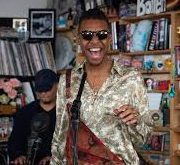 Naturally when I saw this guy’s name, I assumed Massive Ego. And he does seem to have a massive ego. But he totally earns it. And I’ll agree with this allusion:
Imagine for a moment if Cab Calloway, the Cotton Club’s exuberant bandleader, was reincarnated in the 21st Century. Now imagine if he was dropped in the middle of the music world of today. He’d no doubt be a tall and slender, silky-wearing goof ball with a moisturized braid-out, instruments inscribed as knuckle tattoos and a penchant for genre-blending. Yes, the spirit of Cab lives on in Masego, the singer, producer and multi-instrumentalist who surprised NPR’s Tiny Desk audience with a zany sense of showmanship and a demonstration of his own genre, TrapHouseJazz.
Masego gets five songs (and over 20 minutes…come on!), but the whole set is fun and flows really nicely with Masego acting as the great frontman he is.
First, before opening with the jazzy “Tadow,” Sego pulled off a quick, mini-prank by sending his friend, comedian Lorenzo Cromwell, up to the mic before stepping forth himself.
Cromwell wears a Michael Jackson glove and plays a fake saxophone (the credits state: comedic saxophone). But Masego plays a proper saxophone, smooth and jazzy. Then he starts singing and he has a nice smooth voice too. Lex Nelson adds some nice call and response backing vocals.
Throughout the song, Maxwell Hunter plays some excellent grooving sliding five string bass.
This next song, “Nayhoo” he says “white people love it.” It opens with some fantastic guitar work from Melanie Faye–she plays amazing guitar licks throughout the show.
Next, Sego tossed up 100 dollar bills with his face on it and beckoned the crowd into a call-and-response of “hi-di-hi-di-hi-di-ho.” (There’s the Cab Calloway).
Up next, is “Queen Tings.” He points to Jon Curry and says “You. Show me that junk you showed me yesterday.” Curry stars playing a nice beat. Masego says, “Now gimme that shoulder” and Curry starts swaying his shoulder into it.
Midway through the song Masego plays a saxophone solo. Then keyboardist Dan Foster picks up a saxophone and plays a solo as well. Then the two play together and it sounds fantastic.
Before the fourth song he says, “there’s black people here, I got a song called ‘Black Love.'” Then he points to the keyboards. “You. Play some keys for me. This is Dan Foster. He has a flower tattoo.” The melody of this sounds a lot like the melody for “Careless Whisper.”
All these instruments you see here are tattoos on my knuckles because I can play them all. That’s why he wrote this song, “I Do Everything.” This song is pretty good but the best part is when he introduces Melanie Fay and she plays a ripping guitar solo. I wonder what else she’s been in.
Finally, to have a few more moments of fun after “I Do Everything” — and to prove he really does do everything — Sego juggled water bottles to the rhythm of the luscious music his band providing.
Masego is a lot of fun and I enjoyed his set a lot more than I expected to.
[READ: July 31, 2019] “Three Days”
I enjoyed the way this story started but hated the way it ended. I hope it’s an excerpt, because there’s so much more that could be done with all of this and yet so much was wasted on a dead horse.
Beatrice is walking to her mother’s house from the bus station. The house is actually a farm, but not a working farm. It is the only remaining farm in the area, since all the other farms sold out to to the box stores.
The farm is in disrepair. I like this detail:
There are some withered Duane Reade Easter decorations–a hip-high bunny rabbit and a bright-green egg–wired to the front porch. It is Thanksgiving.
Her parents weren’t farmers and as soon as they both agreed they didn’t want to farm, they gave up and got proper jobs. Beatrice’s mother loved her work. She was employed by “Mythologic Development, which turned myths and sometimes history into marketable packages used for making new products and ideas more digestible to the consumer public.”
I love this idea and want to learn more about it. Although the examples her mother gives about Atlantis and Montezuma are disappointing.
After dinner, Clem goes to smoke a joint.
Their mother can’t stand that Clem is a pothead…She stares at Clem. She is drunk.
Beatrice follows her brother, who has made an apartment for himself out of the barn. She smokes a joint with him and he sets up a video game for her. She puts on his haptic glove and being stoned makes the movements seem extra intense. After dying in the game, Beatrice says she wants to go to town to see if any stores are open.
She said she doesn’t want to drive, she wants to ride their horse. Their parents had gotten rid of most of the farm animals, but had kept this one horse, Humbletonian. A Hambletonian is a distinguished trotting horse, a Humbletonian is not: “It is like changing your name to Stonefeller because you are not a Rockefeller.
So they ride Humbletonian towards the WalMart. The horse activates the door sensor.
A guard says
I know you’re not thinking about bringing that beast in here
But I was thinking of it, Clem answers quickly. So that’s weird that you would say you know what I was thinking, because you would be wrong.
Beatrice thinks the guard looks like the kind of guy who would arrest them for some insane livestock violation from 1823 like No Horse-Riding on Public Holidays.
They tie up Humbltonian and go in. Clem asks a worker why the store is open on Thanksgiving. The boy looks like he wants to punch Clem in the face. Clem steals a pack of gum and they head out.
Humbletonian is not there. He is standing in a pit that is frozen over with ice.
As soon as you see that you know it’s curtains for the horse–how could it not be? But why? What purpose does it serve? I really enjoyed the beginning of this quite a lot, but the end turned me against it terribly.

 I Just Read About That...
Leave a comment