 SOUNDTRACK: RHEOSTATICS-The Siboney Club, Toronto, ON (November 17, 1988).
 I thought I had listened to every show on Rheostatics Live and then I saw today that Daron had posted this new (very old) show. This show is from before they released their second album Melville. Most of these songs would appear on Melville, but a couple wouldn’t be released until their third album Whale Music.
This is a live cassette recording of Rheostatics at The Siboney club in Toronto November 17 1988 provided by Tom Parry. It is the earliest live versions I’ve heard so far of Christopher, RBC, The Royal Albert, Greensprouts, Horses, Chanson, What’s Going On, Queer and a one off song which I’m not even sure what it is called. Something about Space? The sound quality is rough but it is an interesting document due to the early nature of these songs – Queer in particular.
This show starts off with a TV show (I guess) about the history of hockey with a story that Bobby Hull has signed a contract with the new World Hockey Association and then a clip of Canada v Russia. I can’t tell if the reaction to the Canadian goal is from the TV or the people in the room. It goes for about three minutes and then the ripping guitars come in to start “Christopher.” The first part of the guitar solo is very different from the sound that Martin would eventually get–although the second half of it is pretty raging.
“RBC” is quick and to the point. Someone (Dave?) starts the intro to “Dope Fiends” but Tim slaps some bass as Dave says they’re going to play “The Royal Albert (Joey 2)” which I didn’t think was written for a few years.
“Dope Fiends” feels faster than usual. In fact the whole show feels kind of fast. Is the tape sped up or did they just play faster back then?
Martin starts playing the Green Sprouts Theme Dong with a crazy hopped up vibrato which actually sounds like munchkins.
Dave: Welcome folks! Hot dogs only $1.75 Dijon mustard is an extra 30 cents. It’s hand carved by Dave’s Irish grandmother.
I don’t love the song “Ditch Pigs” (from Greatest Hits) but I always like when they play it because by now it’s such a novelty. There’s a jamming end section in which someone (Bidini?) is singing about the good food “I want an egg salads sandwich and a box of popcorn”.
DB: It’s poetry time from Clark. Will it be a winsome poem or a lonesome poem.
Clark: It’s not necessarily a poem. This is more of a lyric than a poem. I wrote for a friend and it about if you’ve ever worked for somebody who is kinda dumb and they’re mean to you because they feel threatened by you when you just want to be their friend.
It begins: Don’t call me pal or buddy when your not really my friend…
“Horses” is remarkably slow with a thumping bass. The chorus is almost painfully slow. But the ending is really intense. Martin does some great soloing as Dave screams the end, but there’s very little in the way of horse sounds.
“Chanson Les Ruelles” is loose and fun–Tim’s “French” is quite good. Dave rambles about some kind of voodoo that he put on the Baltimore Orioles pitcher. And it worked!
Then out comes Tim with the accordion for “What’s Going On Around Here.” It all sounds quite good even though the tape is sounding worse.
The last three songs sounds pretty bad (in quality). The song that Daron says he doesn’t know sounds like Dave calls it “Space Arm.” It’s a stomping heavy song with some ripping guitars. Wonder whatever happened to it.
“Queer” sounds very different in so many ways. It has a really long introduction and a decidedly honky-tonk/country feel to the verses. The verses end with a kind of old-timey rock n roll bah-bah-bah-bah. And there’s no ending part. I’m so glad they fixed it up.
The final song is cut off. It’s a slow song that I recognize but can’t place called “Seems Like.” I see that it was only ever released on a Green Sprouts music compilation.
This is a great find–one of their earliest shows where you can hear what their new sound is going to be like.
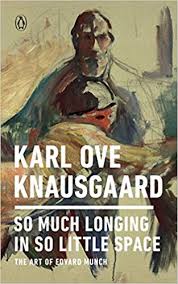
[READ: May 8, 2019] So Much Longing in So Little Space
Karl Ove Knausgaard just never stops writing. And he never stops exploring the world around him–through words or, in this case, art.
This book is divided into three parts, although unlike his massive tomes, this one is only 233 pages (with pictures). Before the parts, he offers a little introduction about how he sees art and how he has always been moved by an (admittedly) simple painting by Edvard Munch called Cabbage Field.
There is a longing in this painting of the cabbage field, a longing to disappear and become one with the world. And that longing…fulfilled the painting for him. That is why the painting is so good, what disappears re-emerges in what comes into being as he finished the painting, it is still represented in the picture, which fills us again and again with its emptiness.
In Part One he gives a brief biography of Munch. Everyone knows The Scream of course, but that represented only one brief phase of Munch’s life-long career as a painter. Indeed, he started painting when he was a teenager, making small pictures of potted plants and interiors and he continued painting until he was eighty years old.
The years are divided somewhat into phases. First was the apprentice years during which he painted his first masterpiece, The Sick Child, when he was twenty-two. In the second phase he was searching and trying many styles–from realistic harbor scenes to Impressionist street scenes. Then comes the period for which he is most famous (The Scream and more). The final phase was less abstract and more painterly.
Knausgaard offers a portrait of Munch who suffered greatly from loss throughout his life. He never held a job, he didn’t have a family of his own. But he never stopped painting–he was dedicated and solitary. But the loss was encompassing. His mother died when he was five. His older sister died when he was thirteen and his father died when he was twenty-five. His younger brother died when he was 32. And his other sister became mentally ill at an early age.
Some other fascinating things we learn about Munch were that he painted hundreds and hundred of pictures. He often duplicated the same picture. For instance, in 1882 and 1883 when he was nineteen, he painted three different pictures of his younger brother Andreas as he sat reading. He painted one of them again in 1936 when he was seventy-two and his brother had been dead for over forty years, (probably as a gift for his brother’s daughter).
Munch also left many pictures unfinished (as far as we can tell). He also made sketches and drawings–he was an excellent draughtsman.
For context, around the same time, Van Gogh began his own career. Van Gogh was twenty-seven when Munch was nineteen. Ten years later Van Gogh would commit suicide.
This being Knausgaard, he is full of comparisons to other artists–in various media. He feels a better comparison for Munch would be Norwegian novelist Knut Hamsun. Hamsun was born four years before Munch and wrote his firs novel Hunger in 1890. This book defined the literary decade of Norway.
After about 50 pages about Munch, Knausgaard gets into his own things: “It is cold in the room where I am writing this, the heat pump has stoped working while at the same time, the outside temperature has fallen sharply.” So even though this is non-fiction, it is also about Karl Ove. Which I love.
He tells us about visiting an exhibit of photographs by Anselm Kiefer. A few weeks later he met and interviewed Kiefer. Kiefer had a print from Munch on his wall and Knausgaard was surprised as their work is very different. Ultimately he sees a connection between the two, and it’s interesting that Kiefer all of a sudden sees the connection too.
He also met and interviewed Stephen Gill, a British photographer who moved to Norway. I love that Karl Ove builds faux drama as he drives up Gill’s driveway. He’s not sure he’s in the right place when a tall figure looms large. Of course it is Gill, but i love the sort of “drama is all around me” style that Karl Ove is still employing. Gill mentions Peter Doig of the Group of 7, which is pretty cool. Doig was influenced by Much even as he was painting Canadian landscapes.
Each section is separated by some of Munch painting, but frustratingly, not the ones he talks about in great depth,.
Part Two concerns his curating a Much exhibition for the Mucnch Museum. It was Towards the Forest — Knausgaard on Munch in 2017. He talks about going into the archives of Munch Museum and seeing the many works that are stored there–most of which have never been seen by anyone, really. He looked at the pictures and decided he wanted to emphasize works that no one knew. He decided to break up the gallery into sections, almost like a narrative. You can see the rooms as well as the text at the Museum site although this site from Snohetta is much more comprehensive.
After making his selections her returned there with art critic Stan Grøgaard mostly talk about the works, but also to make himself feel better about his choices. This doesn’t always work though, because whenever Stan says something negative about a picture Karl fears that he messed up.
Part Three involves Joachim Trier and the documentary they want to make about Munch. Karl Ove starts by raving about Von Trier’s film Oslo and how well the introduction brings you into the minds of the characters. He then meets the man and they have very similar ideas about how they’d like their documentary to turn out.
The end of the book shows Knausgaard bidding on a print of Munch’s in an online auction. He says it cost roughly the same as a six or seven year old Volkswagen Golf (what a fascinating unit of comparison). According to the Kelley Blue Book That’s about $13,000. He spends a few pages dithering about the purchase and then getting caught up a bidding war. (It’s nice to see everyone gets aught up in it).
Knausgaard is a guy who really gets into a subject and his take on art is always interesting. I enjoyed this quite a lot.
It was translated by Ingvild Burkey.

 I Just Read About That...
Leave a comment