 SOUNDTRACK: RHEOSTATICS-Harbour Station, Saint John, NB (December 08, 1996).
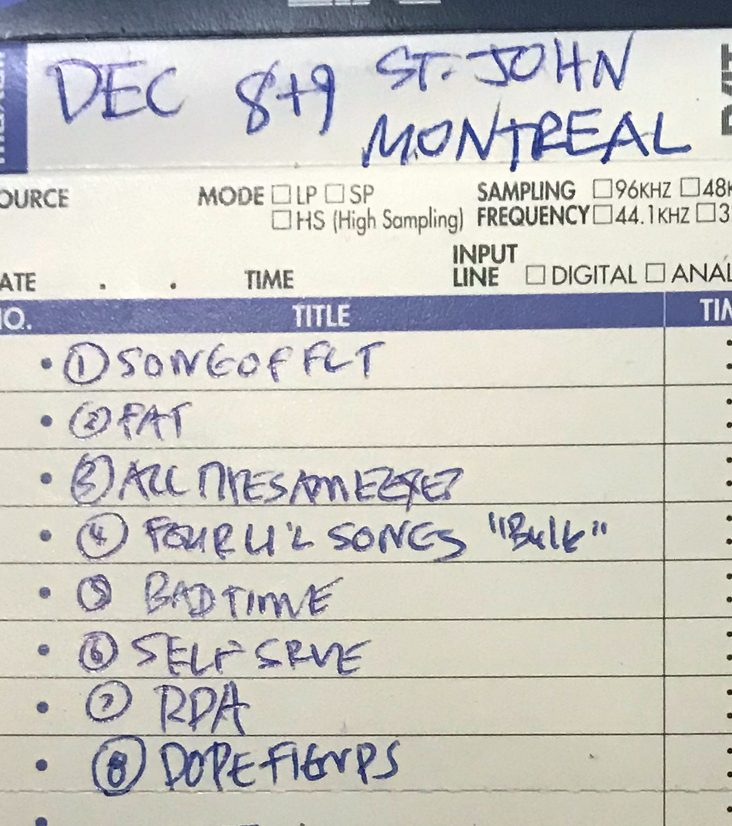 This is the 20th night of the 24 date Canadian Tour opening for The Tragically Hip on their Trouble At The Henhouse Tour.
This show opens with a Stompin’ Tom recording of “Bud the Spud.” Then there’s some tuning up and some cool noises from Martin as they prepare to soar with “Song of Flight.”
They follow it with “Fat” and after the line, “I drank pop, ate Pez, laid down and played dumb” Dave explains, “I wasn’t really sick.” They whole song is fun and they tack on a melody of “Artenings Made of Gold” at the end.
“All the Same Eyes” rocks a much faster than usual. At the end, Tim says, “Get well soon, Willow.” Wonder who that was.
Dave thanks St. John and describes the show as “a little matinee affair. It’s like going to see a movie on a Sunday.” He continues, “We’re from Toronto. Actually we’re from Etobicoke. We went to Vancouver, all the way to St John and now we’re crossing back.”
A fun “Motorino” is followed by “Four Little Songs” which Dave promises is “Four songs in One. Honest.” Tim: “What a deal.”
After the song Dave asks, “What was that last bit of shouting? For “Record Body Count?” We see we have some Green Sprouts in the audience. They’re standing. See them over there. What are your names? Rob is the leader I can tell because I heard his name.”
Instead of “RBC” they play “Bad Time to Be Poor” which segues into a nice “Self Serve Gas Station” in which Martin asks, “What went wrong with Nimrod?” The ending has Martin playing a lengthy series of notes that just bumps abruptly into a ripping “RDA.” Tim says “Bye,” at the end of the song but they jump into “Dope Fiends” instead. Tim’s backing vocals sound particularly excellent during the end part.
After the roaring ending, the rhythm guitar picks out a lovely melody while Martin soars away. Its a nifty denouement.
[READ: April 29, 2019 Science Comics: Sharks
Joe Flood has drawn many of the Science Comics books and this time he writes and draws it. This one is all about sharks. And what I found fascinating about this book is that there’s a bunch I didn’t know about sharks, but there’s not a lot to know about them overall.
The book opens with an introduction from David Shiffman a marine conservation biologist. Then Flood gets right into it by talking about how the movie Jaws has unfairly harmed the reputation of sharks. We must never forget that the sharks were here first (for millions of years–their ancestors go back 420 million years) and we are trespassing on their turf.
Like most of these Science Comics, there’s a narrative. And the “story” of this book is of a stupid ship’s captain in the hunt for a shark. He;s an ignorant and rather unpleasant guy but our guide is here to set him and us straight,.
We are also helped by out friend Red Snapper who is justifiably afraid of sharks.
We tend to forget that sharks are quite diverse–some are the size of whales and some fit in the palm of your hand. Sharks are Chondrichthyes–cartilaginous fish like rays and skates (some sharks can bite their own tails). Most other fish are Osteichthyes–bony fish. And we see that even though sharks have a spinal column, their skeleton is made of cartilage not bone. So the book tells us that a shark and a red snapper are about similar as a cat and a hummingbird.
We learn that fish don’t sink because they have a gas bladder. But sharks have an enormous liver which is filled with oil which keeps it afloat.
Every few pages is devoted to a specific shark: Nurse Shark, Bull Shark, Great Hammerhead Shark, the bizarre goblin shark.
A two page spread details the eight different types of sharks: Ground Sharks [hammerhead, blue], Dogfish Sharks [lanternshark, Greenland], Carpet Sharks [nurse, whale], Cow & Frilled Sharks [bigeyed, sixgill], Sawsharks [spined pygmy, sawshark], Angel Sharks, [sawback angel shark] Horn Sharks [bullhead] and Mackerel Sharks [great white, mako]. The chart shows what makes them all so different–fin placement, size, eating habits.
And then there are small bits about other sharks. Slow-moving sharks like the cow shark have larger upper caudal lobes. Fast-moving sharks like the mako have symmetrical caudal fins which gives them more power.
It is true that sharks has a lifetime of teeth but their teeth are different depending on the kind of prey they eat. Anything they can’t digest (cans, turtle, shells) can be expelled via stomach inversion “this means sharks can turn their stomachs inside out.”
There’s a cool picture of basking, megamouth and whale sharks with their giant mouths all eating plankton. Their throats are only a few inches wide so anything too big just bounces back out.
But the book also dispels rumors–sharks can’t smell a drop of blood in a swimming pool. In fact most sharks determine prey from the sound in the water, not the smell.
We go back millions of years to see early dinosaurs and how they probably thought of sharks. Mammals like Aulophyseter would never have survived against a Megalodon. It was most likely sharks and their teeth that gave way to stories of dragons.
Most shark species are harmless to humans–although there are of course stories throughout history of sharks killing people.
The book ends with the one thing that causes Great White Sharks trouble (besides people). The killer whale. It was believed that the Great White was the apex predator but a recent documentary shows a pod of orcas killing a great white.
There’s a lot of death and blood in this book, but it is somehow not all that gory. It is safe for kids for sure (especially kids who love sharks).

 I Just Read About That...
Leave a comment