 SOUNDTRACK: AMANDA PALMER-“The Ride” Tiny Desk Family Hour (March 12, 2019).
 These next few shows were recorded at NPR’s SXSW Showcase.
The SXSW Music Festival is pleased to announce the first-ever Tiny Desk Family Hour showcase, an evening of music by artists who have played NPR Music’s Tiny Desk Concert, at Central Presbyterian Church on Tuesday, March 12 from 8-11pm.
This show is the most interesting visually because Palmer is sitting at her piano and the camera is at all angles–so you can see the crowd and how close they are to the performers.
The blurb is also interesting because I had no idea the performers only played for about 15 minutes.
When Amanda Palmer heard she’d have around 15 minutes for her Tiny Desk Family Hour performance, she assumed there wouldn’t be time for most of the songs on her new album, There Will Be No Intermission, a sprawling masterwork with epic tracks clocking in at 10 minutes or more. So, she showed up with just her ukulele in hand, prepared for a stripped-down, abbreviated set. But when we wheeled out a grand piano just for her – and after I gushed to the crowd about Palmer’s brilliant new opus on the nature of humanity called “The Ride” – she decided she had to play it.
Like many of the tracks on There Will Be No Intermission, “The Ride” is a deep, existential dive into fear, death, loneliness and grief, with the tiniest glimmer of hope or comfort at the end. This is Palmer’s first album in seven years and it documents all she’s been through in that time. It’s also an album she says wouldn’t have been possible if she hadn’t decided to make it on her own, with crowdfunding support from fans. “It’s a very intense record. It’s been a very intense seven years of my life since I put out my last one,” she told the crowd at Austin’s Central Presbyterian Church. And without having a label to answer to, she said she was able to “write an entire album with songs that are really long and about miscarriage and abortion and about the kind of stuff I don’t want to take up to ‘Steve’ in marketing to try to explain why this record should exist.”
It’s a powerful song–simple and mostly unchanging–where the focus is on the words. But those few times when the vocal melody changes or she adds that circus melody it’s a jarring change from the story she’s presenting.
Though she’s played abbreviated versions of “The Ride” in past shows, this is one of her earliest performances of the full, album-length song. Two days after her Tiny Desk Family Hour set, Palmer returned to the Central Presbyterian Church for an epic, two-and-a-half hour concert with just her ukulele and piano.
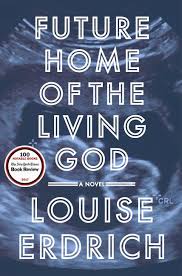
[READ: February 2019] Future Home of the Living God
I’m not sure what drew me to this book. I have read (and enjoyed) many short stories by Erdrich, so I assume her name stood out. The title is also pretty cool.
But I really had no idea what was coming. I also didn’t know that Erdrich is Turtle Mountain Chippewa, which obviously lends weight to her Native American depictions.
This story is about Cedar Hawk Songmaker, an adult woman who was adopted by “Minnesota liberals” as a baby. When she went to find her Ojibwe parents, she learned that she was born Mary Potts.
The book is written as Cedar’s diary. It begins August 7 (year unstated). The book is set in the future. A cataclysmic event has happened and I absolutely love that since this book is written from Cedar’s point of view, she doesn’t know what happened. She will never learn what happened, and neither will we. It is just understood that evolution as we know it has stopped. People seem to be devolving. Or more specifically babies are being born in a state of devolution. Again, no more details are given.
Cedar is a practicing Catholic (despite her parents’ atheism). She even writes a Catholic zine, which she creates by herself. So she has her own thoughts about what his happening. Is it the end of the world?
And more importantly for her–what will become of her baby. For Cedar is four months pregnant. She lives with her adoptive parents and hasn’t told them yet. They’d understand of course, but they’d be insufferable.
This entire diary is written to the baby. And she writes that the baby’s father was an angel. Literally.
Well, no as it turns out not literally. It’s not that kind of story, thankfully. But he is a very good man–sacrificing himself for everyone at the church. It’s odd that she doesn’t want to see him.
Given the state of things Cedar decides to talk to her birth mother–maybe lean something about their family’s medical history. Her birth mother has a daughter (who is hilarious). When Cedar calls, the daughter answers and says, “MAAAAAHM! Some INSANE BITCH is on the phone who says you’re her mom and you wrote her last year.” Her Ojibwe mother, Mary Potts, invites her out to the reservation and so Cedar decides to check out her ancestral home.
Mary’s husband is a sweet man, he works at the local gas station and writes his manifesto. It’s currently 3,027 pages and is titled Why Not to Kill Yourself or Don’t Off You. It is still a work in progress.
The scenes there are great–funny and touching with a swath of cynicism.
Eventually Cedar goes to the doctor for an ultrasound (assuming she is still covered under insurance). They are very cagey around her. She asks questions but they refuse to answer. Finally the doctor gives her a printout and hurries her out the door. Now we know something is up.
When she gets home her computer interrupts her searching and says “Mother is thinking all about you Would you like to tell me about your day? Gah!” Who even knows what is real.
The writing was so wonderful that all during these scenes the feeling of dread and dystopia stayed with me when I stopped reading. I was reading during a stormy and snowy week and that weather seemed consistent with what was happening on the page. And even on days when it was nice out it still felt oppressive.
When she gets home, she more or less barricades herself in her house. She uses all of her remaining money to buy booze and cigarettes.
And then the baby’s father, Phil, shows up. He is supportive and kind and very helpful. He winds up getting all of the supplies she needs. She insists on going out once in a while and that’s when she sees a pregnant woman grabbed and taken away–in broad daylight. She knows she can’t go out anymore. She also doesn’t know who she can trust.
People seems to be meandering through the streets–up to her house–checking things out. There’s also a story that the government has been overrun. They are changing street names to biblical names and money is no longer any good.
And then one day Phil doesn’t come back. Plans are afoot from both of her sets of parents to take her north, across the border. But before that can happen, she wakes up in the hospital. And she is told that Phil turned her in.
Part 2 shows that she has been captured and is the care of the people in charge. It is blissful and she can’t believe she resisted. Until she sees her neighbor freaking out and she realizes that she is being drugged. She stops taking the drugs and realized just how horrible things are.
The scenes in the hospital are powerful and exciting/horrible. She and her roommate plan on a jailbreak.
But if they get out, what then? Where can they go?
She learns of an underground railroad type of system in place. Can she possibly get in touch with them? Can she get in touch with any of her parents?
There is so much tension and excitement in the second and third parts, but I don’t want to spoil anything.

 I Just Read About That...
Leave a comment