 SOUNDTRACK: WHITEHORSE-Live at Massey Hall (December 8, 2017).
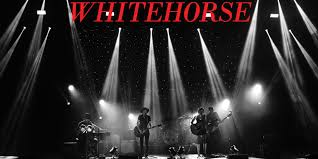 I saw Whitehorse open for Barenaked Ladies a few years ago and they blew me away. I really want to see them again.
When I saw them it was just the two of them and the magic of their interplay was what really impressed me the most. For this special Massey Hall show, they have a full band. But as Melissa McClelland explains:
This is the first time playing the Massey stage with a full band. We wanted to … finally invite some friends on stage with us and play music.
Those friends include John Obereian on drums, Ryan Gavel on bass, guitar and backing vocals and on keys and bongos and guitar, the second best singer in this band Gregory MacDonald. He replies, “Thanks to the second best guitar player in the band.” I have seen MacDonald on tour with Sloan a bunch of times and he is awesome.
As to why they are a duo, she says
we knew that Whitehorse was always going to be just the two of us and that everyone would know that we are equal partners in the band. But we didn’t want it to be a folk duo so we started brainstorming and bought looping pedals and a kick drum and a stomp box and we found new arrangements and once we got it we were like Yeah!
The show opens with hand clapping from the band and the audience and then Melissa’s slinky bass intro to “Baby Whats Wrong. Then comes Luke Doucet’s echoing Western guitar. Their voices are wonderful together and I love when Doucet sings in that weird telephone microphone. He also plays a ripping guitar solo.
Luke introduces “Tame as the Wild Ones” by saying they needed to write a sexy song so “Melissa kicked me out and said she’d do it alone. I go to the bar to get drunk and when I come home, she plays me this song. And nine months later our son Jimmy was born.” I love the way the bridge (or is it a chorus) builds and settles–that melody is just gorgeous.
“Pink Kimono” has a simple rocking riff and the two singers singing at the same time. Doucet’s soloing is on fire in this song.
“Die Alone” is a showstopper. A slow moody piece in which Melissa sings over a wash of synths. The music so much build as just unfold as first Luke sings with her and then the band kicks in. Wow can Melissa belt out a song.
“Downtown” is a celebration of how you can put hundreds of thousands of people in a city and for the most part everyone gets along. It s got a great throbbing bass and some cool guitar scratching and riffs from Doucet. It’s a bummer that they interrupt the awesome middle solo section with an interview, even if it is quite interesting.
After Melissa lays out how they wanted the band to sound, Luke says that when people ask him about what it’s like to do Whitehorse, he says
we were solo artists first but we had been involved with each others albums as singer or producer or touring musician.
So in order to be successful
you have to hang out together for five or six years and play in each others bands and make eight albums together and then you have to go on tour as freelance/hired gun musicians working for Blue Rodeo or Sarah McLachlan and then you have to live together for five or six years and listen to music together and fight and then you have to get married and once you’ve done all these things and listened to 10,000 hours of music and dissected Tom Waits entire catalog and argued about which is the best Beatles record and had fights on stage about who is speeding up or slowing down and once you’ve done all those things together then start a band.
It certainly worked for them. The only bad thing about this show is that it’s only 30 minutes.
[READ: January 24, 2019] Hits & Misses
It has been a while since Simon Rich published a collection of his stories. This one was pretty enjoyable. Overall, not as much fun as some of his previous collections, but still a lot to laugh at. Rich tends to write what he knows, which is often a very good sign. However, sometimes what he knows is limited to writing and filming, which tends to miss the everyman silliness of his earlier pieces.
Having said that there are still some hilarious pieces that anyone can enjoy and some pieces about writers that are very funny.
A few of these pieces appeared in the New Yorker, and I indicate as much, with a link to my longer review.
“The Baby.” This was a highlight. A sonogram reveals that their baby is holding a pen–he is going to be a writer! But when word gets out that the baby is already getting a reputation AND representation, well, that baby’s writer father is pretty damned jealous. Wonderful absurdity based on reality taken to its extremes.
“Riding Solo: The Oatsy Story.” This was a weird fun story. It concerns the fame (or lack thereof) for Paul Revere’s horse. When the reporter asks Paul how he rode so long through the night, Oatsy is there with the truth: “Paul did not ride. I rode. He just clung to my back with eyes closed, crying whenever his face got brushed by leaf.” Like many of these stories, the end is quite dark.
“The Foosball Championship of the Whole Entire Universe” [New Yorker, May 9, 2016] This is one of my favorite stories in the book. I love when Simon portrays himself as a terrible person/child. His family stories are my favorite.
“Birthday Party.” This was actually kind of a makes-you-think piece in addition to being pretty funny. When Stephen blows out half of the 30 candles on his birthday cake, he is visited by his fifteen year old self (when he went by Spike). And Spike is not too happy about the sellout he has become. With a little more exhaling, they learn that their seven-year old self doesn’t think much of either of them (he wants to be a basketball star). I enjoyed the way this story surprisingly went into the future. And Stephen’s slide into selling out is complete.
“The Book of Simon.” [New Yorker, September 26, 2016] This is a hilarious, blasphemous story in which Simon Rich unintentionally proves to the devil that God is not respected anymore. God assures the devil that the more he showers Simon with success and happiness the more Simon will thank God for his fortune. If only he knew Simon.
“Relapse.” This story was okay. It is about an aging rocker who has given up the life to become a working mother. But when she gets a melody in her head–a relapse–her friends are there for an intervention. This intervention involves lots of drugs to forget the music business. The basic joke simply inverts all of the normal intervention stuff from drugs to music. Mildy amusing, but I would have preferred a story about her actually doing music.
“Hands.” Simon Rich has gotten pretty dark over his books. This story is quite dark as it involves monks trying to prove that they are more self-sacrificing for their faith. The main character monk wishes to cut his hands off to show how devout he is. But before he can do so, they are interrupted by a beautiful smooth skinned aristocrat who wants a tour of their monastery. There’s some very funny moments in here–mostly having to do with urine–but overall it was a little long for the payoff.
“New Client.” This story felt totally like a Woody Allen piece to me. I’m not sure if Woody wrote about the same thing or if it’s just has a very early Woody feel, but I enjoyed seeing it through. Essentially death comes for a man. The man is a talent agent. Rather than go with death he asks death his he ever acted. “”I MEAN, I DID A LITTLE THEATER BACK IN HIGH SCHOOL…”
“The Great Jester.” This story plays with the idea of an unfunny jester and how the kingdom might deal with him. [I am pleased to make your acquaintance Lord Béarnaise. But I pray you refrain from being saucy!” (The joke, in case you missed it, is that Béarnaise is a type of sauce in addition to being Lord Béarnaise’s name]. He believes he is hilarious though, so when a new jester–a dwarf with a red beard–arrives and is much funnier and much meaner than the current jester. “I don’t have indoor plumbing” is a great refrain.
“Physicians’ Lounge, April 1st.” This was a short trifle with a good punchline. Dr Metzger is being informed that he is no longer allowed to make April Fools jokes to patients. The list of ones he has previously done are pretty hilarious.
“Menlo Park, 1891.” [New Yorker, June 25, 2018 as “Edison Labs, 1891”]. This story cracked me up as Thomas Edison is unprepared for paparazzi after his first film is made. It was even more fun after going to the Edison Museum and seeing the film in person.
“Tom Hanks Stories.” This was a weird piece. Five examples showing how much of a class act Tom Hanks is.
“Adolf Hitler: The GQ Profile.” Hitler is often an easy punchline. In this one the target is actually celebrity profiles. What was weird about this was that yes it was funny that they would treat Hitler as a normal celebrity, but it never really had a punchline or an aha moment where GQ realizes that Hitler is so terrible. I mean, I can see how this kind of thing could happen (many famous people are terrible people) but this was too “real” to be funny.
“Any Person, Living or Dead.” This was a short piece in which they make the “If you could have dinner with any person, living or dead, whom would you choose” conundrum actually happen. The technology brings a person from the past (not dead) to the present for your dinner. But the joke is mostly that they are confused and disoriented from the trip.
“Upward Mobility.” I tend to enjoy Rich’s shorter pieces, but this longer one was pretty darn funny. Dylan is a gofer to Jack Kreiger, a powerful studio boss. Dylan does everything for him and Jack is a pretty awful person. So when they both wind up in front of St. Peter, it’s Dylan’s job to try to get Jack into heaven. Until an unexpected glitch changes things a bit.
“Dinosaur.” This was a pretty funny take on the #metoo movement. A dinosaur (an actual dinosaur) has been writing comedy for decades. His humor is not funny anymore–the ones about killing people with your mouth just aren’t funny anymore. It would have been nice to have more comeuppance, but the extended metaphor was pretty funny.
“Artist’s Revenge.” In this case, which any creative person can probably relate to, a film director is sick of the really bad reviews he gets from one critic. His films are blockbusters and he makes a ton of money but this one critic is always tearing him apart. So he conceives of an idea to make this critic create his own film to see how he likes being judged. It’s really dark and the way the critics film turns out is pretty unexpected. Once again it went in a direction I didn’t really want. And while I like the sharp turn of pacing, I wanted to see it through in a different way.
“Stage 13.” So here’s another Hollywood story. This one is about a ghost who refuses to leave the set of Stage 13. No matter what the studio does to get rid of her she won’t leave. She believes she is destined to be famous. So the producers get the idea to tell her she is famous (through a fake Variety front page) and maybe she’ll leave. They just need a director desperate enough to make a fake film with a ghost. This one wasn’t exactly funny, it was more about pathos. It has a sweet, satisfying ending.
The connection to Woody Allen continues [without any kind of sexual accusations or anything like that, just writing] with this book because, as with Woody, I miss the early funnier stuff.
I do appreciate Rich’s growth as a writer. Just don’t forget how to tell some jokes, eh?

 I Just Read About That...
Leave a comment