 SOUNDTRACK: ALFREDO-RODRÍGUEZ-Tiny Desk Concert #796 (October 18, 2018).
 As this Tiny Desk Concert started, I was sure the main musician was the bassist. Given his fascinating outfit and his amazing bass playing, I was sure it was all about him. I was still more impressed with the bass even after learning that:
Cuban pianist Alfredo Rodríguez gave our office audience a very quick lesson on why pianists from that island nation are so impressive: they treat the piano as the percussion instrument it is. Rodríguez immediately let fly with an intense flurry of notes that were as melodic as they were rhythmic.
But really, once Rodríguez starts playing you can tell that he is the composer and creator, even if guitarist/ bassist Munir Hossn is the exciting splash on the music. I didn’t mention that Hossn also plays guitar. It’s on a stand which he walks over to play in between amazing bass runs.
“Dawn” opens with some singing and a very simple rocking kind of feel. Then Hossn plays some wonderful guitar soloing notes while Rodríguez plays his complicated main lines. Meanwhile, Hossn has switched back to bass and is playing some amazing jazzy lines–fast, furious and at times really high notes. It’s pretty cool.
There’s a lengthy guitar solo (with Rodríguez clapping) before the main song resumes with two very distinctive styles of music.
The mash up of European lyricism and Afro-Cuban percussion is at the heart of the Cuban piano tradition and it is very present in the first song. It wasn’t long before Rodríguez dug deep into rapid-fire syncopation along with drummer Michael Olivera.
Listen to the expansive and lyrical exploration of the second song in this Tiny Desk set, “Bloom.”
It opens with a lovely piano melody twinkling along the keys. But it’s that great low-end and the simple drums (check out Olivera’s jacket) that takes it beyond “European lyricism.” There’s some wonderful interplay between the musicians and some great effects from Hossn on bass (how does he get those super high notes?).
The final song is called “Yemaya.” It opens quietly with Rodríguez singing before turning into a frenetic piano melody with Hossn’s intricate guitar pyrotechnics. The song is eight minutes long and features many components including a lengthy, beautiful (and impressive), piano-only section. But I still love watching Hossn (as he hat falls off) the most.
West Africa-based Yoruba spiritual tradition, commonly known as Santeria, infuses so much of Cuban daily life in music and Rodríguez closes with his take on the music dedicated to the Orisha Yemaya, the goddess of the ocean and all waters. The song’s melody is a derivation of the song associated to Yemaya and the Tiny Desk trio explores the rhythms of the melody, up to and including the sing-along at the end.
Every exposure to Cuban music presents an opportunity to walk alongside historical music figures and Santeria spirits alike.
Especially when it ends with an engaging sing along like this one does.
Actually they seem to be having so much fun that they refuse to end the set by playing one more wild coda to top everything off.
[READ: November 28, 2018] “Children are Bored on Sunday”
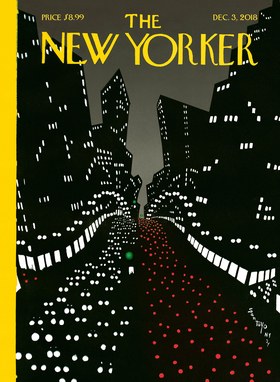
 The December 3, 2018 issue of the New Yorker was an archival issue, meaning that every story was taken from an earlier issue. The range is something like 1975-2006, which is odd since the New Yorker dates back so much longer. Although the fiction pieces are at least from the 1940s and 1950s.
This story was written in 1948 and it is certainly of a certain time and place–specifically The Metropolitan Museum of Art in 1948.
Emma is a young, single woman browsing the art gallery. She is excited to see a Botticelli, but as she nears the room, Alfred Eisenburg is standing there right in front of “The Three Miracles of Zenobius.” She liked Alfred and even flirted with him at a party “in some other year.”
At most other times she would have been pleased to see him, but she turned quickly back the way she had come.
I loved this next bit so much:
As she turned, she came face to face with Salvador Dali, whose sudden countenance, with its unlikely mustache and its histrionic eyes, familiar from the photographs in public places, momentarily stopped her dead, for she did not immediately recognize him and still surprised by seeing Eisenburg, took him also to be someone she knew. She shuddered and then realized that he was merely famous.
She wondered what she would look at next–her whole day’s plan has been scuppered.
Then she thinks aback to that cocktail party. New York cocktail parties were neither work nor play yet they were indispensable to the spiritual life of the artists who went to them. She could see that now after having not attended one for several months. The gossip was different and precise. The drinks were much worse and far more plentiful. There was never ice and if there was it was probably from a bed of fish at the fishmongers. No one left a party until ten and that was to go eat, or not eat at a restaurant. When she spoke at these parties she was always “lamentably off-key.”
She thought of them all as Olympians. Most of them had a New York upbringing which she could not understand. She believed that they had all been deprived of “many of the innocent pleasures because they had lived in apartments and not in two-or three-story houses. (In the early years in New York, she had known someone who had not heard cat purr until he was twenty-five and went to a house part of Fire Island).” By contrast her own childhood had not equipped her “to read, or to see, or to listen, as theirs had done.”
The reason she has not been out for months is a mystery to me. I can’t tell if its something obvious that people in 1948 would know or just a nebulous unhappiness with life. From the story itself we get this:
In so many words, she wasn’t fit to be seen. Although she was no longer mutilated, she was still unkempt; her pretensions needed brushing; her ambiguities needed to be cleaned; her evasions would have to be completely overhauled before she could face again the terrifying learning of someone like Alfred Eisenbrug.
For he was an intellectual. Although she honestly didn’t know if he was a writer, composer, sculptor or something else entirely. Emma, no matter how smart she was, could never see herself as an intellectual. In her mind the opposite of intellectual was rube.
But she was often mistaken for an intellectual because she had gone to college and knew the motions. She had studied but never seemed to reach the same conclusions as anyone else. It was possible to be a successful rube amid the Olympians, for example:
Someone calling himself Nahum Mothersill had done it brilliantly, but she often wondered whether his name had not helped him, and in fact, she had sometimes wondered whether that had been his real name. If she had been called, let us say, Hyacinth Derryberry, she believed she might have been able, as Mothersill had been, to ask who Ezra Pound was.
But while she is in her reverie, Alfred saw her and was heading her way. Suddenly everything seemed different.
Despite not fulling getting this story, I loved the way it went from one of fear to one of acceptance.

 I Just Read About That...
Leave a comment