 SOUNDTRACK: FLORENCE + THE MACHINE-Tiny Desk Concert #795 (October 16, 2018).
 Florence + the Machine has slowly won me over. When I first heard their (her) songs, I wasn’t impressed. I felt there was something missing.
I don’t know if I changed my mind on those early songs, or if she did something more in her layering but I suddenly found her songs intense and really powerful.
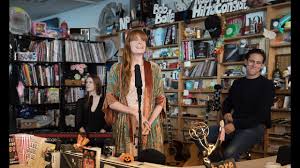
Florence Welch and her band play three songs at the Tiny Desk. I have so much grown to love the full production that I wasn’t sure I would enjoy it as much when stripped down. For the Tiny Desk it’s just her on vocals, with a guitars a synth an d a harp! And man her voice has just become a force unto itself–she could sing a capella and it would be great. But the backing vocals add an amazing and unexpected punch.
She starts the show with the lovely “June.” It begins with her voice and some harp notes.
Florence performed with her eyes closed. Within seconds of hearing her first note, the raw power of her un-amplified voice was chilling.
Then the guitar joins in and the lovely “oh ooh, oh ooh, woah” fill in the gaps perfectly. Even something as simple as Florence’s hand clap add an interesting percussive element to the climax of the song.
It’s impossible to talk about Florence without her backing band. Tom Monger adds exquisite ethereal textures to the songs with his stunning mastery of the pedal harp. Hazel Mill’s backing vocals and anthemic power chords on the keys accentuate the poignancy of the lyrics at just the right moments. And Robert Ackroyd’s rhythmic, steady acoustic guitar drives the music forward.
The second song “Patricia” builds slowly over its time. The harp plays a kind of haunting melody that is accentuated by two almost sinister deep notes. The song feels like it’s heading to an end after about three minutes, but that’s just the middle section. After a big smile, the hand claps continue as the song grows louder and louder as they sing “it’s such a wonderful thing to love.”
The intensity of the musicality is almost secondary to the message in her lyrics. Ear-worm melodies coupled with repetitive phrases create universal, awe-inspiring anthems.
Her nervousness was palpable and stood in stark contrast to her fully produced stage show. “I’m sorry I’m shy,” Florence Welch told the crowd of NPR family and friends gathered for her Tiny Desk performance. “If this was a big gig, I’d probably be climbing all over here and running around.”
The final song is the one that won me over, “Ship to Wreck.” She reveals her humorous side when she says, “We haven’t practiced this. It could be terrible. Especially for you.”
I love the hugeness of the recorded version of the song. This version replaces some of the power with more interesting subtleties in the harmonies and the lovely melodies. It’s a striking version of the song.
[READ: November 28, 2018] “A Diamond to Cut New York”
 The December 3, 2018 issue of the New Yorker was an archival issue, meaning that every story was taken from an earlier issue. The range is something like 1975-2006, which is odd since the New Yorker dates back so much longer. Although the fiction pieces are at least from the 1940s and 1950s.
This particular piece is a collection of vignettes from Dawn Powell’s diaries which range from 1933 to 1963 (she died in 1965).
I have wanted to read Dawn Powell for years and yet I keep finding other books that jump in front of me first. As I read this I wondered if maybe Powell isn’t for me, as I really didn’t know what in the world she was talking about for many of these entries. but there were many glimmers of the wit that Powell is known for poking through.
There’s also the problem of context. I have virtually none for most of these entries, so even if there are clever comments, I probably have no idea.
Powell wrote her first novel in 1925, but she really considered She Walks in Beauty (1928) as her real debut. It’s in her 1936 novel Turn, Magic Wheel that she starts working on New York social satire. Her first commercially successful book was A Time to Be Born (1942).
The excerpts from her journals begin in 1933: “that little gadget I wrote sold to New Yorker for $70.” She bemoans her general lack of money and vows that in a year she will be loved and respected by all.
In 1934 she speaks of being impressed by women writers who “make their art serve their female purpose, whereas once it warred with their femininity” and how different they are from the he-man writers (like Hemingway). The women write word that squirm with sensitivity while the men tersely proclaim their masculinity.
In 1935 she says she believes that her new book Turn, Magic Wheel is the perfect New York story–it could not happen any place else.
In 1940 she bemoans the intelligent idling rich. “There’s no way a creative mind could thrive in such a situation.” The great temptation in all middle age [is] comfort and security–“but the surest death to the artist if accepted wholly.”
The pull quote from the story comes in 1942: “I am still so amazed at the brazenness of people who only remember you when you’ve gone into your fourth printing.”
There’s a devastating passage in 1945 when her cat Perkins dies.
In 1948 she approves of her book The Locusts Have No King and finds it “an admirable, superior work.” She laughs at some of the criticism that she’s not writing about “nice people–people one likes”
Who likes? I’m doing the work. I write about people I find interesting…. My readers and critics never recognize themselves. I find this country monstrously hypocritical–absolutely unable to stand the truth.
There is sensible advice for writers in 1951
You must remember that you don’t know what people find in your work so there’s no sense in trying to repeat it. …So for reassurance in finding some of your work so bad–remember, you don’t know.
In 1954 she bemoans that “violent deaths are the only thing that can give writers now any immortality.”
She enjoys Gore Vidal but then mocks a panel on Open End: Dorothy Parker, Truman Capote, and Norman Mailer pontificating on writing with “a shy admission that there are only 15 really good writers in the United States (who are the other 12?)”
The final entries are about her 1962 book The Golden Spur which made the short list for the National Book Award. A girl asked her, “Have I ever read any of your books?” I said, ‘You look as if you had.’ She took this as an insult–I assured her author-ego made it a compliment.”
The last entry is that she did not win the Award and she felt relief–she has no equipment for prize winning.
This diary at least gives me an idea of where to start when it comes to reading her books.

 I Just Read About That...
Leave a comment