 SOUNDTRACK: DANIEL HOPE-three pieces (Field Recordings, August 21, 2013).
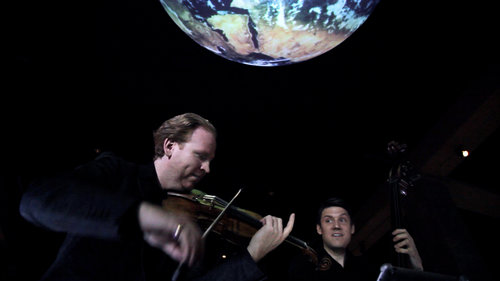 The only thing I like more than a Field Recording set outside, is one set in an unlikely building, like the way this Field Recording [Daniel Hope’s Earth And Sky Expedition] is set in the American Museum of Natural History.
When Daniel Hope was a boy, the only thing he loved as much as his violin was his telescope. Gazing into the night sky, he pondered the vastness of space. Now a grown man, Hope still has a penchant for wonder and discovery — especially when it comes to music.
In his latest album, Spheres, Hope returns to the spirit of those early astronomical adventures. His idea, he says, is “to bring together music and time, including works by composers from different centuries who might perhaps not always be found in the same galaxy.” The unifying factor is the big question: Is there anything out there?
What better place to play with that ancient query than the Rose Center for Earth and Space at New York’s American Museum of Natural History. We invited Hope and jazz bassist-composer Ben Allison into the “performance crater” in the Hall of Planet Earth.
As if the Hall isn’t interactive enough — with its glowing orbs and 4.3 billion-year-old zircon crystal — we wrangled afternoon museum-goers to participate in our own Earth and sky expedition. Equipped with small flashlights, they became the twinkling stars surrounding Hope and Allison in the darkened room.
The music seems to live and breathe in the space, as each of the three pieces (spanning four centuries) reverberates a unique voice. “Imitation of the Bells,” with its rippling arpeggios and tolling bass line, comes from the long forgotten Johann Paul von Westhoff, a German violin master who crisscrossed Europe a generation before J.S. Bach. In “Berlin by Overnight,” from contemporary Max Richter, Hope’s violin asteroids whiz past while Allison’s bass propels through outer space. And finally, the otherworldly beauty that is Bach’s “Air on a G String” floats in a safe, gentle stasis.
It’s neat watching the little kids swing their flashlights around while the older kids watch on, bored, from the balcony during “Imitation of the Bells.” Hope’s violin is flying in a flurry of activity while the bass keeps things grounded.
I’m not sure that I have heard many violin pieces performed with a bass accompaniment. The bass doesn’t add a lit of melody to the violin work, but it adds a very cool feeling of grounding and rhythm especially in “Berlin by Overnight.” The piece feels very contemporary with a cool, fast, Glassian kind of repetitiveness. And the bass adds occasional notes (that feel like rock bass notes, he plucks so hard) to keep the pace going.
The bass is much more pronounced on the familiar J.S. Bach: Air on a G String. I feel an imperceptible sitting up straight once the first notes ring out of the violin. But I keep coming back to the bass. The violin melody is so pretty and so familiar that it’s interesting to listen to the way the bass plays off those notes.
[READ: February 9, 2018] “The Botch”
I have not enjoyed Means’ stories in the past. They’re usually pretty violent and just not my thing.
This one was a bit more enjoyable until the end. The only problem with it per se was that it was about a bank robbery and I feel like there’s not much you can say about a bank robbery that hasn’t been said in films and stories already.
But there’s some interesting tweaks. It is set around the Great Depression–tommy guns and wise guys. And the mastermind behind the scheme has thought out everything ahead of time. There is a repeated refrain of “the idea is” which I kind of liked. Although for some reason it bugged me when it was switched to just “idea being,” which I know is how it would be said, but it bristled.
Anyhow, the idea was to go into the bank where they’d be dealing with corn fed Mennonites and moms with kids. People who would scream when things started happening but who would soon stop and whose lives would thereupon become more meaningful.
Donnie chomping on his cigar had the ideas. They talked through a dry run in their hideout–an old forge.
They wanted to make sure everything was planned meticulously so no loose idea could lead to a botch. They even got crazy with their rationalizations saying that “most good folks will side with the money and, in turn, with us….secretly root for our success while recognizing … that we’re doing our best to free the money from its reluctant association with the bank and big syndicate empires of speculation.”
Then it moves to the present where he lets us know there was a botch. But you couldn’t attribute it to them not being prepared. They were.
Some types of botch to avoid include: The silent alarm botch, the mix-up botch , the heroic fallacy botch. Idea was to have a non-botch scenario.
There was an Old Order Mennonite in the bank, but he didn’t do what was expected. He resisted. Not physically, but in the set of his jaw.
The narrator tells us that he might be responsible for the botch. He looked out the window and saw a woman–a natural distraction–something that draws the player usually the door guy, away from the mechanics of the heist, “reorienting the mind so that the player must…reconnect with the nature of his obligations in relation to the task.” She had on a tight red skirt and was laden with bags.
When he turned back and saw what was happening, the botch became apparent. It was a bloodbath.
The end of the story sees the narrator imagining revenge on the poor woman, which I didn’t care for but I guess is a reasonable feeling for him to have.
I do like when wise guys talk all sophisticated.

 I Just Read About That...
Leave a comment