 SOUNDTRACK: SUFJAN STEVENS, BRYCE DESSNER, NICO MUHLY-“Mercury” (Field Recordings, June 8, 2017).
 I love Sufjan’s Steven’s voice. And this song, from the Planetarium project is just beautiful. [Watch Sufjan Stevens, Nico Muhly And Bryce Dessner Play ‘Planetarium’ Track ‘Mercury’] It opens with just the simple repeating piano melody and Stevens’ singing. Eventually a guitar is added, playing complimentary melody.
Steven’s voice remains pure and powerful in this live recording. The viola from Nadia Sirota adds a lovely counterpoint to this song and leads it into the middle part which is minor keys and stings.
“Mercury” is the closing track off Planetarium, a song cycle about the planets by Stevens, Dessner, Muhly and James McAlister. The work was originally composed on commission for the Dutch concert hall Muziekgebouw Eindhoven, and first performed there in 2012. Five turns around the sun later, Planetarium will arrive in recorded form on June 9 via 4AD. “Mercury” is one of the most intimate songs on the record, a quality that’s emphasized by its spot just after the 15-minute, ambient, electronic epic, “Earth.” Where the record’s other songs foreground synthesizers and spastic electric drum samples reminiscent of 2010’s The Age of Adz, “Mercury” largely rests on Muhly’s gentle piano work and Stevens’ beautiful vocal. Where once, in the original live performances, the song swelled to a cinematic rush on the order of Illinois, it’s now spare and elegant. Its warm intimacy is all the more apparent in the group’s live performance, which features Dessner of The National lightly doubling on guitar Stevens’ wordless refrain at the song’s close. Like many of the pieces on the record, its lyrics are a constellation of the cosmic, the personal and the mythological. The song, named for the messenger god, is a perfect musical setting for the feeling of having something dear carried away from you. “All that I’ve known to be of life / and I am gentle,” Stevens sings. “
I love hearing his voice live, because it’s so perfect on record and while this is in no way imperfect, it lets us see a bit of humanity. Even if this recording isn’t in a field or even an unconventional space, it’s still quite lovely.
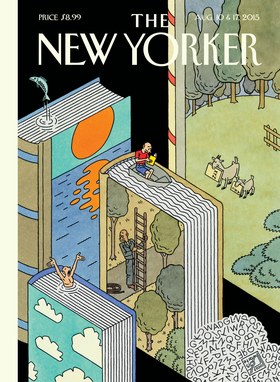
[READ: January 3, 2015] “Little Man”
I feel like it takes a lot if chutzpah to recreate a story that is familiar to everyone. This is the story of Rumpelstiltskin as told from the point of view of the little man himself.
But the twist on it is that Rumpelstiltskin isn’t a strange psycho bent on stealing children. Rather, he is a lonely man, with no hope of finding love or having a child of his own. Indeed, the first section is taken up with the man’s desire to have a child and his belief that having a child is not like ordering a pizza, which is how many couples seems to take it.
The story is written in second person (you), so it is meant to be even more intimate.
First he hears the rumor–an impoverished miller (who has no health insurance or investments) has told the king that his daughter can spin straw into gold. You suppose he is hoping that if he can just get his daughter in front of the King, he’ll see how beautiful she is.
The miller obviously didn’t expect his daughter to get locked into a room with straw. It gets worse. The King, who really hates being duped, announces, from the doorway to the cellar room, that if the girl hasn’t spun it into gold by the morning he will have her executed.
What? Wait a minute…
Here’s where you come in. You’re descended from a long line of minor wizards. And you talk to a relative to learn about turning straw into gold.
(The bit about castles being easy to penetrate and mistaken magic is very funny).
You don’t succeed at first but slowly it starts to come and she is delighted and very relived. She even rests her hand on your shoulder as you work And to show her gratitude she gives you a ring.
The King’s response? Do it again tonight. He’s joking, right?
Before the third night, the King announces he’ll marry her if she does it again. “That’s the reward? Marriage to a man who’d have had you decapitated if you failed to produce not just one but three miracles? Surely she will refuse. But she says she can’t afford to refuse.”
You offer your services and she says she has nothing more to give. It just slips out “Promise me your first-born child. Let me raise that child. I’ll be a good father.”
You don’t want it to be blackmail but when she fears it as such, that’s what it becomes.
And the rest is familiar. Rumpelstiltskin, usually a quiet solitary man. foolishly reveals his name. A guard hears it allowing her to break the pact,
The end is weird with the little man being split in two but staying alive. I don’t know if that’s a part of the original story ends, but I guess you have to end it somehow.
I really liked the way this story was done. It was funny and presented a nice twist.

 I Just Read About That...
Leave a comment