 SOUNDTRACK: CONSTANTINES-Live at Massey Hall (May 27, 2015).
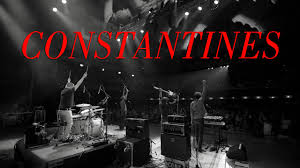 From the clips I’ve seen, Constantines are (were?) an incredible live band. They have so much intensity.
In the opening, they are asked Are you guys nervous? They don’t seem to be although they concede that “Nervous is good, it keeps you on your toes.”
At some point we decided to run the band where we would play anywhere with a three-pronged outlet. It led to playing a lot of amazing spaces…non-performance spaces like skate shops and basements and art galleries. This feels like an incredible extension of that to play Massey Hall… a historic venue.
“Draw Us Lines” opens the show with thunderous drums and squalling feedback as the band gets the audience clapping along to a simple rhythm while Bry Webb sings in his deep raspy voice. I love how much noise the keyboardist makes just pounding on keys–at times leaning on the machine with his whole arm.
“Our Age” has martial beats and an interesting low riff that runs through the verses–but the choruses burst forth really catchy. “On to You” was a single I believe. It has loud verses and a quiet, understated chorus. I love how much they raise their guitars–the bassist even plays with the instrument raised over his head
“Young Offenders” rocks as hard as anything else they play, but it adds the surprising lyric: “young hearts be free tonight … time is on your side,” before launching into the heady section with the crowd shouting “Can I get a witness.”
“Nighttime/Anytime {It’s Alright)” has a great slinky guitar intro and sounds very familiar–as if it’s quoting another song, but I can’t figure out what.
More thumping drums (the drummer must be exhausted) and some distortion and feedback introduce “Young Lions” which starts as kind of catchy rocks song but features wonderful noise section in which everyone plays with feedback and the keyboardist actually sits on the keys before returning to that really catchy section.
The show ends with “National Hum,” a blistering loud track with discordant chords and intense vocals. The drums just seem to go faster and faster as the song goes on.
They play this show like it’s the most important show they’ve ever played. And the crowd responds accordingly. It’s unclear to me if Constantines are broken up or not, but if they ever come around, they are a must-see show.
[READ: June 2, 2018] “What is Possible”
This issue of the New Yorker had a section entitled “Parenting.” Five authors tell a story about their own parents. Since each author had a very different upbringing the comparison and contrasting of the stories is really interesting.
I love the opening of this essay in which Mohsin says that his mom worked an entry-level job at what would now be considered a Silicon Valley tech business. They made audiocassettes.
His father made peanut-butter and jelly sandwiches and picked Mohsin up from school on his bike. His dad had a mustache and sideburns but no hair. They went to the university where his father was studying. Or they went home to watch cartoons on the small black and white TV.
Mohsin says he always saw colors on it “though I was told by friends that this wasn’t possible.” I relate to this because I had a black and white TV in my room growing up and I was sure it was color until one day when I went to my parents TV and compared sided by side and saw just how colorful their TV was.
He and his dad hung out other days: hiking, feeding butterflies. Meanwhile his mom worked and “brought home the bacon” (non-pork variety since they were Muslim).
When his uncle visited from Pakistan he asked the older man where his wife was. When the man said he was not married Mohsin asked “Then who makes the money?”
Mohsin had friends–a Dutch kid whose dad was a geologist and whose mom was part Indonesian. And another who was American whose father was an African-American poet and whose mother was from Texas (should she be called European American?) But his real best friend was his dad.
He marvels that he is now twice the age that his father was when he himself was born. When Mohsin was nine his dad finished his PhD and they moved back to Lahore. His dad also got a job and wasn’t home as much.
That was four decades ago and in that time Mohsin has lived all over the world–from Manhattan to London and back to Pakistan. He has lost his hair like his dad and has two kids of his own.
His wife works and he writes and his life is like his own when he was a kid except he is the dad. He sometime resents not having a “real” job, but he ends the essay with a wonderfully sweet moment with his five-year old son.

 I Just Read About That...
Leave a comment