 SOUNDTRACK: KING CRIMSON-The Elements Of King Crimson – 2017 Tour Box (2017).
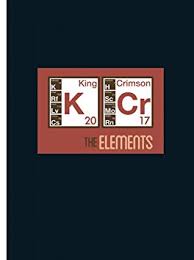 The (so far) final Tour Box (although the band is still touring in 2018) is notable for having what might be the definitive collection of live “Lark’s Tongue in Aspic” recordings–Parts I to IV (and more) from different eras.
But that’s disc two. Disc one continues with the sampling of the band’s career.
Disc 1 opens with “Wind.” Although each “Wind” extract seems a tad different. This one is all talking, no wind.” (extract) talking no wind.
Next comes an a capella first verse of “21st Century Schizoid Man.” It’s just Greg Lake singing really loud before seguing into the rest of the song, this time from 2015. It’s a great version.
Continuing like the other boxes, there’s an instrumental edit of “In The Wake Of Poseidon,” which is quite lovely.
This disc has a number of Mel Collins flute improvs taken from various Lark’s Tongue recordings in 2016. Each one is wonderful and I could listen to his flute all day.
Another recording of “Peace,” this time with in a rehearsal that ends with Jakko cracking up because of something that Gavin has done (with lots of bad words bleeped out).
It’s followed by a stellar recording of “Cirkus” from 2016. This is the first time played since 1972 and it sounds much more intense and complex than the version on the previous box.
It’s followed by an abridged instrumental recording of “Islands” and a 2015 live recording of “Easy Money” (complete with sound effects–I loved hearing this live the first time.
“Suitable Grounds For The Blues” is a 2015 rehearsals that ends when someone calmly says “It was Harrison, sir. He made me laugh, sir. He did the drum fill out of Hawaii 5-0 twice.
“The Great Deceiver” from 1974 sounds tremendous and I hope this means they might be busting it out for the 2018/19 tour.
“Asbury Park” is a live recording. It’s a fast and rollicking instrumental edited down to fit nicely with a terrific 2016 recording of “One More Red Nightmare.”
There’s a 2015 rehearsal of “Meltdown” and then a jump to an alternate (instrumental) mix of “Thela Hun Ginjeet.” I normally love these instrumental mixes, but i find that this song really uses the words wonderfully and I miss them.
The only other track from this era is a 1982 recording of “Heartbeat” which is insanely catchy and I can;t believe wasn’t a hit. The disc ends with a 2008 performance of 1984’s “Sleepless” which sounds really 80s (the bass in particular) even though it was recorded in 2008. I’ve often thought that Adrian Belew makes King Crimson sound like The Talking Heads, and that seems to be true with this song.
The disc ends with the intermission and photography announcement from 2016 concerts.
Disc 2 is the Lark’s Tongue disc, but it doesn’t start with it. It opens with 2004’s “Form No. 1” with strings guitars and a Tony Levin groove. Then there’s a version of “THRAK ” from the Thrak sessions.
The disc has several tracks called “Keep That One Nick” which are some early recordings and dialogue. Each one is about 4 minutes long of guitars or drums or the whole band recording primarily parts of LTIA.
When the series starts, we’ve got a
2015 recording of “Larks’ Tongues In Aspic Part I” followed by a
1974 recording of “Larks’ Tongues In Aspic Part II.”
after a Nick recording of percussion (in which the drums sound like child’s toys and like Bruford is hitting everything in the studio, they continue the series with a
1984 recording of “Larks’ Tongues In Aspic Part III.” This is my least favorite Part–I can;t get over how much I’m disliking the 1980s recordings, especially since Discipline is one of my favorite KC albums.
after a recording jam of Part II (keep that one, Nick) there’s a
1999 recording of “Larks’ IV ConstruKction” where you can see the connection to the LTIA series in this song. Then comes a
2003 recording of “Larks’ Tongues In Aspic Part IV” which sounds great once again.
It’s followed by a 2016 recording of “Level Five” which is sort of an unofficial Part 5 to LTIA.
Presumably these are Fripp’s favorite versions of the series. So there.
The disc and set ends with a radio advert for the Larks’ Tongues In Aspic album because who even knew they made radio adverts for albums. It’s a great piece of history.
I imagine there will be a 2018 box, as the band has taken a few months off and is getting ready to start touring Europe and Japan through the end of the year. And who knows, one more trip back to the U.S. in 2019? Yea, I’d be ready to see them once more time by then.
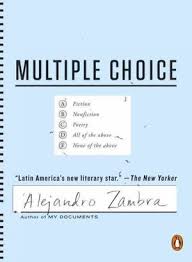
[READ: February 1, 2017] Multiple Choice
I have really enjoyed Zambra’s stories a lot. As with most of Zambra’s work, this one was translated from the Spanish by Megan McDowell and I thought it was terrific.
As it turns out almost half of this book has been previously published: “Reading Comprehension: Text No. 1” (New Yorker, July 6 & 13, 2015) and “Reading Comprehension: Text No. 3” (Harper’s, July 2016). In total, there are three Reading Comprehension texts in the book, as well as a few other types of “test questions.”
The original of this book was called Facsímil, and it uses “the structure and questions of the Chilean Academic Aptitude Test as its organizing principle. Called both a work of parody and poetry, Multiple Choice examines the role of the education system and standardized testing in promoting compliance to authoritarian rule.”
Since this book is set up like test there are 5 parts to work through.
Part 1. is called Excluded Term, in which you are prompted to “mark the answer that corresponds to the word whose meaning has no relation to either the heading or the other words listed.”
It starts with MULTIPLE: A) manifold B) numerous C) untold D) five E) two
and moves on to things like CHILDHOOD: A) childlike B) childproof C) childcare D) childless E) childfree
and ends with SILENCE: A) fidelity B) complicity C) loyalty D) conspiracy E) cowardice
and then SILENCE: A) silence B) silence C) silence D) silence E) silence
Part II. is Sentence Order: “mark the answer that puts the sentences in the best possible order to form a coherent text.”
An example:
Nineteen eighty-something
- Your father argued with your mother.
- Your mother argued with your brother.
- Your brother argued with your father.
- It was almost always cold.
- That is all you remember.
with answers:
A) 2-3-1-4-5
B) 3-1-2-4-5
C) 4-1-2-3-5
D) 4-5-1-2-3
E) 5-1-2-3-4
By the end of the section there are 11 sentences in the question and multiple ways to organize them
Part III is Sentence Completion “Complete the sentence using the appropriate elements.”
I often used to lie, ______ I wore dark glasses
A) but
B) though
C) so
D) but even so,
E) but only when
The last few choices vary on this question:
You were a bad son, but ______.
You were a bad father, but ______.
You are alone, but ______.
with a pretty diverse grouping of answers
Part IV is Sentence Elimination: “Mark the answer that corresponds to the sentences or paragraphs that can be eliminated because they either do not add information or are unrelated to the rest of the text.”
This section gets harder to parse and harder to answer (if you are trying to answer)’
- There are hamburgers in the refrigerator
- There’s some lettuce and mustard, too
- I went to the beach with my kids.
- It’s normal, they’re my kids too.
- I’m afraid of you.
- And they’re afraid of you, too.
- And that, too, is normal.
A) None
B) 1 and 2
C) 2
D) 4
E) 7
The final one has 25 options and all are about the narrator now.
Section V, the final section, is the Reading Comprehension section.
Text #1 opens with the amusing sentiment:
After so many study guides, so many practice tests and proficiency and achievement tests, it would have been impossible for us not to learn something, but we forgot everything almost right away and, I’m afraid, for good. The thing that we did learn, and to perfection—the thing that we would remember for the rest of our lives—was how to copy on tests.
At his school especially, the teachers gave mostly multiple choice tests–ostensibly in preparation for future standardized tests.
The only class that the students went to willingly was religion–an elective that they took because the teacher Mr Segovia was full of fun stories and allowed them to tell their sins at the beginning of class. This is how the narrator learned just how many people cheated–because they would say so in front of the teacher and he would absolve them.
Then one day the teacher tells the narrator and his friend the story of the Covarrubias twins. These twins were inseparable until something changed in them and they began to drift apart. It took one final act of cheating to get them reunited for good and now they are hugely successful adults.
What tickled me about the end of the story is that there are 8 multiple choice questions that wrap it up. While some of them can be answered “according to the text” they questions are also pointed and interesting beyond the story.
One can infer from the text that teachers at the school:
A) Were mediocre and cruel…
B) were cruel and severe….
C) were deadened by sadness
D) were cruel and severe because they were sad
E) The kid next to me marked C, so I’m going to mark C as well
I especially enjoyed the final question.
Text #2 is the shortest of the three. It concerns the narrator’s wedding day back in September 200o, 14 years earlier. The party was intense. “The bride–of course I remember her name, though I think eventually I’ll forget it.” One of the guests was filming for posterity and asked how does it feel to be married in a country where there is no divorce. Chile is one of the few countries where divorce isn’t legal. The bride looked at him and said we will stay married even if we hate each other.”
Two years later divorce was still not legal but annulments were–and that was the common way of separation in Chile.
Questons:
What is the worst title for this story–the one that would reach the widest possible audience?
A) “Five Thousand and One Nights”
B) “Two Years of Solitude”
C) “Fourteen Years of Solitude”
D) “Two Weddings and No Funeral”
E) “The Labyrinth of Nullity”
The end of this story is, without a doubt:
I. Sad
II. Heavy
III. Ironic
IV. Abrupt
V. Immoral
VI. Realistic
VII. Funny
VIII. Absurd
IX. Implausible
X. Legalistic
XI. Bad
XII. It’s a happy ending, in its own way.
A) I,II, and IV
B X
C) All of the above
D) VIII and XI
E) XII
Text #3 begins with a man writing a letter to his son.
I loved the way the beginning started with the narrator telling his son to forget all of the things that he has said or done: “mitigate my shouting, my inappropriate remarks, and my stupid jokes.”
In the story, the father tells the son all about the son’s birth. How the father and mother were young and stupid and did not feel responsible enough for a dog, much less a child.
He assures the boy that his birth was a happy experience for both of them, despite the fact that the parents separated shortly afterward. However, he does tells him that they separated because of the dog that the boy found.
The questions
“The comparison between having a child and having a pet aims to show… ”
I. The contradictions of a generation that, under the pretext of a pessimistic view of the world chose to have pets rather than children
II. The importance of passing laws regarding responsible pet ownership
III. The importance of passing laws regarding responsible child ownership.
A) I and III
B) I and II
C) I
D) II
E) III
and
After reading this text, you would rather
A) Not have read it
B) Not have children
C) Have many children
D) Not have a father
E) Have a parrot
But the final question got to the heat of the matter: “If you were the addressee of this letter, your reaction would be:”
The five options are really pretty intense.
Despite the hugely unconventional way the story is written it conveys a wonderful story and the unconventional format really makes you think about what you’ve read, even if you don’t plan to actually answer the questions.

 I Just Read About That...
Leave a comment