 SOUNDTRACK: SHAKEY GRAVES-Tiny Desk Concert #495 (December 14, 2015).
 I thought I had posted about every Tiny Desk Concert, but on double checking I found that I had missed this one. I had heard of Shakey Graves and I assumed he was a country/folkie singer. Which he is, although really his style is to mix country, blues and rock ‘n’ roll. I also had no idea his real name is Alejandro Rose-Garcia.
This set sees Graves on acoustic guitar (with a strap with his name on it) accompanied by another acoustic guitar (which seems rather small) and a mandolin.
“To Cure What Ails” is a pretty, slow folk song. It’s simple enough with nice high mandolin notes and a good guitar line between verses. Shakey has a nice voice and the song feels compelling like a story, although I don’t think it is. He’s also charming and funny in little ways–he makes a lot of funny faces and chuckles. But his music is really solid and the harmony at he end of the song is really great.
For “The Perfect Parts” the mandolin switches to bass and they have a little discussion n how to play it. Shakey tells the drummer how to play the beat and then says they’re going to make it us as they go along. This song is darker and has a cool sinister vibe. He sings in kind of deep mumble for this song which works well for this song. The song gets a little intense for a few lines. And by the end it builds pretty loud with some good whoa ho ho backing vocals. So much so that for the last chord, “he attempted a stage dive at the Tiny Desk.”
For the last song, “Only Son,” he:
breaks out his guitar and suitcase kick drum/hi-hat, [and] a palpable rush of swooning adrenaline hits the room. I felt that at the Americana Festival in Nashville, at the Newport Folk Festival and here at the Tiny Desk.
He says it is soon to be the last of the suitcase kick drums (this is his third). He dreamed about having an object that he could cart around with him and still make a lot of noise. The drum is actually behind him and he stomps the pedals with his heels (I can;t believe the camera never zoomed in on it).
He says the song is about “the moment in your life when you realize you’re not alone… there’s an aha! moment where you’re like ‘not just me?’ The drummer plays bass, the mandolin player has the mandolin back and Shakey has the kick drum suitcase. There’s some terrific harmonies (and chuckling ) throughout the song, and I love the way it stops and starts.
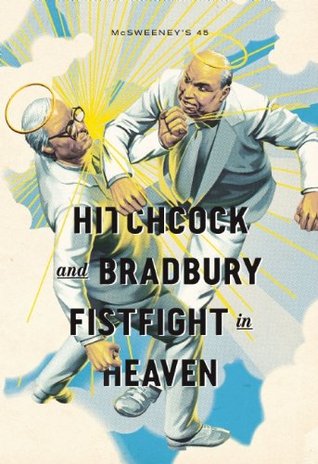
[READ: Late 2016 and early 2017] McSweeney’s #45
The premise of this collection was just too juicy to pass up. Although it did take me a while to read it. Eggers’ introduction talks about the contents of this issue.
DAVE EGGERS-Introduction
Eggers says he came across a collection of stories edited by Hitchcock. He really liked it and then learned that Hitchcock had edited 60 volumes over the course of 35 years. He was excited to read literary genre fiction. But he was more impressed that theses stories did what literary fiction often forgets: having something happen. He then bought a cheap book edited by Bradbury (Timeless Stories for Today and Tomorrow) and he liked it too. He was surprised that there were so many canonical writers (Steinbeck, Kafka, Cheever) in a Bradbury collection.
So, why not make a new collection in which we can compare the two genres.
Despite this looking like a pulpy paperback, there were still Letters.
LETTERS
CORY DOCTOROW
Doctorow says that Science fiction is not, indeed, predictive. That any genre which deals with so many potential future events is bound to get some things right.
JAMIE QUATRO
Quatro says she was asked to write a letter for this genre issue, but Quatro doesn’t do genre, so she was about to pass. Then her son, from the backseat, asks what bulwark means. Then inimical. Then miasma. He is reading a book called Deathwatch about soldiers whose brains are removed so they no longer fear. Suddenly, when she compares this idea to her essay on Barthelme, she sees that maybe McSweeney’s was on to something after all.
BENAJMIN PERCY
In fifth grade Percy (who has a story below) gave his teacher a jar full of ectoplasm. He has always been different. He proposes the Exploding Helicopter clause: if a story does not contain an exploding helicopter (or giant sharks, or robots with lasers for eyes or demons, sexy vampires. et al), they won’t publish it.
ANTHONY MARRA
Marra discusses Michael Crichton and how something doesn’t have to be Good to be good. He says Crichton was a starting point for him as an adult reader. And what can be wrong with that?
RAY BRADBURY & ALFRED HITCHCOCK-“Introduction” & “A Brief Message from our Sponsor”
Bradbury talks about how life is more than fantastic and these stories illustrate how fantastic life is. None of the stories take themselves so seriously that they become sociological ramrods or symbols of political belief. Speaking of Steinbeck’s delightful “Saint Katy the Virgin,” he comments “good humorous fantasy is a rare thing to come by.”
Hitchcock is indeed brief–half a page. The crux:if you are nervous: chewing your fingernails, jumping from your chair when a door slams, or swooning when someone playfully shouts boo in your ear I have only two words of advice–pass on.
ROALD DAHL-“The Sound Machine” [Bradbury]
Dahl’s story has an intriguing premise–a man in his basement is building a radio (which he describes as the size of a child’s coffin). It is a box full of wires and he spends a crazy amount of time fiddling with it before we learn what it is. It is only when the doctor pops by to see how he is doing (from an unspecified problem) that we learn that the man is making this radio which is designed to capture audio at waves that we cannot hear. When his neighbor goes out with some clippers and starts trimming the garden we learn what frequencies fall into the range he is trying to hear. That in and of itself would make for an interesting story, but Dahl pushes it even further. It’s very good, if not a little disturbing (like most Dahl, actually).
JOSEPHINE W. JOHNSON-“Night Flight” [Bradbury]
Joe is reflecting on the visit he just had with his wife. Almost like the real thing, but very good nonetheless. But we learn that his wife was asleep when he visited her, and that’s when she was able to see him. Then we flashback to see that he is actually in the army, hundreds of miles from home. Then we learn exactly how he visited his wife, and it’s a fascinating idea, especially when someone else does it so wrong.
JULIAN MAY-“Dune Roller” [Hitchcock]
This is a story that begins strangely, grows rather normal and then gets really surreal. It opens with a meteor falling to earth “long ago.” It killed the fish which attempted to eat it. Then we move to the present where Dr. Ian Thorne is studying water creatures in a pool off of Lake Michigan. He is alone there, in contact with the mainland via someone on ship to shore radio. Much of the beginning of the story is an interesting character study of him. And then he finds these two amber droplets. They are strange but not that remarkable, so he keeps them in a small jar. It is only when the person he is in contact with brings his daughter with him one time that Thorne breaks with his solitude. He likes this woman, although he doesn’t think he loves her, but he gives her the amber as a charm. The story shifts to a man who was returning to the island to see where he used to work on the fishing boats. He is killed by something unseen. Because of the introduction of the deadly meteor, we know that somehow the meteor is responsible for the deaths, but the way it is revealed is pretty cool and suitable frightening.
CHINA MIÉVILLE-“The Design” [new]
This was certainly a strange story. It felt like a very old story (it takes place a long time ago) and it follows a man as he is plagued by what he finds. Set in a surgery school morgue, we see that a student is notices a design carved into the bones of the body. The more he looks, the more complex the design is. And soon he becomes obsessed with how this could have happened (understandable). He casually looks at the other bodies but none have the designs. And soon he feels compelled to see what these designs represent. So he must bring the body to a private location.
I loved that the story was told by the main character’s friend–long after the main character told him everything that had happened. But the way it is told, we see it happen as it happens–we see the creepy deeds that the young surgeon does. And then we see thee effects this has on the man. The disappointing thing is that no real “Story” comes from the design. I wanted there to be something more than the way it ended, even though I rally enjoyed the story.
J.C. FURNAS-“The Laocoön Complex” [Bradbury]
A man relaxes in a bathtub only to find a snake in there with him. It’s four feet long. He freaks out and jumps out of the bathtub. When he drains the water, it manages to squeeze down the teeny hole in the drain. He is understandably freaked. Especially when it happens again. The doctor tells him to see a psychiatrist. The psychiatrist is very excited by what the man tells him. And even more so when the expert in snakes reveals that this snake is, well, impossible. I loved the psychological conclusion to the story, a wonderful melding of mind and matter.
RAY BRADBURY-“The Pedestrian” [Bradbury]
Set in 2131, a man is out walking the streets. He is the only person out, because everyone else is in their houses watching their screens. For the most part, this future is now, although I imagine it must have been a pretty frightening story when it was written. Once the ending comes into play, it seems obvious, but it still plays out very well.
LUCILLE FLETCHER & ALLAN ULLMAN-“Sorry, Wrong Number” [Hitchcock]
This story was fantastic. It was very long and I put off reading it accordingly. But it was so well told and so well-paced that I loved it. The story is fairly simple. A woman–the wealthy daughter of a wealthy business man–has always gotten what she wanted. Including her husband. But that was a while ago. Lately she has become an invalid, fearing for her heart and needing a constant nurse. She calls her husband often for reassurance. But one time when she calls him (the nurse is out and she is by herself), the line is crossed and she hears a murder plot: two men are planning to murder a woman. She has no details, so when she calls the police she can;t offer them any help at all. And they don’t believe her anyway.
Then the story flashes back to her young life–how she met her husband and the fascinating way she snagged him. We also meet the woman whom she “stole” her husband from. And that woman comes back into the story in a pretty major way: she tells a story and the narrator doesn’t believe her. Her story is an awesome one of intrigue and scandal. It is wonderful. The way these two stories intersect is tremendous. Apparently this story is so popular it has been redone in many different ways.
BRIAN EVENSON-“The Dust” [new]
This story was the least interesting or dramatic of the book. Basically a crew is on a planet digging for something useful. The whole ship is covered in dust. They have one security guard on the station–his job is to keep order, but there’s not much he can do. So the foreman tells him to clean the dust off of the vents–it has been building up quickly. Soon enough they begin to worry that the dust is building up too much–will they have enough oxygen? Will they start going crazy? Yes, they will.
JOHN CHEEVER-“The Enormous Radio” [Bradbury]
A man buys a radio for his wife–they love music. When she plugs it in, she can hear conversations in other rooms in the apartment building. Because this is Cheever and he loves to poke at conventional living, this story is all about how learning people’s secrets is a bad thing. The ending is a little unsatisfying but the premise is great.
JOHN STEINBECK-“Saint Katy the Virgin” [Bradbury]
This was a very strange little story–especially considering it came from Steinbeck. Set in the year 13– in P— France, Roark is an ornery farmer–he would never consider donating to charity or anything like it. He realizes one day that one of his pigs is an evil creature. There are details about the pig’s wickedness. Then one day when the charity-seekers come to his door, Roark happily gets rid of the pig–to the initial delight of the missionaries. The church doesn’t know what to do with this creature, which is clearly the work of the devil. And as such they exorcise it. And now Katy is seen as a holy creature (it is lying on the ground making the sign of t cross with its hoof). Weird enough, but a bit as weird as the reverence that surrounds Katy.
JACK RITCHIE-“For All the Rude People” [Hitchcock]
This story was awesome. It basically involves a man who has four months to live. He decides to play judge and executioner. He targets people who are rude and mean. He also leaves a note about why he chose them–rude to customers, laughing at helpless people. And soon, the city starts behaving a little better.
BENJAMIN PERCY-“Suicide Woods” [new]
A group of teens who are on suicide watch have joined a group led by Mr Engel. Engel is their life line and they find him comforting in his way. Then a new girl enters the group, Tenley. She is charismatic and breaks the unspoken rule: do not speak of killing yourself in the group. And yet this somehow draws Mr Engle closer to Tenley. And the group notices. Suddenly Mr Engle starts acting a little differently. They don’t hear from him for a while. And then he invites them all out on a hike. In which he tries to prove to them the value of life. At whatever cost. [No exploding helicopter appears–see above].
FRANZ KAFKA-“In the Penal Colony” [Bradbury]
This is an astonishingly violent story for its time. But the violence is meted out and not overwhelming. Basically, a tourist is visiting a prison guard who shows him his latest contraption. It is designed to inscribe the crime on the criminal’s skin. It is horrifying and the man can’t believe that it is something that the country used. But the executioner reveals that the new leader of the country doesn’t approve of the device. The executioner hopes that this stranger will speak out for its brilliance.
E. LILY YU-“The Pilgrim and the Angel” [new]
This was probably the funniest story in the book It didn’t really have the elements of the other stories so much. There was some supernatural, but there was nothing sinister about it. A man is suddenly met by the angel Gabriel. The angel takes him on some magnificent journeys to prove that he is the Angel. The man is still unimpressed–he finds the travel to be rather sickening and he would much rather be at home working. Finally, he asks Gabriel to take him to see his son, whom he has not sen since he moved to America. The real surprise comes to the son.
HENRY KUTTNER-“Housing Problem” [Bradbury]
This story was set up in such an interesting way. A couple, who lives in a less than exciting neighborhood has been looking for someone to rent their empty room. They finally found someone, but he is more than a little odd. He also has a birdcage with the strangest sounding birds in it. But every time they ask him about the birds, he just growls and tell the not to touch the cage. They don’t really like the man, although he does seem incredibly lucky–the narrator gives several examples of things that could have been disastrous but actually turned out o be okay for the man. Finally, the man goes away for a week He tells them not to touch the cage. But the homeowners can’t resist. And when they lift the cover they are shocked by what they see. Whats even funnier (both ha ha and strange) is how they react and how the things in the cage react. It’s hard to say more without giving things away but the repercussions are certainly entertaining, for better or worse.
SIDNEY CARROLL-“None Before Me” [Bradbury]
This is the story of a solitary man who become a collector of things. But rather than collecting a lot of the same thing, he wants to collect the best, most expensive item of every category. It begins with a piece of ivory–he buys the most expensive piece in the world. But he feels unsatisfied. So he starts buying more and keeping all of his treasures in a room. He spends some time every day admiring what he has. Then one day one of his dealers tells him about a dollhouse. It is exquisite. And soon enough the man can’t get enough of the thing–so many details, so many things to look at. He spends all day in there with it. It seemed like perhaps that was going to be the end of the story–kind of underwhelming, but then Carroll added a new element that made the story wonderfully creepy. At the end, there s a twist that is amusing and perhaps a little obvious but still great.
FREDRIC BROWN-“Don’t Look Behind You” [Hitchcock]
I love that this story was placed at the end of the book–after the “credits.” And I loved the way it began:
‘Just sit back and relax, now. Try to enjoy this; it’s going to be the last story you ever read, or nearly the last. After you finish it you can sit there and stall awhile, you can find excuses to hang around your house, or your room, or your office, wherever you’re reading this; but sooner or later you’re going to have to get up and go out. That’s where I’m waiting for you: outside. Or maybe closer than that. Maybe in this room.’
Okay, so that’s kind of cheesy/funny/interesting. But Brown doesn’t just write that the man is standing behind you ready to kill you. No , he establishes a wonderful story about a charming man and a rather unpleasant-looking man. The unpleasant-looking man proves to be a printer–an excellent artist. And the charming man enlists him to make counterfeit plates. Which he does. The story unfolds at a perfect pace — the way they have success and, ultimately the way that the charming man is taken out of the story. Which leaves the artist. He gets rid of the plates (as agreed on with the charming man ahead of time), but the other who know about the plates aren’t so easy to shake.
So what does this all have to do with the opening? It’s a wonderful connection.
The details are great and while I won’t say I was actually afraid, the way the book ended was pretty superb.

 I Just Read About That...
Leave a comment