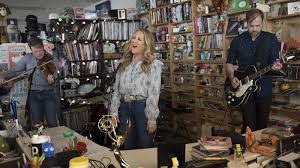
 SOUNDTRACK: LEE ANN WOMACK-Tiny Desk Concert #711 (February 26, 2018).
Obviously I’ve heard of Lee Ann Womack. I don’t know much about her, except that I’ve heard of her, like a lot, and that she’s a country music legend.
I wasn’t expcecting to like this Tiny Desk, but I really like the music of the first song, “All the Trouble.” It’s rocking, the violin (Luke Bulla) is really moody and it sets a great tone. But man, I just do not buy this lyric from her.
If you’re a country singer and I’ve heard of you, you certainly ain’t got all the trouble you’re ever gonna need, that’s for sure. She may sound sincere singing those lines, but I’m not convinced at all.
My favorite part of the song was when the guitar (Jonathan Trebing) and violin played off of each other using the main riff from Phish’ “The Song I Heard The Ocean Sing.”
I also feel like she missed a great opportunity to flip some of the cliched lyrics of the song (and there are many) by making this one little twist:
If you got some good news give me a chance
if you’ve got some good love just put it in my (now, she says “hands,” but the better rhyme is clearly “pants”).
I also find her vowels to be very troubling. The way she sings the word “more” is rather unsettling to me.
I was rather taken with the first verse of the song “Mama Lost Her Smile.” I thought it was personal and thoughtful, but I feel like it was ruined somewhat by the overuse of the title phrase (I didn’t realize it was the title when I heard the line
I ain’t got much to go on / just a box of photographs / but every picture tells a story (ugh her vowel) and every story has two halves /
I keep on separating in before and after piles and somewhere in the middle is where mama lost her smile
I thought that was pretty great, but the overuse of it took away the specialness.
And then this chorus. Why change from “you” to “we” it feels antagonistic.
you don’t take pictures of the bad times / we only want to remember the sunshine
but we don’t live in pictures this is real life / and they’re about as different as black and white
That last line was just painfully obvious.
Of the final song, “Hollywood” she says it is “one of my favorite things I’ve ever written or recorded. I just like the vibe. It kind of takes you to a different place.” Wow, it is so dark, I can;t believe she’s so happy with it because it’s such a bummer song about a couple who have fallen out of love.
i ask you if you mean it you say yes. I knew you would.
either i’m a fool for askin’ or you belong in Hollywood.
Damn.
The blurb says that although she is massively popular and has had commercial success and widespread recognition, “these days, she’s working on the fringes of the genre.”
I find that hard to believe, but it’s not my genre. The rest of the band is Dave Dunseath (drums) and Lex Price (bass).
[READ: February 27, 2018] “Seeing Ershadi”
This story starts with the narrator talking about her work as a dancer. And while that sets the tone somewhat, it really doesn’t have much to do with the rest of the story. Except that while she was injured she watched a film called “Taste of Cherry” by the Iranian director Abbas Kiarostami.
I didn’t realize that this was a real film while reading the story. I have just looked it up and it is very real (and Roger Ebert hated it). The narrator of this story is mesmerized by the story.
The film opens with the actor Homayoun Ershadi’s face. Not much happens in the film (which is what Ebert hated) but the narrator is mesmerized by Ershadi. He is driving an SUV looking for someone. When he finally picks someone up, the man, a solider, eventually flees the car. It turns out that Ershadi (as Mr Badii) is looking for someone to bury him. Badii plans to kill himself and wants to ensure that someone will bury his body. Suicide is forbidden in the Quran, so obviously no one will be an accomplice to this.
The narrator explains that Ershadi was an architect with no training or experience as an actor. Kiarostami saw him in traffic and knocked on his window.
After some time the narrator was in Tokyo on a dance tour. She is certain she sees Ershadi in the museum that she is touring. I really enjoyed the description of the museum (and the slippers) and the crowd of women that she gets stuck with. In fact the whole museum scene was my favorite part of this story.
She tries to catch the man’s attention but fails. She follows him out of the museum, but he is lost for good. She was passionate about meeting him about “saving him.” But with distance and time, this event seems foolish.
When she returned home she talked to her best friend Romi about all this. Romi responded: ” I don’t believe it, the exact same thing happened to me.”
Romi is apparently a very serious person who does not lie, so the narrator wanted to hear his story.
Romi had seen Taste of Cherry five or six years ago. She had also been moved by Ershadi’s face. Romi’s story about why she went to the movie in the first place is frankly more interesting, more personal than the narrator’s. She was going through a very traumatic time in her life.
The narrator says she won’t reveal the ending of the film, but then she does (which is why I assumed it wasn’t a real movie). The ending, which is quite meta and involves revealing the film crew is quite puzzling without having seen the film (or according to Ebert, might actually be puzzling while watching the film).
Romi had been feeling dead inside after the events that she dealt with. She wound up dating a guy who was into really rough sex which was the only thing that made her feel anything. After sex one night she turned on the TV and flipped through channels only to see Ershadi’s face up close. Since she had been flipping channels, she went right past him but as she went back through the channels she couldn’t find him or anything that would explain why he was on TV.
The story jumps forward a year. The narrator is walking past a cinema and sees that Taste of Cherry had recently played there. This made her call Romi. Romi said she decided to watch taste of Cherry again about three months ago. (Ebert is no doubt reeling ta the thought of that).
The second viewing brought up things she hadn’t noticed before. But I’m not sure if they were good or bad for her.
I can’t say much more without giving things away but the story was a weird mixture of fascinating details and kind of flat moments. Which sounds a lot like the movie itself.

 I Just Read About That...
Leave a comment