 SOUNDTRACK: BIG DADDY KANE-Tiny Desk Concert #708 (February 19, 2018).

I remember Big Daddy Kane, of course, although I don’t think I knew any of his songs. As far as I can tell, Kane hasn’t released an album since 1998. But his voice sounds great and he seems pretty content to rap his old hits.
The smooth operator, Big Daddy Kane, still emits that same palpable swag he did as a lyrical heartthrob during his heyday. He strides into the room and fully commands it with his presence.
One of the greatest to ever bless the mic, Big Daddy Kane treated Tiny Desk to an office block party in the true essence of hip-hop. Kane, aka Dark Gable, was a breakout member of the seminal Juice Crew in hip-hop’s golden era during the latter part of the 1980s. He popularized quick-cadence flows and multisyllabic rhyme schemes.
He performed a short set of classics, including “Smooth Operator,” “Ain’t No Half Steppin’,” “Raw” and a bonus freestyle. Through his warm, engaging and devilishly self-effacing style, the pioneer used an interlude between songs to address the intergenerational divisiveness defining rap today and the importance of fans of all ages supporting whatever they like, while “focusing on what’s positive and keeping that in the spotlight.”
The Concert opens with a great drum beat and a funky bass line for “Smooth Operator.” The rather wimpy keyboard riff with the sax is kind of a wasted opportunity to give fuller sound to this song.
It’s interesting that Kane–whose voice still sounds deep and full–keeps the old songs with incredibly dates references like “Freddy Krueger walking on Kane Street.”
Mid song Kane says, “stay right here Ben… gonna make this into a family affair. Are there any smooth operators out there?” They sing the riff. Then, “Let me see whats happening behind me. Jay Dub (John Williams) on sax, is he a smooth operator?” He is. Kane tells him to “Make yourself at home” with a good solo.
While that solo is going on, he says “certain members of the band just can’t wait till their turn (looks at keyboardist who had been playing with the solo). He says, “He’s been with me a long time, he’s the baby of the crew we call him J Minor (Judson Nelson)–most places we play he’s not supposed to be there, he’s not old enough. If I ask you to play like a grown man, how’s that sounds, baby? He plays a smooth solo.
Kane: “I forgot there was another verse. I was having so much fun looking at them.”
We should keep this party going. I saw a couple of these people looking at their watch. Some of you all might be on lunch break I don’t want to mess it up
“Ain’t No Half Steppin” starts off with simple sax and some more dated lines: “Friday the 13th, I’m gonna play Jason.” (Rappers loved horror movies back in the day). He gets the crowd into it: “Say it like it’s 6’o clock Ain’t no half steppin’.”
“Let me hear you once more… I lied, just one more time y’all.”
After the song he says, “I’m enjoying myself. This is all right for real I might fill out an application for a job here next week. this ai’iiht.”
“I’m gonna do one more song and then were gonna shut it down and this ain’t got nothing with y’all getting back to work, I’m starting to get hot in here.”
A great drum beat starts off “Raw” which is followed by that crazy squeaky sax. And there’s this one last pop culture line: “The rhymes I use definitely amuse better than Dynasty or Hill Street Blues.
Mid-song, a cool faster drum beat is added–I love the snare sound Matt Lambert gets and then the whole band kicks of for a great riff on bass and sax to end the song–it’s a shame it ended there as it was really taking off.
People don’t want him to leave, so they do a freestyle. A cool slide bass line from Benjamin Geis and staccato piano. It’s my favorite music of the show. And the speed of his freestyle rap is really impressive. And he (virtually) drops the mic and is off.
It’s a great old school set.
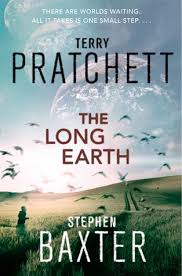
[READ: Summer 2017] The Long Earth
I have read nearly everything that Terry Pratchett has written (I kind of drifted a bit towards the end, but I’ll catch up eventually). Anyway, I was in the bookstore in Bethlehem, PA and saw this book. It’s a series I’ve known about but didn’t know very much about. I decided to check it out to see what it was all about. I don’t know very much at all about Stephen Baxter except that he’s a hard science fiction writer, meaning he focuses as much on the science as he does on the fiction.
So how does this pair–a hard science writer and a comic parodist of fantasy work together? Well, honestly the story is much more Baxter than Pratchett. Although since I haven’t read any Baxter, I guess I can’t say that legitimately, but it’s definitely not very Pratchetty.
Well, maybe some of the character interactions are kind of Pratchetty, but certainly not like any of his Discworld characters. As with any co-writing experience, I wondered how this story was constructed. So I found an interview with Stephen Baxter from around the time they finished writing the fourth and final book
How did the idea for the Long Earth series come about?
The whole thing was basically Terry’s idea. He’d started work on this project and short stories set in this world back in the ’80s but he got stuck with it. He wanted to have a very human, level way to access these words. You don’t need to get there on a rocket ship, you can just walk in. At the same time, the vision for the end was going to be out on a galaxy somewhere.
We’d known each other for years and [about] five years or so ago at a dinner party, Terry [said he] was going through his archives looking for unpublished short stories and things like that and he came across an aborted project from about 30 years ago. We were just talking about that and it just struck me as immediately a great idea because it’s so simple and yet it’s got endless possibilities. By the end of that [party] we already had the storylines and Terry was going to send me the material.
Terry was having trouble seeing so Stephen did the typing and then “We fixed each line and each scene together.”
So that’s that sorted.
Baxter also says “it just struck me as immediately a great idea because it’s so simple and yet it’s got endless possibilities.”
And that is the truth. The story can be summed up pretty easily.
A man creates an invention (The Stepper) that allows one to step into a parallel world that is next to ours. There are a possibly infinite numbers of parallel worlds in each direction (East or West). The worlds that are closer to ours are almost identical to our Earth (known as Datum Earth). The further you go, the greater the differences. But none of them have experienced humanity before Step Day (aside from earlier hominids).
That’s it.
The remainder of the story is how humanity is going to deal with this new vast amount of real estate.
Naturally people try to exploit the real estate by bringing various resources back to Datum Earth. They also learn how to rob places by stepping into the next world, moving to the location you want to be and then stepping back right where you want to be on Datum Earth. The problem with both of these entrepreneurial ideas are several. The basic one s that metal can’t step with you. But also, many people have the same ideas so any advantage that a person may get will soon be lost when hundreds of other people do it. It’s going to be hard to exploit stepping on Datum Earth. Really, the only plan people have is to travel through the earths and start fresh.
Or stay home.
The main character is Joshua Valienté. Joshua is a natural “Stepper.” He doesn’t need the device to Step from one word to the next, nor does he feel the nausea and other side effects that most people feel as they travel. Most of the book follows his exploits.
I love that the front pages show the diagram for the Stepper (which is run by a potato–that has Pratchett all over it). Joshua’s backstory is fascinating–his life in an orphanage and his rescuing hundreds of children when they all stepped at the same time and had no idea what was happening to them. But his natural Stepping ability drew him to the attention of a corporate entity bent on exploring the Long Earth (Parallel Earths that are hundred of thousand of Steps away).
The corporate entity has a ship with an entity known as Lobsang who claims that he was a human reincarnated as artificial intelligence. Joshua is sure that Lobsang is a computer, but Lobsang’s human skills are uncanny. This ship has managed to Step as an entity, meaning everything in the ship can go with them. Normally you can only bring what you can carry (aside from metal).
The novel more or less is an exploratory one with Joshua and Lobsang Stepping through millions of Earths. Not a lot happens, but the novel never grows boring. The interactions between Joshua and Lobsang are often funny. And the writers have infused the Earths that they stop in with just enough differences to make each stop strangely compelling (this must be Baxter’s hard science leanings).
One of the most fascinating things to discover is a humanoid species (which the call elves or trolls). They all seem to be fleeing something and causing havoc wherever they flee to.
But the story is not only about Joshua. There is also the Green family. They are a typical American family preparing to Step. The whole family plans to travel with a large contingent of Steppers. All, that is, except for their son Rod who makes a big deal out of not wanting to step (although in reality he probably can’t). There is some discontinuity with them leaving their son behind to move hundreds of thousands of Earths away, I must admit. We see most of the Green family adventures through the diary of Helen, the daughter. They experience various mild highs and lows until they reach the new community called Reboot on Earth West 101,754.
It is at this earth that Joshua and Lobsang discover Sally Lindsay, the daughter of the inventor of the Stepper. She is more cynical than anyone else. But she has also known about Stepping far longer than anyone else. She also believes that her father has Stepped somewhere far and is trying to not be found. She decides to join Joshua on his travels. Eventually they reach a place that they call “The Gap” – a universe around two million steps from the Datum where the earth no longer exists. They pop into space and there is just void (which nearly kills them). I love that this Earth is believed to have been destroyed by the meteor that killed the dinosaurs-it hit Earth in a more dramatic fashion.
But on the other side of the Gap is where the thing that the trolls are fleeing from actually lives. It is known as First Person Singular and its existence is simply to absorb everything it encounters.
Joshua and Sally decide to return to Datum Earth (with an even faster stepping technique that Sally knows about). When they get back to Earth West 101,754, they learn that a terrorist group (which includes a member that we have encountered) are planning to destroy Madison, Wisconsin (where the Stepper originated–in the introduction, the authors apologize to Madison for any residual harm they might have felt).
As the story closes in on the end it become very clear that the book isn’t going to “end” (the fact that there are four books also tells you that). But the way it ends, with a dramatic moment and then a stunning cliffhanger, is pretty great.
As I said this story is really quite simple, but its the character development and fascination with the possibility of new worlds that really makes the story work. I found that I couldn’t put it down even if nothing was really happening. When things actually started happening about 100 pages form the end, it was wonderfully intense, like a perfectly paced roller coaster.

 I Just Read About That...
The last Pratchett duo novel I read was Good Omens. Which I didn’t enjoy too much… because I went in hoping for Pratchett-y goodness, and only got a watered down version of his humor. It was decent, but I have trouble recommending it.
Did this one work well for you? Would you recommend it?