 SOUNDTRACK: PARAMORE-Tiny Desk Concert #656 (October 2, 2017).
 I had always thought that Paramore was someone else (although I don’t know who). I thought they were a pop punk band. And maybe they were.
But this six-piece incarnation of the band is not pop punk at all.
Indeed, the blurb says, Paramore
captures the moment between rapture and its comedown, the glitter wiped away, left with skin rubbed raw. It’s a record, more than a decade into the band’s career, that not only exposes the sparkling pop that’s always lit Paramore’s songs, but also deals with the ache of growing up and growing apart.
The first song “Hard Times” opens with a keyboard line that sounds vaguely like steel drums. It makes me smile that Logan MacKenzie’s keyboard is about six inches long. There’s slices of jagged guitar, but the chorus is pure pop. The drums (Zac Farro’s drum machine) have an Afro-pop texture and Joseph Howard’s bass plays a few sliding moments that seem very dancey. Although I do like that the song ends with another jagged guitar chord.
Singer Hayley Williams has a really lovely voice. Before the next song, “26,” she say that the new songs are dancey and happy but this song is the most transparent in not covering up the emotions of the record. Hope we don’t bum you out too much.
The song is simply a gentle echoed guitar from Taylor York and William’s exposed voice. And the blurb assures us that Paramore’s quieter songs have never quite shown this depth of understated devastation and determination.
Bummed or not she does encourage everyone in the office to sing and dance along, unless that’s awkward.
The final song, “Fake Happy” has synth drums and more of those steel drum keyboard sounds. The blurb says it’s a soaring anthem to expressing your truest self (and calling out those playing pretend). There’s a groovy bass line and minimal dancey nods. There’s some interesting guitar sounds from both Taylor and Justin York. I like this song, although she tends to fall into some vocal pop trappings that I don’t like, especially in the middle section.
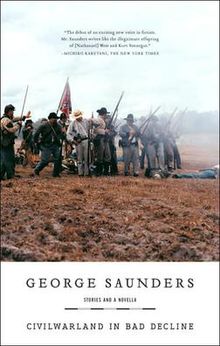
[READ: February 2, 2017] CivilWarLand in Bad Decline
I have been really enjoying George Saunders. I had considered reading all of his published pieces in the New Yorker. And then I realized that they were probably all collected in his books, right? Well, yes, most of his pieces have been collected. Although for this book, his first, there was only one New Yorker story, “Offloading for Mrs Schwartz.”
When I read In Persuasion Nation many years ago, I remembered thinking that Saunders is supposed to be very funny but that his stories really aren’t. And now, after reading so many things about his generosity and kind spirit, I was expecting to get more of that from these stories too. But in both cases, I feel like Saunders was a very different writer. While there is certainly humor in these stories, it is very dark humor and is often surrounded by characters who are incredibly cruel. It makes these stories rather hard to bear sometimes.
CivilWarLand in Bad Decline
I was puzzled about this title from the minute I saw it was the book title. I really didn’t get it. Well, the title refers to a theme park called CivilWarLand (aha!). And the decline is in visitors and sales. Most of the humor in Saunders’ stories seems to come from making fun of brands. This one features the Burn’n’Learn tanning salon and library. The crux of this story is that CivilWarland is being plagued by gangs. The owner of the park wants the actors who play the militia to include live ammo in their weapons. Of course the actors are actors, not violent folks, so that doesn’t go over well. Eventually they find a guy who is not afraid to take matters in to his own hands vis-a-vis the gangs. There’s a side story about actual ghosts haunting the park, which I rather enjoyed. The ghosts interact with the narrator and even tell him that he’s not the man he could be. Later, his wife also tells him off. He can’t get a break from the living or the dead. When trouble comes at the en of the story, what does he have to fight for?
Isabelle
This story made me very uncomfortable. It’s about a guy named Split Lip and his handicapped daughter Isabelle. The local kids (including the narrator) called her Boneless or Balled-Up Gumby for the way her limbs were twisted and useless. The story is full of racism (from both cops and whites being “forced out” by “the spades”). Split Lip even kills a boy–while the boy’s brother watches. The boy seeks revenge. But what will become of Isabelle? The story has a surprisingly sweet ending but the bulk is so violent and ugly that I’m not sure it compensates.
The Wavemaker Falters
This is another story of death. The narrator works at a water park. There is a Center for Wayward Nuns up the street. One of the nuns came unglued and they gave her a free season pass. She nearly drowned one time and the narrator says he won’t have another death on his hands. But the real action of the story comes between the narrator, Simone, and Leon. Leon has an office (on the wall of his office is a photo of him Jell-O wrestling a Jell-O wrestling celebrity). Simone is the narrator’s wife and they haven’t had sex since he killed the boy at the park. Well, the boy was caught in the Wavemaker (a rather gruesome explanation follows), and the narrator did not turn it off in time–he is haunted by that boy all the time. He even goes to the family’s house at night to do nice things for them in secret (the sister thinks it is her brother’s soul doing all the good work). Leon was hired at the same time, but he has saved three people’s lives so he is much more appreciated there. And Simone is well aware of Leon’s achievements….
The 400-Pound CEO
There’s a death in this story too. But first the humiliation. The company that this story is based around is called Human Raccoon Alternatives. They trap raccoons from people’s yards and then relocate them. At least that’s what they claim. Really they bring them back to the office where the CEO bashes in their brains with a crowbar and buries them on site. The CEO is a real jerk (obviously). The narrator, Jeffrey, is the 400 pound guy and everyone at the office is mean to him. But when an outsider spies on them and sees what they are doing with the raccoons, the CEO acts–violently. But Jeffrey gets in the way and in the process he kills his boss. And with the boss missing, he writes a note to the company that the boss has put Jeffrey in charge. Immediately Jeffrey starts implementing wonderful new rules that treat all the employees fairly and actually relocates the raccoons. But some things seem to good to be true.
Offloading for Mrs. Schwartz (New Yorker, September 28, 1992).
I somewhat recently posted about this story,
Downtrodden Mary’s Failed Campaign of Terror
This story is about a woman who works at an interactive museum. She loves the things in the museum and cares for them attentively. But every day 80 kids come in and mess it all up. The main exhibit at the museum is the see-through cow (to provide school children insight into the digestive process of a large mammal). But her supervisor is a real jerk–having her deduct time from her sheet when he has her listen to a presentation of his. And for once, while he was away, the cow didn’t die. The woman is 92 and while every one treats her as old and foolish she has a past (one that includes her husband killing her lover). It also turns out that she is the one who has been killing the cows. In part because she feels bad that they have a Plexiglas side, but also because she hates her supervisor and the death of the cows hurts his career. But if she is caught it’s pretty clear her boss wont look kindly on it.
Bounty
This is the novella (nearly 100 pages). And like every other story in this book it is mean and brutal and ugly and dystopian. This one is more dystopian than the rest though.
The story begins in the night of a national vote. The vote comes in that Flaweds are not going to be freed. Indeed, that night many Flawed are lynched.
Our main character is a Flawed–he has claws. His sister is also a Flawed–she has a vestigial tail. All Flaweds are treated as slaves to Normals. The narrator bristles at all of the work he is meant to do–even though he has a reasonably decent job. But when he screws up he is sent to clean up at SafeOrgy (even in a dark story like this Saunders can throw in some humor). When he accidentally touches a Normal during the SafeOrgy, he is summoned to the boss’ office.
Rather than getting into trouble he learns that his sister was proposed to by a Normal. We met the Suitor earlier and the scenario wasn’t great. This leads the narrator to believe that she will not be taken care of by this man–that she will be treated like a slave. And he sets out to rescue her.
The bulk of the story talks about his escape (by removing his Flawed bracelet) from where he currently lives/works and heading out West where it’s even more dangerous for Flaweds. His journey West is predictably horrible. He’s attacked and beaten. He is made a slave where he is starved.
Later, he gets a job (selling GlamourDivans) and is actually treated pretty well. He finally has sex (with a Normal no less. She is pretty delighted by him until she takes his socks off.
He finally makes it to where his sister is, but what will he learn when he gets there?
~~~
Saunders proves to be a pretty dark writer. There’s heart at the center of his stories, but his characters are so badly mistreated that it is hard to believe he cares about them.

 I Just Read About That...
Leave a comment