 SOUNDTRACK: NONAME-Tiny Desk Concert #609 (April 3, 2017).
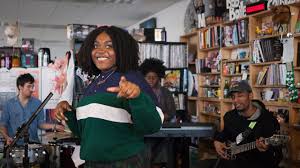 Noname (born Fatimah Warner) is a wrapper and crooner. her voice is pretty and her demeanor is infectiously upbeat. Although I don’t really love her songs, I find her attitude infectious.
The blurb says
It’s in the way she’s able to muster a smile while performing a heartbreaking tale of abortion. It’s those sometimes bleak, melancholy lyrics over brilliant, colorful production.
“Diddy Bop” is a strange mix of gentle music (delicate guitar lines from Brian Sanborn meld with synthesized flutes) and rather vulgar lines: There’s a line “you about to get your ass beat” and lots of “my niggas” thrown around. Phoelix (bass) sings a verse as well. The song is only two minutes long.
After it she says she has watched many Tiny Desk Concerts and she “Just wants to be as good as T-Pain.”
The second song is actually a medley. It begins with “Reality Check” and then segues into “Casket Pretty,” and “Bye Bye Baby.”
She says “Reality Check” is her most straightforward song, but “it would be shitty if you were like ‘damn that made no sense either.'” I normally speak “in like, scramble-think, so hopefully you guys follow it.” “Scramble-think” refers to the clever metaphors she weaves in detailing the many ways she’s dodged destiny.
Akenya Seymour (keys, vox) takes a verse in this song and Phoelix gets some backing vocals.
“Casket Pretty” is quite an evocative expression but she repeats the lyric an awful lot during the song. The drums by Connor Baker are interesting throughout the set, but especially in this song.
She says that “Yesterday” is her favorite song on the tape. It’s the first song she made. It’s vulnerable and honest and she was surprised how much people liked it so she decided she had more sadness and vulnerability for her album.
[READ: January 20, 2017] “Constructed Worlds”
I enjoyed this story very much. It is the story of a girl who is off to Harvard. The story is set in the early 1990s–in the time of Discman and the beginning of e-mail. It even opens with the fascinating line:
I didn’t know what e-mail was until I got to college. I had heard of e-mail, and knew that in some sense I would “have” it. “You’ll be so fancy,” said my mother’s sister, who had married a computer scientist, “sending your e-mails.”
The girl, Selin, has been hearing all about the World Wide Web from her father. He described that he was in the Met and one second later he was in Anitkabir in Ankara.
When she gets to school she was given an Ethernet cable and asked, “What do we do with this, hang ourselves?”
This sense of flat, cluelessness pervades the story and the narrator is so detached that it was an interesting perspective to read about. It also made Harvard sound awful.
When she gets to school, she is living in a triple. Her roommates are already there. Hannah Park is whistling along to Blues Traveler, while Angela, their other roommate had been playing The Last of the Mohicans soundtrack on repeat since she got here. And since she got there first, she claimed the one bedroom and hadn’t come out. The girls agree that they will split the one bedroom in shifts of three.
Hannah tells Selin that she should bring a poster–preferably psychedelic. But they don’t have any, so she buys one of Einstein–Hannah’s second choice. But that poster proves to be nothing but terrible for her (ans she doesn’t even care about it).
The Harvard students hated Einstein–he had invented the atomic bomb, mistreated dogs, neglected his child. There were many greater geniuses than Einstein.
Finally getting sick of the abuse she retaliated “maybe he really is the best and even jealous mudslingers can’t hide his star quality.” Nietzsche would say that such/a great genius is entitled to beat his wife.
Then it was time to sing up for classes. She signed up for a literature seminar. But the professor said her essay was so creative, he worried that she was more creative than academic. She says very little : “I like words.” And then doesn’t get into the class.
She did get into a Film class and an art class called Constructed Worlds. The art teacher is a jerk: His first questions is how old she is. When she says 18 he replies, “Oh for Christs sake, This isn’t a freshman class.” But when he offered her the class she hesitantly took it.
She also signed up for a Russian class. The teacher explained that her name (Barbara) would be Varvara. The students were to take names and a girl named Svetlana said she wanted a different name than that. She wanted to be Zinaida. But the teacher wouldn’t let her. When Selin said that she should be Zinaida, Svetlana agreed, that she would be a perfect Zinaida, but the teacher refused her as well and named her Sonya.
Svetlana and Sonya became friends. Svetlana tells her of a horrifying episode in her past. In Yugolsavia her father was a psychoanalyst. Two of his patients became opposition leaders and had soldiers search their apartments. Fortunately, he had no indictments because he had a photographic memory. Svetlana has a graphographic memory and needs to take notes about everything
We learn a lot about the Constructed Worlds class. In addition to showing slides, Gary talks about artifice. Who selects what we see? Museums, which we think of as the gateway to art, are actually the main agents of hiding art from the public. Museums owned 100 times as many paintings as they exhibited. He told them that they have Harvard IDs and should go into all of the museums and demand to see what they aren’t showing. “Let’s do it” a student shouted.
Eventually they go to the Museum of Comparative Zoology and demand to see behind the scenes. This proves to be mostly torn up taxidermy. But Gary was unflappable–you think it’s any different at the Met?
Svetlana and Selin take the T to the Russian neighborhood in Brookline to see abut renting Russian VHS tapes. Svetlana is far more open, telling Selin that she always imagines the man she will lose her virginity to–what if she knows him already? Selin says she never thought about it. She did wonder on what day she would die but never the question about sex.
We get to the crux of Selin’s problem near the end of the story: In high school I had been full of opinions, but high school had been like prison with constant opposition and obstacles. Once the obstacles were gone, meaning seemed to varnish too.
The final project for Constructed Worlds was an art project. But Gary said they couldn’t use the studio and couldn’t use the school’s art supplies because that was “like life.”
Final exams are after the Christmas holiday break, and we see her home in New Jersey (an amusing scene) and then her return to Boston
As I describe this story it’s very clear that not much happens. But the narrator is strange and engaging and I really loved it. This could easily be a novel and I would love to read it.

 I Just Read About That...
Leave a comment