 SOUNDTRACK: LYDIA AINSWORTH-“Afterglow” NPR’S SOUTH X LULLABY (March 23, 2017).
 I was unfamiliar with Lydia Ainsworth, but I was instantly struck by the setting of her lullaby.
We asked Lydia Ainsworth to perform in Raum Industries’ Optic Obscura installation. Surrounded by dim, long-hanging optical fibers that look like an infinity room of cat’s whiskers, she sings a stripped-down version of the slow-burning “Afterglow,” accompanied only by an upright bass and light percussion.
I’m not sure what the original song sounds like, but this version is moody and intense. The upright bass opens the song as Lydia’s whispered, sensual vocals come forth. She has a beautiful voice and it is especially haunting in this setting. It reminds me a bit of someone else although I can’t decide who.
The starkness of the silence when she stops singing is intense. And I really like the way the song ends, not abruptly exactly, but rather unexpectedly.
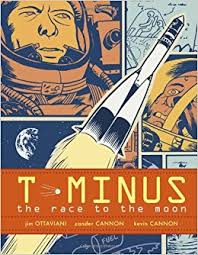
[READ: March 21, 2016] T-Minus
Jim Ottaviani did the amazing graphic novel Feynman, and in the blurb about him in that book, it said that he also wrote T-Minus. Coincidentally I had just brought T-Minus home for Clark and I to read. He read it quickly and said it was very good. It took me a little longer to read (I’m sure he didn’t read all the details) because Ottaviani jam packs this book with interesting facts.
As the title says, this is about the race to get a man to the moon. It begins 12 years before the actual date occurred. And it toggles back and forth between the United States and the Soviet Union.
On the margins of many pages there are drawings of all of the various attempts each country had to get a rocket into the air. The drawings show the design and then at the bottom it states the duration of the flight, the date and some other details. The USSR’s first rocket (1957) lasted all of 20 seconds before exploding. The U.S’s first rocket lasted about 7 seconds.
We meet a handful of people who were instrumental in the design and origination of these rockets. (Ottaviani explains that many of these people are composites of real people involved–if he wanted to include everyone, there would be 400 people in every panel).
Incidentally, the drawings are outstanding. Zander and Kevin Cannon worked together to create some wonderfully stark drawings (rich contrasting blacks and whites) and very distinctive looking characters, I also love that when they got to Moscow, the letters changes slightly and distinctly (and all of the Ns are backwards–a nice touch).
So the story follows the space race over those twelve years (many panels have a small footnote that explains anything unclear in the picture above).
When Sputnik was launched in 1957, it caused a sensation. We see the attempts to condition men (men only, even though one of the characters points out that women are typically lighter than men and just as tough) to become astronauts and cosmonauts. We see some of them die in trials.
We also see that on both sides of the Atlantic, the countries were racing each other to be first. Each victory from the other side prompted more work (with perhaps fewer safety checks).
We see Yuri Gagarin’s flight into space (and his awesome landing). And then we see JFK promise a man on the moon by the end of the decade (and appropriate spit-takes from all involved. So then they have to plan for how to get a rocket into space safely and to then have it return safely.
But there’s also some moments of beauty like when John Glenn becomes the first American to orbit the earth and we get to see the sights from his point of view. The Soviet Union was the first country to put a woman in space–Valentina Tereshkova, who orbited the earth. There’s also the amusing story of Alexei Leonov, who brought very little food and a gun with him in space.
There’s some wonderful mages of Alexei’s first spacewalk (and funny comments from his children)
And then came the series of Titan Gemini rockets in 1966.
The big change seems to have come with the death of Sergei Korolev, the head of design and the driving force behind the Soviet space program. He died from a simple operation and it seemed to sap the energy out of the Soviet’s teams.
As we get less than a year away from the actual date, the story focuses mostly on the American team as they work through the Apollo missions. Like the lunar orbit done on Christmas Day.
And you get to be “inside” of the cockpit with the astronauts, reliving their experiences–it is breathtaking to think about. And to see them just acting like normal people, trying to take pictures of the earth. And the full page image on page 100 is awesome.
The last twenty or so pages are all dedicated to the moon expedition, the take off, orbit and landing. And even though we know the outcome, it was still incredibly dramatic. Like the simple computer errors that they had to ignore! And how much fuel they had left is staggering–something like 17 seconds worth of fuel.
The end of the book includes references and a bibliography including Laika and First in Space for comic books and a series of full length books and videos, including:
Charles A. Murray: Apollo, The Race to the Moon (1989). About which he says “if these stories don’t get you interested in studying math or taking apart your bicycle to see how it works, nothing will.”
I have become a huge fan of Ottaviani (and the Cannons as well). Ottaviani “used to work as a nuclear engineer, but now in addition to being an author he’s also a librarian living in Ann Arbor, Michigan.” That’s a bio I’d love to have! (Well, not necessarily the Ann Arbor part).

 I Just Read About That...
Leave a comment