[ATTENDED: April 13, 2017] Tanya Tagaq performs Nanook of the North
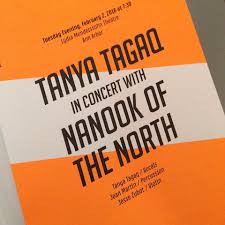 No use burying the lead: I just witnessed something singular. Something unique and unforgettable. Tanya Tagaq is a magical performer and I consider myself lucky to have seen her (even if I wasn’t always looking at her). And to have heard her incredible band live.
Tagaq is an Upik performer who incorporates throat singing into her music. And when she performs, her entire body is possessed by the music. She becomes animalistic, both low and growling as well as high and soaring.
Nanook of the North is considered the first documentary film. Filmed in 1920 by Robert J. Flaherty, it depicts Nanook, a “happy Eskimo,” and his family as they go about their lives. For many people it was their first and only exposure to Native culture. This film has been praised for its documentary techniques, but ridiculed for its patronizing attitude and for fudging reality.
I learned last night that part of the reason some of it was fudged was because his original film was destroyed in a fire and he returned to get more footage–often recreating what happened the first time. [Some Wikipedia details shed some light on his good intentions and controversies–see bottom of the post for a few details].
I first watched Nanook of the North about 20 years ago in a college film class. It was fine–less boring than I imagined, with some interesting moments, but not exactly gripping after 80 years of filmmaking. But with Tagaq’s new soundtrack, the film took on an amazing and powerful component which added intensity, drama and tension to this film.
Tagaq walked out on stage with her band and introduced the movie to us. She said she liked the movie for its beautiful depiction of her homeland, but resented it for basically creating every stereotype we have about Eskimos.
I was delighted by her speaking voice–quiet and fragile–which was so different from her performance which is raw and strong and unrelenting. She made some general comments on unity and love. They were heartfelt and a great introduction to her performance and as an address of the current political climate. And then the movie began.
Each performance that she has done on this tour has been unique. She and the band perform for some 70 minutes, all improvised. But this performance upped the uniqueness because the band was accompanied by a pipe organ. The Kimmel Center’s Fred J. Cooper pipe organ is the 47th largest in the world with almost 7,000 pipes. (For some more interesting facts about the organ, click here).
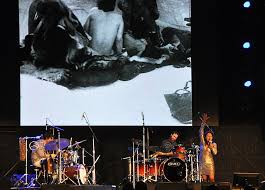 As the movie began, Dr. Aaron David Miller played some of the most incredibly lowest of the low notes on the organ and you could feel the rumble. It was an auspicious beginning.
Typically, her live band consists of percussionist Jean Martin and guitarist Bernard Falaise. And while the organ did not overshadow the rest of the music in any way, it was a very cool additional component.
Then the drums began. For the entire performance, Martin ‘s drums were the unifying component. In addition to a tribal beat that he played for most of the performance (growing and ebbing in intensity), he added great sound effects and percussion. He was also constantly in motion, grabbing different items and, when the movement built-in intensity, hitting cymbals and drums with abandon. I found myself unconsciously tapping along throughout, mesmerized by the drumming.
I also really appreciated that they added natural sounds to the soundtrack as well–dogs yapping, water flowing, babies crying–just loud enough to be heard as if they were naturally part of the movie. It was very easy to forget that this was a silent movie.
But the focus (when not on the movie) was on Tagaq herself. She sang, reaching high octaves, howling, screaming and then incorporating her throat singing. In the introduction she explained that traditionally throat singing was a friendly contest between two women. They sang face to face and performed a kind of call and response. Tagaq does her own thing, obviously. She takes traditional elements but she makes them her own. And it is intense.
Descriptions of this event are pointless. It needs to be experienced. But her music is certainly transportive. We were totally absorbed in her music. It filled the room (which had amazing acoustics, by the way) and was all-enveloping.
While it was hard not to watch the film–that was the ostensible purpose of course–she was also amazing to watch. She is fully into her performance–making fish motions during the fishing scene, getting on her knees and howling–going on a journey and taking us with her.
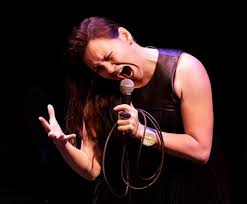 For 70 minutes, the music rose or quieted. From whispered sounds to dramatic explosions–with her voice ranging from glorious heights to animalistic growls. She often employed her intense “breathing”–a pulsing, grunting, moaning rhythm that she could keep up for impressively long stretches and which called to mind all kinds of human sounds–breath, pain, sex–all together.
And as the movie ended, she created some wolf howls that in addition to raising the hairs on the back of my neck, were shockingly authentic-sounding,
When it was over it felt like it had been barely 10 minutes but possibly 10 hours. I was exhausted–I can’t imagine how she must have felt.
We sat pretty far back in what was an audio sweet spot–the sound was amazing. I would have loved to sit closer to see the band perform better (the stage was in semi darkness) but I would have hated to not get the full experience that I had from back there–being able to see the film and her. It was a toss up. But if I ever see her again (and I would see Nanook again or her regular tour), I will certainly want to get closer to really be a part of her visceral performance.
It was unforgettable.
I have seen that Tagaq has been selling out performances across Canada. So the fact that the Verizon Theater was barely half-full was disappointing in many ways. Also disappointing were the two guys behind me who were occasionally talking when they should have been rendered speechless. I need to spread the word about her live shows so that she will be inclined to come back again.
After such an amazing performance, I would have loved if she came out to her merch table to chat. But alas it was not to be. But that would have been icing on an already amazing performance.
Since nothing I can say can possible convey the experience, the closest thing would be to watch this wonderful Massey Hall recording.
Some more info about Nanook
In 1910 Flaherty was hired as an explorer and prospector along the Hudson Bay for the Canadian Pacific Railway…. Flaherty spent 1914 and 1915 shooting hours of film of Inuit life. By 1916, Flaherty had enough footage that he began test screenings and was met with wide enthusiasm. However, in 1916, Flaherty dropped a cigarette onto the original camera negative (which was highly flammable nitrate stock) and lost 30,000 feet of film…. With his first attempt ruined, Flaherty decided to not only return for new footage, but also to refocus the film on one Eskimo family as he felt his earlier footage was too much of travelogue. He returned to the North and shot from August 1920 to August 1921. As a main character, Flaherty chose the celebrated hunter of the Itivimuit tribe, Allakariallak.
But some controversies include:
Flaherty has been criticized for deceptively portraying staged events as reality. “Nanook” was in fact named Allakariallak while the “wife” shown in the film was not really his wife… [the women] were in fact common-law wives of Flaherty. And although Allakariallak normally used a gun when hunting, Flaherty encouraged him to hunt after the fashion of his recent ancestors in order to capture the way the Inuit lived before European influence. On the other hand, while Flaherty made his Inuit actors use spears instead of guns during the walrus and seal hunts, the prey shown in the film were genuine, wild animals. Flaherty also exaggerated the peril to Inuit hunters.
The traders/gramophone scene is played for comic effect and Nanook’s naiveté, but the scene was entirely scripted and Allakariallak knew what a gramophone was.
In his defense, the only cameras available to Flaherty at the time were both large and immobile, making it impossible to effectively capture most interior shots or unstructured exterior scenes without significantly modifying the environment and subject action. So the scenes in the igloo which I wondered about were filmed inside of a three walled igloo designed to fit the camera.

 I Just Read About That...
Leave a comment