 SOUNDTRACK: DONNY McCASLIN-Tiny Desk Concert #590 (January 9, 2017).

Donny McCaslin’s band was responsible for the jazzy music that propelled David Bowie’s final album. As the Tiny Desk blurb says:
David Bowie had long wanted to make a record with a jazz band, and on Jan. 8 of last year, he realized his dream with the release of Blackstar. Two days later, he was gone. Donny McCaslin’s band helped him make that record, and now, a year later, we pay tribute to Bowie and Blackstar by bringing McCaslin’s band
As a bandleader and sax player, [McCaslin’s] put out a dozen albums, the most recent of which is Beyond Now, with musicians Tim Lefebvre on bass, drummer Mark Guiliana and keyboardist Jason Lindner.
Beyond Now was recorded after Blackstar, features a few Bowie covers and stretches the band’s own usual boundaries. For this Tiny Desk concert, you can hear an extraordinary group playing extraordinary music — including an instrumental version of “Lazarus,” from Blackstar.
The band plays three pieces. “Shake Loose” is 7 and a half minutes. The music is great behind the sax—dramatic and interesting. I think I just don’t care for the sound of saxophones as much these days, because I love the bass thumping and the great sounds from the keys but the soloing doesn’t excite me. I love in the middle of the song that there are really cool spacey sound on the keys. And the whole middle section where it’s the keys playing weirdo stuff and the drums keeping a groovy jazz beat–that’s awesome.
So I may be the only person in America who has not heard the whole of Blackstar. I actually don’t even really like the one song I did hear (I don’t care for the jazzy parts). So I can’t compare this six-minute instrumental version to the original of “Lazarus.” I love that the keyboard is playing a very convincing grungy guitar sound. I’m not sure if the sax is doing a vocal line or just playing around, but I love the music for this song a lot.
“Glory” is about the glory of the creation of the beautiful world that we live in “that will hopefully be intact as we move forward.” This is an 11 minute song with all kinds of great swirling keyboard sounds. I really like this song—the bass and keys together are great. And either I’ve grown more used to the sax or its mixed a little lower, but it works so much better with the music. About three minutes in there’s a lengthy trippy mid-70s Pink Floyd echoing synth solo. Which is pretty cool. So overall, I really enjoyed this set. And maybe I need to go give Blackstar a listen.
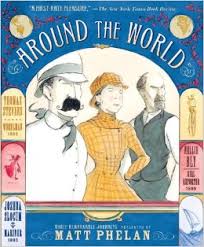
[READ: March 25, 2016] Around
I really enjoyed Phelan’s Bluffton. The story was interesting and I really enjoyed Phelan’s artwork–subtle with delicate coloring and very thin, expressive lines.
This book also contains Phelan’ wonderful artwork and the story (or stories) are also really interesting. For this is a book about three remarkable journeys around the world.
Phelan gives a fictionalized (but accurate) history of the adventures of Thomas Stevens (Wheelman in 1884), Nellie Bly (Girl Reporter 1889) and Joshua Slocum (Mariner 1895).
I hadn’t heard of the two men and I found their stories quiet fascinating. I knew of Bly’s journey but I didn’t know all of the details and I found it equally interesting.
Thomas Stevens
Stevens was a miner. He saw someone riding a penny-farthing bicycle (called the Columbia) and declared that he was going to do something no one else had ever done. He said he would cycle across the United States. I love Phelan’s drawing of him with his giant mustache. And the drawings of people falling off the bicycles are hilarious.
What’s most amusing about his claim is that he had never ridden a bicycle before. So he prepares and tries and gets ready and then on April 22, 1884, he set out along what is more or less Rte 80 today from California to Boston. He brought writing supplies and camped under the stars. And on August 4, 1884 he arrived.
Not bad!
Using this as a stepping stone, he then proposed travelling across the world. And with some financial backing, he headed for England, which had already known bicycles. And then to France and Germany through much of Europe and then he sailed home a hero.
Nellie Bly
In 1888, Nellie Bly had already made a name for herself a fearless reporter (Nellie Bly was awesome). She told her newspaper editor that she wanted to beat the record set by Phileas Fogg (from Jules Verne’s Around the world in 80 Days) and make it around the world in less than 80 days. She was met with resistance but was eventually given the okay–no doubt because of the look of steely determination that Phelan draws on her face.
She sets out aboard a ship. She is seasick for the early portion of the journey and is mocked for it. But she soon lands in England and has to decide whether or not to have a meeting with Jules Verne–it is an honor and yet will put her off schedule. Nevertheless, she accepts only to find out that the Verne didn’t speak English at all.
Once the papers see what kind of a splash she is making, they try to market her traveling outfit–her plaid coat and her hat–to others.
Most of the trip seems rather dull for her. Men try to propose to her but mostly she takes notes and keeps up her spirits.
There is a delay when they reach Hong Kong though–one which could put her off schedule. If only she can get another boat!
Meanwhile back home, readers have become so invested in her story that they are taking guesses as to when she will arrive.
Finally as she nears the end of her trip someone reveals that there is another woman who has undertaken the same trip as her and plans to beat her time as well. She had no idea and in fact, makes a point of saying that she is not racing that woman, she is racing the story.
She completed her journey with a pet monkey and the respect of the world. It took seventy-two days.
Joshua Slocum
Slocum’s story is the most intense of the three. Slocum decided to refurbish a boat and then sail it solo around the world
He refurbished the boat by himself and when his wife declined to come with he, he sailed atone in 1895.
His journey was a perilous one–loneliness, starvation, dehydration, pirates–there were so many things that could go wrong. Not to mention steering at night, but somehow he was able to keep the boat on course.
There’s a flashback to Slocum’s first wife and her untimely death and his regrets because of it. Phelan draws a ghostly vision of his wife on the water–I have to assume her wrote about that in his journal.
When he was done, he returned the ship to the very spot where he had taken it out after a three-year journey.
None of their epilogues are especially happy. While Stevens and Thomas were able to parlay their adventures into books, Slocum decided to return to the sea and was then never heard from again.
I really enjoyed this book a lot, and Phelan’s art is, as always, quite beautiful.

 I Just Read About That...
Leave a comment