[ATTENDED: March 24, 2017] Pippin
 Pippin has been Sarah’s favorite musical for years. And as a special treat, she is guest co-authoring this post with me. I have highlighted her part in a Pippin-inspired purple.
She has seen it once before in a decent sized production. And we saw it together at a community theater version. Strangely, I don’t remember much about that production (I was more fascinated by the building). Anyhow, this touring production of Pippin is the newly redesigned version.
As I said I don’t remember all that much about the previous version, but I can tell you it was nothing like this one. This new version was utterly spectacular, with an emphasis on spectacle!
SD: You know how the books from your childhood or the movies you watched over and over as a teenager are the ones you know by heart? Pippin is like that for me. My mom loved this musical and I grew up listening to the soundtrack (Original Broadway cast recording) over and over again. I know every bit of the album (and when I grew up and got a dog, I named him Pippin.) The thing about knowing a show by the soundtrack and not the performance is that you might make up what some of the plot is. I remember being surprised at the previous performances I’ve been to (one very good, one, as Paul said, not so great community theater) to find out what the songs really meant in context! Anyway, the songs and the show are special to me and I couldn’t wait to see this.
The story of the musical is fairly simple.
Pippin is the son of King Charlemagne (that much is true, but the rest is totally made up). Pippin has just come back from college, but he is full of ennui. He knows that he is an extraordinary person (he even sings about it), and is certain that there has to be something that will fulfill him. Pippin wants to impress his father so he insists that he join his father and step son in fighting the Visigoths. Charles reluctantly agrees but Pippin finds it less than satisfying. From there he runs to his grandmother who tells him to enjoy the physical pleasures in life–which he does! But that proves empty as well. Finally seeing how much of tyrant his father is he decides to fight tyranny and take over as King. But he finds that he has to resort to tyranny as well and asks for a do-over.
What’s left? Art? No. Religion? No. No No No. All that is left is despair. While lying in the road, Catherine finds him. She is a widow with a son and she tends to him. He is reluctant, but eventually comes around to her care. He spends a year with her, fixing the house, tending the farm, doing very ordinary things. But he is extraordinary! He can’t live a life like that. How can he make his life (or death) special?
Fairly straightforward, right? Well, this production takes this story and tweaks it in an amazing way.
The story has always been set up as a kind of performance–there is a character, Leading Player, who talks to the audience and tells us that this is all a production–a stage for Pippin to show off his life. And there are many opportunities for her to break the fourth wall–often humorously, but not always.
 Leading Player (wonderfully played by Housso Semon–she really has the charisma (and voice) needed for that role) introduces us to the show. And as the curtain drops, revealed is a fantastic circus set. There are acrobats and high flyers. A man walks down a flight of stairs on his hands, people jump and twirl. There is so much going on it’s impossible to take it all in. Then the players line up in the traditional style of spelling out “Pippin” but using hoops for the Ps. And as the song ends, Pippin jumps through the hoop of the P and the show starts with a bang!
SD: I loved seeing this because it looked just like the picture on the album cover.
Sarah and I love Cirques and acrobats and all that so it was great to see these routines used in a plot-driven narrative. And the performers were all great. They are apparently from Les 7 doigts de la main (7 Fingers of the Hand) a Montreal based circus troupe.
But on to the story:
King Charles has a hilarious part–loving battle but also loving to dance and sing, it seems. With great lyrics like:
I’m certain the majority
Of blood that you will spatter’ll
Be theirs, with just a minimum
Of damage that’s collateral
But we know for success
We must always pay a price
That’s why for my success
You must sacrifice!
and this great ending rhyme:
A little rule that ev’ry leader knows by heart:
It’s smarter to be lucky than it’s lucky to be smart
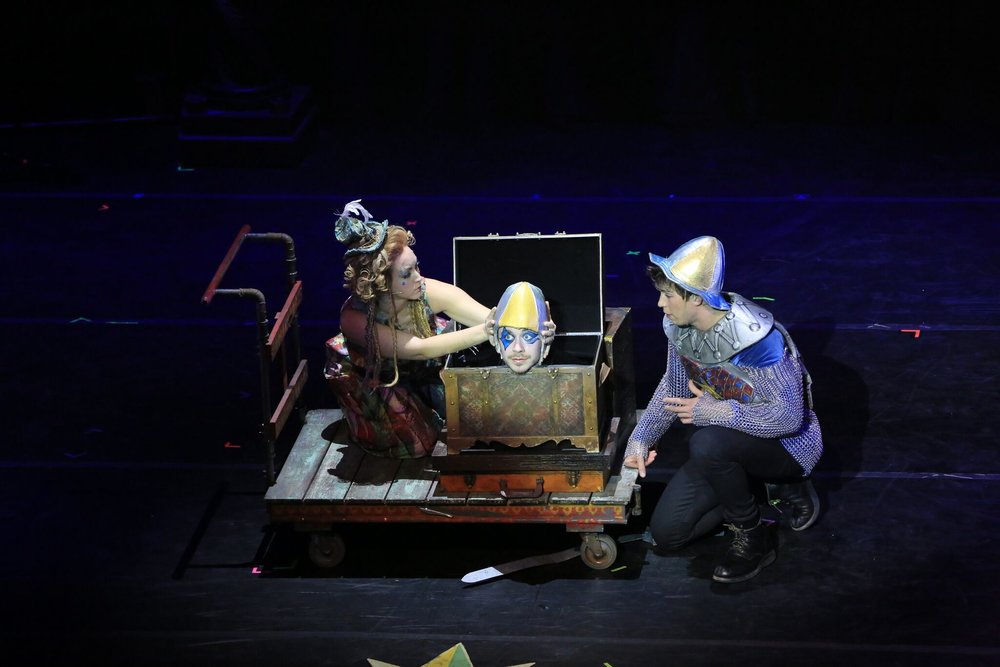 The stage set up for this song was mesmerizing with all of the soldiers lined up, legs akimbo, in wonderful costumery. The spectacle is foiled by Pippin’s clumsy attempts to seem military. If the show wasn’t great already, the battle scene was remarkable. They used the entire set for the acrobats to do their thing–in a kind of slow motion. And then. And then. The first moment of magic–the talking head of a dead body. It is wonderfully done–and Sarah and I still aren’t exactly sure how they did it.
Pippin’s stepmother is also fantastic with her creepy incest-ish dance sequence with her son and her wicked line: “After all, I’m just an ordinary housewife and mother, just like all you housewives and mothers out there.”
His grandmother, Berthe, has the most infectious song of the show–and she implores everyone to sing along to the chorus. She is also hilariously sexual. And, in a new development, she does an impressive high trapeze/swing bit (which is why it was pretty obvious that Berthe the actress wasn’t an older actress).
The following scene of Pippin’s slide into debauchery is incredibly over the top with bodies and cages and more bodies and, wow. There were many kids in the audience and I have to wonder how much of it went over their heads.
When it’s time for Pippin to take over as King, there is a pretty shocking scene to end Act 1–with some cool levitation magic. And then when Act 2 opens there’s more magic to reverse what Pippin has done. This “magic” was not up close and could very easily have been done in ways that we simply couldn’t see from far back, but it was still pretty great looking.
Incidentally, when Act 2 began, the cast members ran up and down the aisles, doing stunts in the aisles–one person bopped the lady in front of me on the head as she ran past. It was really fun–I was especially amused at the usher who had to scamper out of the way before she got trampled.
When Pippin decides to take up art, there’s a great line (clearly recently added) that when the King plans his new budget, arts are the first thing to get cut. Incidentally, during the death to tyrants chant. The villagers chant Death to Charles, Death to Charles and Sarah and I both thought we heard Death to Trump at least once.
Catherine’s introduction is very funny, with Leading Player doing a grand introduction only to see it foiled by Catherine’s lack of skills. Then, when Catherine finds Pippin full of despair on the side of the road, Leading Player is there to instruct Catherine in how she should be acting. Leading Player is quite concerned that Catherine doesn’t realize that she is just another actor in Pippin’s life–she shouldn’t be falling for him. But she clearly is, and Leading Player is pretty angry about that–mostly for comic effect. But I thought Catherine was a huge highlight among the actors. She was played by Savannah Sprinkle and went from love struck to annoyed to sweet to angry to quite funny very easily and convincingly. And her song–where she holds a note longer than the orchestra was done with great comic flair.
Catherine’s son Theo (and his duck) was played by a little boy and he has some pretty unexpected lines–“a dumb ass” here and a “bite me” there.
The farm scene was hilarious with the actors dressed as chicken and as pigs and once again there was so much going on it was impossible to watch it all. And then comes the romantic moment between Pippin and Catherine. They are hidden under sheets and two acrobats are doing suggestive things–throwing their bodies around each other. They indicate failure (humorously) and then success. And the way they showed success is hilarious and amazing (in terms of acrobatics) at the same time.
Pippin seems happy–until he remembers his extra-ordinariness. And that’s when the Leading Player convinces him to do something spectacular as a Finale. From the very beginning she has promised the audience a Finale we would never forget for the rest of our lives. It is even alluded to twice when one of the acrobats come out with a torch–and he is told he has to wait till the end.
I genuinely wondered how they would do this unforgettable finale–there was so much other magic going on, it could have been rather shocking. It really was a dramatic scene done very well. But that’s not exactly the end
I found this fascinating: the ending of the musical is different from how it was originally written. There was a coda attached to the story in 1998 (the show was written in 1972). It adds a whole new dimension to the story, and if Wikipedia is to be believed, the show’s creator Stephen Schwartz prefers this “new” ending to be used.
The show was absolutely incredible. I was enthralled from the opening. And since I knew the music from Sarah playing the soundtrack, it was really fun to be able to hum along to the melodies. I would totally see this production again. And I’m curious now to see the more traditional version to see just how different it is.
SD: I truly loved this performance. The music was outstanding and very true to the original. The changes that I did notice were not jarring and sounded good. The costumes and set were so cool. I loved the cirque aspect. As Paul mentioned we’ve been to a lot of cirques in the past 10 years or so (in fact, we were at the State Theater not too long ago seeing Cirque Eloize, a terrific French Canadian troupe) and I really enjoyed seeing it incorporated into this. I imagine that if you are not used to cirques you would have been extra blown away by seeing people doing daring feats on dangling fabric and contortionists and acrobatics. I was delighted at how perfectly it meshed with the music and conceit of the show. I was also delighted at the choreography, which is listed in the program as the choreographers name “inspired by Bob Fosse.” The choreographer was the co-creator of the Broadway show Fosse, and Fosse was the original choreographer for Pippin, and so overall it just felt true to the original with a bit of a fresh spin. The Lead Player was fantastic.Overall, it was an amazing show, truly special, and Broadway quality (without the hassle or price of Broadway!)Thank you for taking me, Paul!

 I Just Read About That...
Leave a comment