 SOUNDTRACK: IMANI WINDS-Tiny Desk Concert #277 (May 29, 2013).
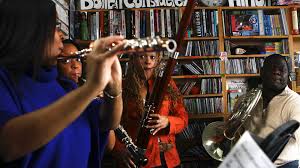 For some reason this video and audio has been removed from the NPR site (no explanation is given). But I found it elsewhere and was able to really enjoy it.
But they have left up the blurb:
When Igor Stravinsky began composing The Rite of Spring, his ballet for vast symphonic forces, he could hear the music in his head but couldn’t quite figure out how to write it down. It was just too complicated.
Today, 100 years after The Rite‘s premiere, the fearless musicians of Imani Winds make it all sound remarkably easy, given that they’ve condensed Stravinsky’s massive walls of sound down to just five instruments: bassoon, clarinet, flute (doubling on piccolo), oboe and French horn.
Make no mistake: Many of the jagged rhythms and crunching chords remain viscerally intact, albeit on a more intimate scale. As the group huddled behind Bob Boilen’s desk, bassoonist Monica Ellis noted the opposing ratios, saying, “It’s apropos in some strange way that we are playing one of the most massive pieces in some of the smallest instrumentation in one of the smallest settings that it could possibly be played in.”
The setting might be small, but in this clever arrangement by Jonathan Russell, we learn that a wind quintet, when called upon, can make a mighty and sonorous wail. Just listen to how the Imanis cap off “Dances of the Young Girls” with the entire quintet in full cry (at about 4:30 into the video). The bassoon repeats a fat bass line while the clarinet runs its snaky scales. The piccolo, in piercing chirps, serves as a foil to a frenzied oboe and snarling “whoops” from the French horn.
But not everything in The Rite is all pound and grind. Stravinsky’s transparent introduction, almost impressionistic, is a fluttering aviary of winds — even in the original — with individual colorings for each instrument. It’s all rendered beautifully here by Imani Winds, musicians brave enough to play David to Igor Stravinsky’s imposing Goliath.
This concert is fascinating to watch (and listen to) because even though this piece is familiar (to me) in theory, it’s apparent that I don’t really know it. And I can see why this piece was so controversial when it came out–it is weird and chaotic and almost random at times. I imagine that seeing it as a ballet might make it more cohesive, but it’s still pretty out there.
I love that the bassoon seems to be the primary instrument–one that doesn’t typically take center stage.
The group breaks up their selections into three primary chunks.
Selections from The Rite of Spring:
For “Introduction” the bassoon is the primary instrument playing the initial melody. Then the clarinet and oboe give the whole thing an unsuaul sound–to say the least. The French horn actually works as the the bass for this part. It’s also neat watching the flautist switching between flute and piccolo. I’m not sure when the second part “Augurs of Spring” begins, but I assume it’s when the bassoon repeats that initial melody and then the French horn plays a staccato bass note. The music sounds kind of threatening but whimsical at the same time.
Somewhere in here “Dances of the Young Girls” begins. I assume once the piccolo starts chirping and swooping. And then the band grows very loud before abruptly stopping.
The second segment she describes as incredibly picturesque. “Ritual of Abduction” begins nosily with almost total chaos from all the instruments–the piccolo stands out as sharp and piercing. As with the other segments, I’m not sure when “Spring Rounds” begins, but I have to wonder if this is when the music seems to go circular and then slow down. There are low notes from the French horn while someone is playing accent notes that sound, not off, but dissonant–providing stark contrast with the rest of the slow movement. There are some blares of music from the French horn as well.
I’m guessing that “Dancing Out of the Earth” begins with the fast bassoon melody: up down up down up down up down with trills and swirls from the flutes and clarinet. It rises and rises very dramatically and then stops.
They tell us that it’s not possible to play the entire ballet so they have taken the “greatest hits” and for this show it’s the greatest hits of the greatest hits. Consider it a deconstruction with five instruments. But it still evokes the spirit of this sacrificial dance.
She talks about how controversial this was in 1913, “when ballet was meant to be about… I was going to say flamingos…. fairies swans, the other water animals.” This is the final moment the virgin who sacrifices herself dances herself to death. And they are going to exemplify trombones and timpani and all that loud stuff (the French horn player laughs and says “Grr I am trombone”).
“Sacrificial Dance: The Chosen One” begins with a three note melody–again it is somewhat threatening. There’s lots of little fast runs by the French horn with accents from everyone else. It stops dramatically at one point and then resumes with so many different melodies. And then comes the surprise ending with a rising flute line and then a low end from the horn.
Without taking away anything from Imani Winds, I ‘m sure this performance doesn’t do the whole thing any justice. But it is amazing to imagine how much more there is to it. And it is amazing that these five instruments can evoke so much. It’s an uncomfortable and somewhat shocking first listen. It’s amazing that is over 100 years old, although it sounds so contemporary.
I don’t know why it’s not on NPR any more. I found it on YouKu (whatever that is). I have been able to watch it twice but on two other times I was unable to watch it. So keep trying, it’s worth the effort.
[READ: May 5, 2016] The Boy in the Dress
David Walliams is best known (if he is known at all) as the tall one on the sitcom Little Britain.
I had no idea he wrote books (he has done over half a dozen children’s books), and I was happy to start with this, his first one.
This book is illustrated by Quentin Blake, who is best known (if he is known at all) as the illustrator for the Roald Dahl books. So his simple, somewhat sloppy, style might look familiar.
The story is, as the title suggests, about a boy who wears a dress. And the story is very funny–not because it makes fun of him for wearing a dress, oh no. In fact, I love the story for going out of its way to show that it is normal that a boy might want to wear a dress.
The story opens on Dennis (the main character) and his depressing household. He lives with his brother, who beats on him, but also plays footie with him. There’s also his father, who has been really depressed since the boys’ mum left.
Their dad doesn’t do much. He works, he eats (a lot) and he watches telly. And, most importantly, he wants nothing in the house to remind him of his wife. So the kids don’t even have pictures of her. The only time the three of them have any fun together is playing soccer in the back yard (their dad is the goalie).
Actually, Dennis does have one picture of her. He saved it from the fire when his dad burnt them all. That’s just one secret that he keeps from his dad. The other is that he just bought a Vogue magazine.
Dennis really likes looking at the dresses in the magazine. He thinks the women are very pretty and their clothes make them look all the prettier. There’s a girl in his school, Lisa, who makes him think of the models in the magagzine. And he has a major crush on her.
They both get detention together one day (their headmaster is a real hard-ass and doesn’t even let them have a soccer ball at school). While they are in the classroom, Dennis sees Lisa drawing dresses and other clothing designs. Dennis is fascinated and tells her they are beautiful.
And they bond. She is thrilled to have someone to share her ideas with and he is thrilled to be near her. She invites him over so he can see the dress she’s working on.
That weekend he goes to her house (if the other boys knew they would be so jealous!) and she shows off her beautiful orange sequined dress. They look at fashion magazines and have a great time. Before he leaves, she suggests that the dress might look really good on him. He is secretly thrilled, but actually scared and so he runs off.
But the next time he goes over, he tries on the dress and he finds it fun and liberating. So he tries on all of her dresses. And they have an even greater time together.
Then she ups the stakes–maybe he should wear them in public and see if he can “pass.” He is reluctant but he agrees, and so she makes him up and tells him to pretend to be her French pen pal, Denise.
And things spiral a bit from there. Like, what if he tried to wear a dress to school? Well, in addition to being against dress code, how would the headmaster react if he found out?
There are some very very funny moments in this book. I loved when the narrator interrupted the story to talk about Dennis playing soccer. He says that Dennis was “the team’s number one… shooter? Sorry, reader, I must look this up. Ah, striker. yes, Dennis was his team’s number one striker, scoring over a million goals in a year. Excuse me again, reader, I don’t know much about soccer, maybe a million is too much. A thousand? A hundred? Two? Whatever, he scored the most goals.”
I also loved that when his father hears about him wearing a dress, he says that he must stop watching that show “Small England, or whatever its called where those two idiots dress up as ‘laydees.'” (If you haven’t watched Little Britain, I encourage you to–although it’s not for kids).
I also loved that Dennis’ best friend is a Sikh boy named Darvesh. Darvesh is too young to wear a turban. He wore a patka, a bobble hat type thing that kept his hair out of his face. That’s because Sikh men aren’t supposed to cut their hair. (This is probably more than most kids will ever learn about Sikh culture). Dennis asks if he feels different because he wears that patka, and he says he did at first but not anymore. And Dennis says he doesn’t care either.
I loved that Raj, the shop owner, was always trying to get them to buy deals–3 for the price of 2? 7 for the price of 5? 11 for the price of 8? “Dennis only got Ds in maths, so he wasn’t sure if that was a better offer or not.”
And I loved all of the big twists at the end. Both from the headmaster (and Raj) and in the soccer game. The book was a lot of fun and was really sweet and open minded.
I’m looking forward to reading the rest of his books.

 I Just Read About That...
Leave a comment