Feeds:
Posts
Comments

Archive for February, 2017

melvin3-cover_SOUNDTRACKCREOLE CHOIR OF CUBA-Tiny Desk Concert #192 (February 6, 2012).

creoleThis concert was something of a surprise for me.  The blurb seems to think that it should be a surprise, especially if you are familiar with Cuban music.  I’m not, so I’m even more surprised.

Just when you think you know Cuban music, along comes the Creole Choir of Cuba. This group sprang from the ashes of Grupo Vocal Desandann, a small vocal outfit created in the late 1990s to celebrate traces of Haitian culture in eastern Cuba.  That history dates back to the late 18th century, when slaves from Haiti were delivered to Cuba to harvest sugarcane after successful slave revolts in Haiti. A long-lost culture was revitalized by the group through music performed largely a cappella and entirely in Haitian Creole.

As with other forms of music associated with the African diaspora, The Creole Choir of Cuba’s work resonates with songs of resistance and celebration of community life, which offered hope and relief from the bitter realities of slavery.

The choir sings three pieces.  And it’s cool the way it is a choir for certain, but that they throw elements into it that are not normally associated with choirs.  For “Marasa Elu” their voices are beautiful, with a great bass voice underpinning the soaring lead voice.  It’s fairly astonishing that she starts to cry at the end of the song (whether fake or not it’s hard to tell).

“Ayiti Krye” has a different lead singer with a very different voice.–although the rest of the choir still sounds great with her.  It comes as quite a surprise about half way through the song when the drums and percussion come in–it really changes the feel of the song and of this choir.  Suddenly the piece is a more dancey song, especially as the percussion picks up speed.  A guy with a wonderfully raspy voice takes over lead.  And the rest of the group really starts to get into it–dancing and singing a beautiful backing vocal that sounds much less like a choir and more like a Cuban dance song.

For “Lumane Casimir” the first singer is back.  There are quiet congas keeping the beat.  While the backing vocals sound a lot like a choir, the lead singer sounds more like a conventional singer.  By the end, they are having a ton of fun and she invites two of the audience members to dance with her (including Felix, the host).  And as any music like this should, the end of the song introduces a whistle keeping a beat.

This is a very different kind of choir–at once sacred and fun.

[READ: January 22, 2016] Melvin Monster Volume 3

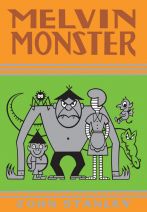
Last year I really enjoyed the Moomin books which Drawn & Quarterly reprinted.  Another artist that D+Q has reprinted is John Stanley.  And they have made the appropriately titled The John Stanley Collection.  This collection is somewhat confusingly labelled because there are collections of different characters (Nancy, Tubby, Melvin) each with multiple volumes, and it seems like maybe they are supposed to go in a certain order.  And really it’s not that hard to figure out once you know the way it works, but it’s a but of puzzle if you see only a few books on the shelf at the library.

These books were originally printed as comic books.  This book contains the final Melvin Monster comics.  The title page says “Collected from the issues seven to nine of the Dell comic book series”  And D+Q has retained that look perfectly.  Even the paper that they have used for this beautiful book looks like comic book paper (although it is very heavy stock).

In the first issue of the book, Baddy tries to get Melvin a job as a babysitter.  The baby is actually a huge giant which leads to all kinds of amusing scenes of Melvin fleeing from the giant.  Although Stanley was never concerned about being PC, the fact that he set his strip in Monsterville certainly allowed him to get a way with a lot of rather un-PC dialogue.

I’m not sure why Stanley only made nine issues (if it was Dell’s decision or his), but there’s a lot of repetition in the premises.  Melvin trying to go to the school and Ms McGargoyle not allowing him in is a very common joke.  Although in fairness, she does think up many new ways to keep Melvin away.

Little Horror is always a fun character.  In this one she does a spell which turns Melvin into a half frog.

There’s a joke about Cleopatra, the family’s alligator, trying to eat him. And the one with Damon constantly giving him bad advice would be funny whether they were monsters or not.

“Blackout” is an interesting strip as it shows Baddy getting ready to watch wrestling –“the first four rows of human bean lady fans armed with cement filled handbags an shish kabob skewers.”

Book 8 opens with “Supermonster” in which a huge monster living nearby is getting ready to destroy Monsterville.  And it’s up to Melvin to help out.

I enjoyed seeing him integrating snow into a few of these strips (although not sequentially in any way).  There’s a good one that involves digging to the school.  There’s a short one that involves Little Horror breaking ice with her high-pitched shriek and another short one with a giant snowball (that I don’t quite get).

Speaking of un-PC, there’s an entire story that involves a Native American totem pole monster–I guess since it’s a monster its okay, although the way it talks is pretty awful.

Book 9 starts with a monster that frightens Baddy.  I enjoy that Baddy is actually quite a coward despite his size and demeanor).

Little Horror returns with a broken magic wand which is pretty fun.  The punchline where a tiny Baddy is afraid of Mummy is outstanding .

I also really enjoyed the way that McGargoyle got rid of Melvin in the final schoolhouse joke–by having him learn C-A-T and B-A-T and then telling him he graduated.  Of course Melvin redefines high school for us all.

The final strip in the book is the one I knew from the D&Q 25th anniversary book.  In it, Melvin drinks a potion that turns him into a normal-looking boy. Which would of course freak out the whole family.

I also like that the final pages of this book include all of the original covers from the Dell comics (12 cents each!)

I’m fascinated at the publishing schedule of these issues

  • Apr-Jun
  • Jul-Sept
  • October
  • December
  • July
  • October
  • January
  • Apr
  • May
  • August

Perhaps the most interesting thing of all though is his biography which states that John Stanley “bitterly left comics sometime in the late 1960s never to return.”  Woah, I want to hear more about that!

Maybe when I read the Nancy books.

Read Full Post »

[ATTENDED: February 4, 2017] Seth Meyers

sethI’d always liked Seth Meyers on Weekend Update, but I never thought all that much about him beyond that.  But when he started hosting Late Night, I realized that he was really really funny.  And in the past year or so he has been outstanding.  Whether political or personal, his jokes are usually right on the money.  And, even better, when they fail, he knows how to make fun of himself and his writers perfectly.

So, when I saw that he was going to be doing standup at MPAC, I grabbed tickets pretty quickly.

This event wasn’t on the MPAC main calendar, because it was listed as The Drew Forum Speaker Series.  I had no idea what this was, but I didn’t care, I wanted to see Seth.

When the show started, a woman, presumably from Drew came out and gave a pretty lavish introduction–atypical for a standup.  And she said that other people who have spoken in this series include Jon Oliver and a guy from Fox whose name I won’t mention.  And then I got worried that this was some kind of Q&A panel or something like that.

But it wasn’t.  It was Seth doing standup. But, I have to gripe that his set was really short.  See the end. (more…)

Read Full Post »

melvin2-cover_SOUNDTRACK: GLENN JONES-Tiny Desk Concert #188 (January 23, 2012).

glennI’d never heard of Glenn Jones.  The blurb says that he only recently took up the banjo (which I assume means he has played the guitar for a long time?).  Also, how funny is it  that there are two banjo players in a row.

Jones plays 3 instrumental pieces  “Tinka Marie” is a very pretty banjo instrumental (although I can’t help but feel that his high string is slightly out of tune—I find it a little jarring throughout the song).  The banjo also sounds very compressed or tight or something.  It’s unusual especially when compared to the expansive sound of the guitar in the other two songs.

Before “The Great Pacific Northwest,” he says that if he plays it right, “Mt. Rainier should burst right through the floor of this room.” He has a very interesting playing style.  He has capoed the three bass strings, but not the higher strings.  He then plays chords up and down the fretboard (leaving the capo where it is).  The beginning of this song is a series of slowly played chords, which allow each individual string to sound.  Then it picks up as he begins playing fast finger-picked (with a  thumb pick for the bass strings) melodies.

“Of Its Own Kind” continue with that half capo style and finger picking.  It has a really lovely melody, as do all three.

[READ: January 17, 2016] Melvin Monster Volume 2

Last year I really enjoyed the Moomin books which Drawn & Quarterly reprinted.  Another artist that D+Q has reprinted is John Stanley.  And they have made the appropriately titled The John Stanley Collection.  This collection is somewhat confusingly labelled because there are collections of different characters (Nancy, Tubby, Melvin) each with multiple volumes, and it seems like maybe they are supposed to go in a certain order.  And really it’s not that hard to figure out once you know the way it works, but it’s a but of puzzle if you see only a few books on the shelf at the library.

These books were originally printed as comic books.  The title page says “Collected from the issues four to six of the Dell comic book series”  And D+Q has retained that look perfectly.  Even the paper that they have used for this beautiful book looks like comic book paper (although it is very heavy stock).   (more…)

Read Full Post »

melvin1-cover_SOUNDTRACK: DEBASHISH BHATTACHARYA-Tiny Desk Concert #319 (November 12, 2013).

I like how the blurb for this Concert begins:

You’ve probably never seen or heard an instrument like this. The Hindustani slide guitar is the creation of Debashish Bhattacharya, whose creation pairs his first love — a Hawaiian lap steel guitar, a gift from his father when he was only 3 — and the sounds of India. You can see the similarities to a lap steel guitar, as Bhattacharya lays the guitar across his legs, sliding a metal bar to create the fluid, almost vocal melodies. The additional strings (and lack of frets) allow him to slide easily between notes, in the process creating a sound that resonates and drones while remaining attuned to his Calcutta home.

It’s a pretty cool instrument and does evoke Indian sounds without necessarily sounding entirely Indian.

His music incorporates a good deal of North Indian (Hindustani) classical music, but you can also hear the blues pouring out from this stunning creation. I first met Bhattacharya 17 years ago when he was touring with other great slide guitarists, Bob Brozman and Martin Simpson. In those 17 years, his music has become even more astonishing, and his instrument refined even further. This trio includes his daughter (Anandi Bhattacharya) on vocals and his brother (Subhasis Bhattacharjee) on tabla.

He plays two lengthy pieces.  It’s clear that the three of them are totally in synch with each other.  He often plays off of his daughter as she sings and he follows her (or vice versa).  He is constantly kepimg an eye om her to see what will happen next.  It’s cool watching him play the drones throughout as well.

“Raaga Khamaj” She sings beautifully.  I love the way the little finger taps can create such a great expressive sound on the tabla, but then he really wails later.  Two thirds of the way through the song almost stops entirely and then he switches to a really funky riff–its a great transition.  At times he’s almost scratching the strings making even more interesting sounds.

There is some tuning between songs and then “O My Beloved!/Pillusion” begins.  It’s more mellow overall, goalmouth the middle has an absolutely wild guitar solo which has him sliding his slide all over the place.  It’s pretty wild

The current album and some of what’s played here today can be found on two different records, the first with guitarist John McLaughlin and Dobro master Jerry Douglas (titled Beyond the Ragasphere) and the second with his brother and daughter (titled Madeira: If Music Could Intoxicate). These are brilliant recordings — and a good place to start exploring more from this unique artist after his intoxicating Tiny Desk Concert is done causing your jaw to drop.

I really enjoyed this set a lot and would love to check out his studio records to see what those sound like.

[READ: January 19, 2016] Melvin Monster Volume 1

February starts children’s month here.  Partially it’s because we can all use the good messages and kindness that children’s books offer.  But also because some of the books that I’m going to post about have been sitting in queue for over a year.  So let them see the light of day.

Last year I really enjoyed the Moomin books which Drawn & Quarterly reprinted.  Another artist that D+Q has reprinted is John Stanley.  And they have made the appropriately titled The John Stanley Collection.  This collection is somewhat confusingly labelled because there are collections of different characters (Nancy, Tubby, Melvin) each with multiple volumes, and it seems like maybe they are supposed to go in a certain order.  And really it’s not that hard to figure out once you know the way it works, but it’s a but of puzzle if you see only a few books on the shelf at the library.

These books were originally printed as comic books.  The title page says “Collected from the first three issues of the Dell comic book series”  And D+Q has retained that look perfectly.  Even the paper that they have used for this beautiful book looks like comic book paper (although it is very heavy stock).

So the premise of this strip is that Melvin Monster is a nice, good boy.  But he is raised by literal monsters.  Melvin wants to do what normal human kids do, but his parents Baddy and Mummy want him to be more disrespectful and monstrous.

The characters are Melvin Monster, Baddy (his father), Mummy (his mom) and Cleopatra their pet crocodile who wants to eat Melvin.  There are a few other recurring characters as well, like the witch and

Even though these books were first, I read them second.  And I have to say I enjoyed the long form of these stories a bit more than the short stories of the later issues.  Although interestingly the very first strips are short and don’t establish the character at all. They are just thrown right on to the page.  Well, it does actually establish that Melvin is a disappointment to his Baddy because he wants to go to school (his father played hooky for 8 years straight).

The next strip sees him going to school and other monsters trying to beat him up for wanting to go.  That’s when his demon guardian Damon shows up, although he calls him Medwick rather than Melvin–this mixed up identity results in some good jokes later on.  Ultimately Melvin winds up accidentally blowing up the school which makes his parents very proud.

The next strip continues right where the previous one left off, with Melvin sailing through the air after the explosion.  He winds up in Human Being Land where everybody treats him very badly–and he thinks it’s so nice that they want him to feel at home.

The next book focuses on the door in the cellar. His parents get mad at him and send him to the cellar.  They never go there, but milkmen and mailmen love it so much they have never come out.   When Melvin is down there he opens a secret door.  The path leads him to the subway which is pretty funny.  Incidentally in this book it is called Humanbeansville.  Through his good intentions, he breaks up a crime ring and flies home

I enjoyed that the following story introduces us to Little Horror but also continues with Baddy’s adventures in the basement hole.

Some funny scenes include him being captured by a zoo, where a specialist on monsters comes to investigate him.

In the third book Melvin gets in more trouble and Damon is there to rescue him (with a little pain as of course) from a quicksand trap.

He also manages to not die from the witch’s apples–one good one spoils the bad ones.  And then there is short strip about him breaking a window, which is deemed a good bad deed.

The final long story is a weird one about the giant rat who lives in their walls and has opened up a 4 star French restaurant (I kid you not).

There’s a few more short ones and then the final strip is about a rock that has been teetering in place for centuries.  Of course, Melvin bumps into it and then has to think fast.

I’m not sure how people reacted to these strips when they first came out–if they were considered “bad” or whatever, but it’s funny how sweet and innocent the bad behavior ultimately is.

For ease of searching, I include: Bela Bartok

Read Full Post »

bythewaySOUNDTRACK: KAYHAN KALHOR-Tiny Desk Concert #203 (March 24, 2012).

kayhanWhy not continue February’s Resistance with an Iranian performer?

Kayhan Kalhor plays the kamencheh, a four-stringed fiddle-like instrument.  The piece he plays is a 12 minute improvisation.  It is otherworldly and unlike anything I’ve heard–although the blurb makes it sound like a fairly common instrument in his native country.  I don’t have much to say about the piece, so I’ll let the blurb do most of the talking:

For Persians, the New Year comes not in the dead of winter, but right at the vernal equinox. As spring renews the earth, people celebrate this fresh beginning as Nowruz, a joyous 12-day festival to celebrate beauty and abundance. We were lucky enough to have a master musician and composer from Iran, Kayhan Kalhor, visit us in time to celebrate with his gorgeous and deeply moving music.

As one of our interns observed during Kalhor’s mic check, Kalhor’s instrument does the dancing as he kneels with his legs folded beneath him. (This performance actually marks a Tiny Desk Concert first: having a musician perform on top of Bob Boilen’s desk, covered for the occasion by a rug, as Persian tradition dictates.) As Kalhor plays, his bowed, four-stringed kamencheh, a spiked fiddle, spins this way and that, swaying gracefully from side to side.

Before Kalhor played for us, I asked him what he was going to perform. He told me that it was to be an improvisation: “I don’t know yet where I’ll start, or where I’ll end up,” Kalhor said simply. That humble comment aside, Kalhor is a great master who embodies the core principles of this style of music: the ability to perform, entirely by heart, a huge amount of music composed over centuries — but then to take that tradition to new places through the art of improvisation. For us, he then proceeded to spin out a soulful, contemplative and beautifully moving improvisation in the mode of Nava.

The piece has been given the title: “Improvisation In Dastgah Nava.”

As the screen goes black, Kalhor asks: “Was this enough for you? I wanted to go on but I wasn’t sure how much time you had.”

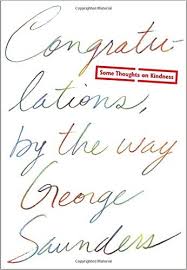
[READ: February 1, 2017] Congratulations, By the Way

Children’s books will commence shortly. But as hatred continues to spread in Washington, one more post on kindness.

Have you ever read George Saunders’ convocation speech at Syracuse University for the class of 2013?  It is stunning and moving and profound.  And yet at heart it is so simple–be kind.

This book, much like David Foster Wallace’s This is Water, is a padded-out book version of Saunders’ speech.  (With illustrations of stars by Chelsea Cardinal).  I am generally opposed to this sort of cash grab book ($14 list price for content that is freely available), but as with Wallace’s book, the speech is so great that any way it can get into people’s hands is a good thing.

There’s not much I can say about the speech, because it is all true and beautiful and doesn’t bear me summarizing.  But I wanted to compare the wisdom of this speech with our horrifying new President and his band of hate-spreaders.  As you read this and know it to be true, wonder what in the hell happened to the people currently running our country that they have fallen so far from the common decency of this speech.

I was thinking how we are taught as children not to lie (Trump lies daily, egregiously) to study hard (Trump is unqualified and none of his cabinet picks are qualified–half of them are downright simpletons), to be kind and obey the golden rule (Trump is literally harming / hurting / damaging / ostracizing / potentially killing people every day with his executive orders).  How did a wicked liar actually win?  Why aren’t the good guys coming to take him out?  I am prepared to RESIST, but it get harder every day with every evil thing he and his minions do.  And watching our spineless elected officials (on both sides, but especially Democrats who were pushed around for eight years) cave to this dictator’s dreams is the most disheartening thing I have ever experienced.

And so, it takes someone liked George Saunders to lift you up.  To believe that somehow this will all be made right.  And to espouse try to kindness where you can.  Because it sure isn’t coming from anyone elected.

The full content of the speech is below.  Read it all, it’s worth it.  Share it with everyone.

(more…)

Read Full Post »

manner SOUNDTRACK: BEN GIBBARD-Tiny Desk Concert #251 (November 19, 2012).

benBen Gibbard is the voice of Death Cab for Cutie.  His voice is instantly recognizable and his melodies are surprisingly catchy.

This Tiny Desk Concert (they say it’s number 250, but I count 251) is just him and his acoustic guitar.  I didn’t know he did solo work, but apparently he does (in addition to being in The Postal Service and All-Time Quarterback).

Gibbard just released a solo album, Former Lives, which he’s said is a repository for material that didn’t work as Death Cab for Cutie songs; from that record, only “Teardrop Windows” pops up in his Tiny Desk Concert. For the rest, he draws from Death Cab’s most recent album (“St. Peter’s Cathedral,” from Codes and Keys) and, of all places, last year’s Arthur soundtrack (“When the Sun Goes Down on Your Street”).

As mentioned he plays three songs and his voice is so warm and familiar I felt like I knew these songs even if I didn’t.

I knew “St. Peter’s Cathedral.” It is a lovely song with very little in the way of chord changes.  But the melody is gentle and pretty.  And the song appears to be entirely about this church.  Which is interesting because the second song is also about a building in Seattle.  “Teardrop Windows” is a surprisingly sad song about an inanimate object.  It’s written from the building’s point of view as he mourns that no one uses him anymore.  And such beautiful lyrics too:

Once built in boast as the tallest on the coast he was once the city’s only toast / In old postcards was positioned as the star, he was looked up to with fond regard / But in 1962 the Needle made its big debut and everybody forgot what it outgrew

The final song “When the Sun Goes Down on Your Street” was indeed for the Russel Brand movie Arthur.  Somehow I can’t picture those two together.  It’s a lovely song, too.

I prefer Gibbard’s more upbeat and fleshed out music, but it’s great to hear him stripped down as well.

[READ: January 2017] “My Writing Education: A Time Line,” “The Bravery of E.L. Doctorow,” “Remembering Updike,” and “Offloading for Mrs. Schwartz” 

I had been planning to have my entire month of February dedicated to children’s books.  I have a whole bunch that I read last year and never had an opportunity to post them.  So I thought why not make February all about children’s books.  But there is just too much bullshit going on in our country right now–so much hatred and ugliness–that I felt like I had to get this post full of good vibes out there before I fall completely into bad feelings myself. It;s important to show that adults can be kind and loving, despite what our leaders demonstrate.  Fortunately most children’s books are all about that too, so the them holds for February.

George Saunders is a wonderful writer, but he is also a very kind human being.  Despite his oftentimes funny, sarcastic humor, he is a great humanitarian and is always very generous with praise where it is warranted.

The other day I mentioned an interview with Saunders at the New York Times.  Amid a lot of talk with and about Saunders, there is this gem:

Junot Díaz described the Saunders’s effect to me this way: “There’s no one who has a better eye for the absurd and dehumanizing parameters of our current culture of capital. But then the other side is how the cool rigor of his fiction is counterbalanced by this enormous compassion. Just how capacious his moral vision is sometimes gets lost, because few people cut as hard or deep as Saunders does.”

These first three pieces are all examples of his love and respect for other writers–both for their skill and for their generosity.

“My Writing Education: A Time Line”

“My Writing Education” comes from a book called A Manner of Being: Writers on Their Mentors.  Saunders’ mentor was Tobias Wolff.  And for this essay, his admiration takes the form of a diary.  (more…)

Read Full Post »

« Newer Posts