 SOUNDTRACK: NO BS! BRASS BAND-Tiny Desk Concert #280 (June 15, 2013).
 With a name like No BS! Brass Band, you think you know what you’re getting: brass and lots of it. And while that is true, the Band goes way beyond what I anticipated a brass band would sound like (nothing like the far more traditional Canadian Brass for instance).
The blurb states:
Funky and danceable, the NO BS! Brass Band takes after the full black-music continuum you hear in groups like Rebirth or the Hot 8. But it’s also proggy, and a bit brutalizing, and full of pride in a different Southern outpost. The group’s new album is called RVA All Day, after all. [I don’t know what that last line refers to].
Recently, Koehler, Pace and nine other musicians piled into a bus and journeyed up the freeway to NPR Music’s Tiny Desk in Washington, D.C. They blasted us with songs from the new album — it was so loud, you could hear the music on the other side of the building, a floor down.
The band includes: Lance Koehler, drums ; Reggie Pace, trombone ; Bryan Hooten, trombone/vocals ; John Hulley, trombone ; Dillard Watt, bass trombone ; David Hood, alto saxophone ; Marcus Tenney, trumpet ; Sam Koff, trumpet ; Ben Court, trumpet ; Taylor Barnett, trumpet and Stefan Demetriadis, tuba. And they play three super high energy largely instrumental songs that are obviously jazzy but which also have elements of the most fun marching band you’ve ever heard along with some rapping, some chanting and lots and lots of clapping.
The first song is all about “RVA All Day.” And yet since that’s all they chant, I still don’t know what it means. While the whole band plays loudly and powerfully, there’s a few solo moments as well. First a trombone solo followed by a sax solo, then a trumpet and a super wild trombone solo (he gets some truly great, crazy sounds from that thing). And then a huge surprise, midway through the song is a rap through a megaphone.
“Run Around” has a sing along to begin the song (and again, vocals through the megaphone). It is also lively and a lot of fun. The final song, “Infamous”sounds a lot more jazzy/big band. It’s got a really nice groove. The middle has a section with just tuba and trumpet where the rest of the band claps and shouts “Ho!” and it sounds great. It’s also interesting watching how the different players “store” their instruments in different ways while clapping.
No BS! Brass band will totally make you wiggle your hips.
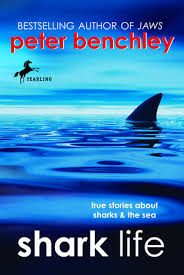
[READ: August 20, 2016] Shark Life
C. had to pick a book for summer reading and he chose this one. He enjoyed it so much, that he encouraged me to read it too. And I’m really glad I did. Although it wasn’t until writing this that I realized that this book was adapted for young people by Karen Wojtyla. And yet I can’t find any mention of a grown up version of this book anywhere. So who knows.
Anyhow, Peter Benchley (who died in 2006) is the author of Jaws, and this book is full of stories of his life in and on the sea. For, in addition to being an author, Benchley was a diver and explorer. And his tales are both exciting and full of conservationist ideas.
The book opens in 1974. After the success of Jaws, Benchley had been invited to Australia to be on The American Sportsman. He was going to be swimming in a cage with sharks feeding around him. They put him in the cage, strapped all kinds of good food to it and left him there (okay they were close by). But a few things went awry and suddenly things weren’t quite as safe as they could be. The shark got caught in Benchley’s air line and then panicked. And a panicking shark is never a good thing.
Then he pulls back from that story to get us more familiar with him. He talks about his failed attempts at pitching Jaws and how that now iconic title was chosen more or less because no one could think of anything better.
Before returning to that scene in the cage, Benchley explains that he had done many dives before the TV show, but never with sharks nearby. He learned a lot about what to do when a shark comes near. He says they are typically frightened by bubbles from sea divers–they simply don’t know what it is. But the most informative thing he learned was “the first law of sharks is this: forget all the laws about sharks.”
He and his diving instructor went looking for sharks (without cages) to get used to seeing them. And on the final day of their prep, they saw a tiger shark. They had “bait” for the shark and Benchley says that at one point he was just over 2 feet from its face when it tore into a piece of stingray. But they had been down there for a long time and he was running out of air. The key was for him not to panic. He made it back to safety and then berated himself: “Why did I have to write a novel a bout shark? Why not a novel about.. I don’t know.. a puppy?”
When he finally returns to the story about himself in the cage with the great white thrashing around, he reveals that the boat crew was so busy doing things that it was actually his wife–who normally wouldn’t even have been allowed on board–who saw what happened and calmly managed to save him. Oh, and the shark came up out of the water and was about 2 feet from her face before diving back down. Gracious.
After giving his own experiences, Benchley talks about shark attacks. He talks about the summer of 2001 which was known for the media frenzy about shark attacks–just what was happening in the water? Was anyone safe? And then he gives us the reality. In 2001, fifty-five people were attacked by sharks. Exactly one more than in 2000. In 2001, five people died from shark bites. That’s exactly seven fewer than were killed in 2000.
So why the craziness? Well, primarily because 2001 was a slow news summer. Shark attacks happen all the time, but that 55 number is pretty average. However, sharks are always exciting news and the media grabbed onto it. Until something more urgent happened in September of that year and then sharks were forgotten.
But he then debunks all the reasons given for the shark attacks–in other words the media speculated falsely about something.
Then he talks about the vastness of the ocean: we have seen/explored less than 5 percent of our oceans–it’s as if we dragged a butterfly net behind an airplane over the Grand Canyon at night and based on what we collected developed theories about life on earth. President Kennedy was lamenting even then that we knew more about the far side of the moon than about the bottom of the sea.
But he doesn’t want us to think that sharks aren’t dangerous. He talks about six dangerous sharks: The Great White, Tiger Sharks, Bull Sharks, Oceanic Whitetips, Makos (the fastest thing in the ocean) and blue sharks. But he is quick to point out that while these are the most dangerous sharks, any shark can ruin your day–sharks are scavengers with sharp teeth and they can smell bloody from a long way away.
Perhaps the most useful chapter was his one about swimming safely. Red Cross Officials say that only about 12% of swimmers are competent in the water and a friction of that are competent ocean swimmers. Some basic swimming rules: Never swim alone; ocean water is always moving; there are undertows and rip tides. Learn how to deal with it (ie. don’t panic). And then he talks about drownproofing.
I found this so interesting and useful that I’m printing the whole technique here, but do look up more at drownproofing.com
3. Basic Technique.
If you can already swim a bit, you can probably do this right away. If you are not a swimmer, don’t try without competent supervision.
Fill your lungs with a good breath of air and float vertically with the back of your head just breaking the surface of the water. Try and adopt the attitude of a kitten being carried by a cat – just hang there and let the water support you. Let your arms float slowly towards the surface, with elbows bent, until your hands are in front of your shoulders. With a steady movement, press downwards and back with your hands until your mouth clears the water. As you come up, breath out and inhale as soon as your mouth is above the surface. Repeat every 10 to 12 seconds.
You could use a scissors kick with the legs if you prefer, or arms and legs together if you find it helps to maintain a balanced position. Choose the method that you find the most comfortable.
The trick is to get the head just far enough out of the water to get a breath. If the stroke is too energetic, you will come further out of the water than is necessary and go down too far as you drop back. Try and achieve a gentle, easy action. The less effort you make, the better.
Getting the breathing right is very important. When your head emerges it should be tilted slightly forward so that the water falls away from your face. Open your mouth wide when you inhale, so as to get as much air as possible. Remember, your lungs are built-in buoyancy tanks! When full, they hold around 4 litres of air. That means 4 kilograms (nearly 9 pounds) of additional buoyancy. On land, you breathe in and out regularly without even noticing. For Drownproofing and for swimming it is important to consciously change the way you breathe. Keep your lungs full of air as much of the time as possible. When you take a breath, exhale and inhale as quickly as possible through your mouth.
Practise on land to get the feel of it – exhale, inhale, hold….. exhale, inhale, hold….. exhale, inhale, hold…..
(You may need to breathe more frequently while you are learning, or if you have been swimming and want to take a rest. That’s alright, the important thing is to feel comfortable.)
Then he talks about how to avoid a shark attack. The easiest way is to stay out of the water. He is quiet sincere that we are invading the shark’s turf, and should be respectful visitors.
Then he tells us some more stories about swimming with sharks. He brought his wife and kids to a shark-feeding event–where people dive among sharks conditioned to be fed by humans. But because of his foolishness there was almost a catastrophe. They did another dive where they encountered a barracuda. It is a scary looking fish but it is not interested in humans at all. His story about them is very enjoyable.
While he’s down there he’s going to talk about other “dangerous creatures” moray eels (he tells an amazing story about eels) , killer whales (an adorable story about a juvenile orca), barracuda and rays.
The story he tells about a manta ray with an 18 foot wing span is unbelievable–literally it is the most fascinating and interesting story of the sea that I’ve ever read and I simply cannot believe that it is true. But he insists that it is–that he and his crew were able to ride on the back of a manta ray. Many times!
The end of the book asks what can we do to help the ocean and its inhabitants. He was such a lover of the oceans and the world within it. His main takeaway: Treat the ocean with respect!
For a guy who mad a ton of money frightening us about sharks, this book is amazingly loving and full of concern about sea creatures.
I really enjoyed this book. And even if it is for young readers, it had some very exciting stories and was surprisingly useful for anyone considering going into the ocean.
Oh and the hardcover book contains a few pages of pictures which the paperback doesn’t. Depending on your love of sharks, you may want to choose wisely as at least one picture is really close up.

 I Just Read About That...
Leave a comment