 SOUNDTRACK: EFTERKLANG-Tiny Desk Concert #270 (April 8, 2013).
Efterklang is a Danish group whose recent album Piramida took its members to an abandoned mining town between the North Pole and Norway. There, they recorded sounds of empty oil tanks, old pianos and pretty much anything they could strike or record.
That blurb made me think this would be a noisy chaotic Concert. And yet despite the found sounds, their music is really peaceful and lovely.
“Dreams Today” builds on a series of echoing keys and guitar notes. After nearly two minutes the singer sings a series of high “ahhs and oohs” until the vocals officially kick in. And then the whole band starts playing a series of fast looping notes while the percussionist plays some water bottles and mugs. The songs builds and builds, with a steady bass keeping the melody strong and then just as it seems it should turn the corner into a new section, it abruptly ends, leaving you wanting much more.
Before the second song, “Danish Design” they explain that they “never went public” with this song. They played it once before in a huge power plant in Copenhagen. It was a big room–very reverby (if you can say that). The office is a very different place and they want to compare how it sounds. They also sampled the worlds northernmost grand piano for this song. They were in Piramida, a ghost town in the arctic. The song begins with slow notes from the sampled piano while the keys play pinked notes. The singer sings in a baritone that is quite lovely. When the loud drums kick in it’s quite a shock to the mellow music. The song is only a bout 2 and a half minutes and, once again, it ends just as it seems like it might soar into something new.
“Alike” is from their previous album. It opens with keys and percussion (all kinds of things like a fork on a mug). They sing in harmony for much of the song. It doesn’t use much in the way of guitar or bass (the bassist is keeping time with a pair of scissors and then a beer bottle on a step stool) until the end of the song when the guitar chords kick in fast (but not too loud). It’s the longest song but the way it builds slowly it feels like it could go on for much longer.
This Tiny Desk really made me want to learn more about this interesting group and to hear more from them.
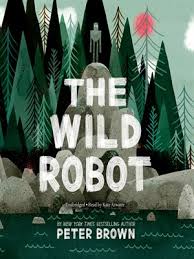
[READ: April 20, 2016] The Wild Robot
I love Peter Brown’s picture books. I think Chowder is absolutely genius and The Secret Garden brings me to tears each time I read it. So I was pretty excited to read this novel–his first.
It’s quite a fast read (with about 70 chapters all about 3 pages long) and lots of pictures. The blurb on the book said that a robot woke up on a remote island. She has to learn to survive from the animals. And once she starts to feel comfortable, her past comes back to haunt her.
And that is a fair summary of the book. The plot is very simple, but Brown adds a lot of details and a lot of characters to make the plot interesting.
One of the most vexing problems when writing animal stories is wondering whether or not the animals should talk. Obviously, if the story is to be in any way realistic, they can’t talk. But Brown gets around that by having his main character be a robot. The robot slowly learns the “language” of the animals and is soon able to communicate with them.
Also, having a robot as the main character allows Brown to avoid the whole “I’m just born, what do I know” dilemma. The robot has been programmed with all kinds of information, so it’s just a matter of time for her to access it as needed.
The robot is activated by curious otters, but as soon as she speaks (and announces that her name is Roz) the creatures are terrified of the “monster.” And they continue to be terrified of her for quite some time. Bears chase her (and break her foot), and the weather is brutal to her. She is soon no longer the shiny machines she once was. She is beaten up and dirty and often camouflages herself in moss and dirt to try to blend in and learn the animals’ speech.
Some of the animals aren’t exactly afraid of her, but none are willing to take time to meet the monster.
But eventually Roz is able to make baby steps with the fox. And he promises to help her out in the future.
Then one day Roz slips and falls down the side of mountain. She lands on a goose nest killing the parents and smashing all of the eggs but one. This was pretty shocking to me. There is actually a surprising amount of (natural) death in this story. Animals freeze to death and some get eaten. There is one egg left undamaged and she decides to rescue it. And when the bird hatches, Roz realizes that she must learn how to care for the poor thing. She speaks to an old goose who takes pity on her. He teaches her what to feed the gosling and eventually Roz gets some help from the beavers to build a house for her.
This is when the story moves beyond mild magical realism with the talking animals and into the realm of real fantasy. This was fine, but it was also unexpected). The animals help each other and, in the sweetest but most unbelievable section, they even agree to a daily dawn truce where the carnivores don’t kill the prey for one hour every dawn.
Soon enough Roz and the gosling have a house and they are becoming friends with some of the other animals too. The gosling is learning to swim and to fly –things the robot can’t do–but the gosling is very happy. Even when the other goslings tease him about his mama. Roz proves to be a smart and tender parent.
And then comes the day when the gosling is told that he must fly south for the winter. Obviously Roz can’t do that either, so they must separate. Roz worries that she will be all alone, but as the winter gets harsher and harsher, she offers warmth to the cold animals and soon enough she has made real friends.
In time the geese return and tell of their adventures–seeing robots like Roz all over the place! None of them were being nice but they were all being helpful to humans. Although the humans weren’t nice to the geese.
As the blurb threatened, Roz’ past comes to island in a fascinating wa–totally unexpected by me. The story suddenly gets rather exciting–it had been mostly a rather slow (but enjoyable) story up until then.
The ending was beautiful and sad with a sprinkle of hope.
So I’m torn about this book–it seems too harsh to be a kids book and perhaps a little childish to be for slightly older kids. It had some realism but not a ton. But the message was really good. And the drawings were simply fantastic.

 I Just Read About That...
Leave a comment