 SOUNDTRACK: CANADIAN BRASS-Tiny Desk Concert #220 (May 26, 2012).
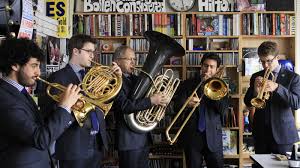 I hadn’t realized that Canadian Brass part of the institution of Canadian Brass. They’re not only part of it, they are it. Indeed Canadian Brass
led by its avuncular tuba master (and sole original member) Chuck Daellenbach, essentially put the idea of the brass quintet on the map. Then there are the recordings — more than 100 of them, selling more than two million albums total. Daellenbach and his fresh-faced players, each with red-striped sneakers and matching outfits, strolled into the NPR Music offices, took their places behind Bob Boilen’s desk and started blowing as if they’d played this peculiar gig a hundred times.
They began with a version of J.S. Bach’s intricately woven “Little Fugue in G minor,” an impressive staple that stretches back to the band’s first recording. In those days, precious little was available for brass quintet (two trumpets, horn, trombone and tuba), so the band relied on making arrangements of existing music. Since then, Canadian Brass has transcribed and commissioned more than 200 works, including “Tuba Tiger Rag,” Luther Henderson’s lighthearted tribute to Dixieland jazz. It’s a showpiece for Daellenbach, who twirls his tuba (while playing) and lands on a final note of such subterranean depth that you feel it more than hear it.
The players closed with another favorite, Rimsky-Korsakov’s dizzying “Flight of the Bumblebee,” in an arrangement by Canadian Brass trumpeter Brandon Ridenour. Although the music buzzes past in less than two minutes, players get plenty of opportunities to shine — as in the lightning-fast runs negotiated by trombonist Achilles Liarmakopoulos, the newest member of the group.
The band consists of Christopher Coletti, trumpet; Brandon Ridenour, trumpet; Eric Reed, French horn; Achilles Liarmakopoulos, trombone and Chuck Daellenbach, tuba.
The band sounds amazing playing these familiar songs in a way that is–unexpected–but still right on.
J.S. Bach: “Little Fugue In G minor” is probably one of my favorite classical pieces. I really enjoy Bach’s fugues a lot and this one is just perfect–and the arrangement here is great–everyone gets a chance to explore the phrasing. It starts with the tuba and then the trombone and then the horn and finally the tuba.
Luther Henderson: “Tuba Tiger Rag” Introducing this piece he says that in Bach everyone is equal, but he felt they needed a tuba song. He says that while this song might be low art for other instruments it is high art for a tuba. And yes he does spin it around while playing it. He uses that instrument to make roaring sounds and incredibly deep notes. This is a medley, I think, because while the trombone and tuba play, the other three sing “hold that tiger / tuba tiger.” How on earth does he reach that super low note?
Before the final song Bob says that his tuba doesn’t look brass. And Chuck replies that there’s an old joke: “How old do you have to be to play the tuba and the answer is old enough to be able to carry it but young enough to still want to.” He still wants to so he’s been so he;s lightening the horn with carbon fiber.
For the final song Nikolai Rimsky-Korsakov: “Flight Of The Bumblebee” he tells us that the two trumpets play very fast–it must be easy for them. But the trombonist Achilles didn’t know what was coming when they had him play along. Chuck says you’ll never see anyone play this song this fast on this instrument.
And it is amazing. The song flies past–a blurry of fingers. And I love that at the end, one of the trumpets sings the triumphant final high note.
You wouldn’t expect a band as old and legendary as Canadian Brass to be so funny and good-natured, but they sure are. And that makes these familiar songs even more fun.
[READ: February 7, 2016] Ava and Tacocat
Sarah brought this book home, in part because Clark’s reading group called themselves tacocat which is a palindrome. Turns out that Clark wasn’t interested in the book, so Tabby and I got to read it together, which was really fun.
The whole book is a language lovers’ dream, chock full of big spelling words and all kinds of palindromes littered throughout.
It was a few chapters into the book before we realized that this is actually the second book of a series (the first one is called Ava and Pip) and that this book references things that happened in book one without exactly explaining what happened. That’s a little annoying for us, but it certainly made us want to read the first book.
The book is set up in diary form with Ava writing in it on most days. I like that she loves palinromes so much (S-E-N-I-L-E-F-E-L-I-N-E-S) and every time she mentions one in the book, they spell it out like that.
So Ava and Pip are the daughters of Bob and Anna. Notice that their names are all palindromes,. along with mom and Dad and Sis or course. Ava is ten, turning 11 on new years day.
Ava and Pip are possibly my favorite fictional girls at this time because they are both language nerds and they are working on a picture book together. Pip does the drawings and Ava is doing the words. It is an A-Z book about fish.
Their mom works at a vet’s office (Dr. Gross) and it turns out that she is the only person at the vet who does not have a pet. Ava and Pip would love a pet, but their mom says that after taking care of animals all day the last thing she wants is a pet at home. The drama of the story starts when their mom tells them about a cat that they rescued and which Dr gross had to fix up. It was going to be sent to the shelter. And Ava gets a bee in her bonnet that she wants to see (and save?) this poor kitty.
And that’s how she comes up with the brilliant name for this pale yellow cat: T-A-C-O-C-A-T. The girls have an ingenuous way to convince their parents to get taco cat (W-A-S-I-T-A-C-A-T-I-S-A-W). Put things in the R-E-W-A-R-D-D-R-A-W-E-R.
And finally, her parents agree to get her a cat as her only birthday present (surely they must have had presents picked out already, though).
Things are wonderful. Well, not everything is wonderful. Taco is basically hiding all the time. He hardly ever comes out from the couch and when he does he certainly never purrs or anything. Whats the point of having a pet that’s afraid of you?
And not everything else is wonderful. Ava’s best friend Maybelle has become very close with a new girl to school, Zara. Zara is a little odd and may be trying a little too hard. Whatever the case, Ava is jealous of the time that Maybelle is giving to Zara (and are they wearing matching necklaces too?). And Zara is kind of a pain. She asks Ava’s oldest friend Chuck if he like-likes Ava (which Ava did not want her to do and doesn’t want to know). She also seems to comes up with ideas that override Ava’s own idea (like calling their fish book Something Fishy instead of its actual title). And worst of all, asking Ava if she and her mom ever checked to see if anyone had lost Tacocat. It just showed up right?
School is the only thing Ava has left. She loves her English teacher. She writes some great haiku and also an excellent story for her class. And it turns out that an author (who I gather was in the previous book) is coming back. She can’t wait to show him Alphabet Fish.
But it turns out that he doesn’t think there’s much of a market for A-t0-Z books. Perhaps she should write something more from the heart. And when she does. When she writes about Tacocoat, well, the thing that Zara asked her about comes back to haunt all of them. What if Tacocat had an owner before and what if Ava’s story (which is so good it gets put in the paper) is actually read by that owner?
There is some serous drama as the story closes.
Bt there are tons of very very funny things throughout the story. Some very funny things in this story are Meatless Mondays (gross!–spaghetti and wheatballs, ugh) and Sunday sundaes. And of course all of the rhymes and word play. I loved near the end when Pip is playing a word game: “It’s good but not great ; It’s silly but not clever ; It’s funny but not amusing.” I wouldn’t have gotten it, so I am glad Ava did.
The back pages are also full of fun palindromes to play around with.
This story is recommended for 10 and up. It was a little mature for 8-year-old Tabby–they talk about getting your period and a few other things that 11-year-old girls might talk about. But they were good moments and nothing to be afraid of. And it was a great way for Tabby and I to bond.
Incidentally, this book is set in a year in which the dates match to our calendar in 2016. And the book finished up on Sunday February 7 which is exactly when we finished the book. Cool! Now to backtrack and find the first book.

 I Just Read About That...
Leave a comment