 SOUNDTRACK: DANIEL JOHNSTON-Tiny Desk Concert #224 (June 11, 2012).
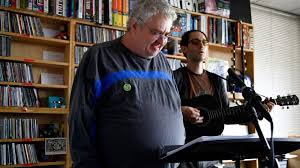 Daniel Johnston makes me uncomfortable. I find his music to be simple and his voice isn’t very good. And yet he is beloved by so many other people. The fact that he is schizophrenic makes me worried that there’s some kind of exploitation going on. But who knows. He has had rather a lot of (relative) success.
The blurb tells us
Johnston has been diagnosed with bipolar disorder and schizophrenia, and he’s been institutionalized, but these days he travels and performs. It’s amazing to see and hear a spark of candor in what he does, all while he’s shaking like a scared child. There’s an odd sort of curiosity to watching Johnston perform, but it’s easy to root for him: He’s endearing and sloppy and unmistakably talented.
He and his guitarist Friend McFriendstein (actually Shai Halperin who plays under the name Sweet Lights) play four songs.
“Mean Girls Give Pleasure” is a pretty funny fast romp. “Sense of Humor” is a slower song.
Between songs, they show off Johnston’s book Space Ducks. There’s an iPad app and video game which is “Much beter than checking out Starbucks on yelp.”
“American Dream” is a clever song that’s full of monsters as metaphors. “True Love Will Find You In The End” is a pretty, uplifting song.
His songs are short and unadorned, and surprisingly catchy. But I don’t think I’d ever listen to him intentionally.
[READ: January 12, 2017] “Uninhabited”
The June 6 & 13, 2016 issue of the New Yorker was the Fiction Issue. It also contained five one page reflections about “Childhood Reading.”
Young says that when he was in fifth grade he read Robinson Crusoe (not the abridged version) in one weekend. But he wasn’t showing off. He saw an image or cartoon of the book and picked it for a book report not realizing how massive the actual book was. He delayed until Friday for a report due Monday and thus had to cram in an entire novel. He did the same thing with Gulliver’s Travels, “Who knew Gulliver met more than just Lilliputians?”
But he says that these masterpieces didn’t seem that different from non-fictional travelogues like Thirty Seconds Over Tokyo, the gory account of the U.S. bombing of Japan.
Crusoe is apt because he says he felt shipwrecked when they moved from New York to Topeka, Kansas.
He had already read the fifth-grade reading textbook the year before, so his parents negotiated with the school that he could sit in th eback during reading and do independent work. Sadly this meant going through Reader’s Digest magazines (where he learned the word abridged).
He recalls an article called :”The Ingenious Eskimo” It was already outmoded in 1980 (the story had appeared in 1939). I like that he thought the word ingenious meant not a genius because the prefix in- usually meant not.
He also imagines what the people who had sued to integrate schools would think of him “segregated at the back of the class, reading forty-year-old articles about ‘natural history’ and racial types.” He wondered why his mother allowed such an arrangement but she just talked about how you have to pick your battles.
But he says, those abridgements, that condensing of words had an impact on him in his life as a poet.

 I Just Read About That...
Leave a comment