 SOUNDTRACK: BILL FRISELL-Tiny Desk Concert #191 (February 3, 2012).
I’d published these posts without Soundtracks while I was reading the calendars. But I decided to add Tiny Desk Concerts to them when I realized that I’d love to post about all of the remaining 100 or shows and this was a good way to knock out 25 of them.
 I’ve been aware of Bill Frisell for decades. He has played with just about everyone that I like, and I’m sure I have his guitar on about a dozen albums. And yet I don’t really know all that much about him. I certainly didn’t know what he looked like and, honestly, I wasn’t sure what to expect from this Tiny Desk Concert. I feel like most of the places I know him from are noisy avant-garde music. So I was pretty surprised to hear that this would be a concert of delicate reworkings of John Lennon songs.
From the blurb:
On this day, Frisell came to perform the music of John Lennon. Now 60, Frisell witnessed the birth of The Beatles and all that it meant to moving the world from cute, catchy songs to sonic adventures — a world of music we don’t think twice about anymore. After all these years of hearing The Beatles’ music, he’s still discovering it, finding small phrases in the songs we know so well — “Nowhere Man,” “In My Life” and “Strawberry Fields Forever.”
Frisell introduces a lot of songs by saying that the Beatles have been a huge part of his life. And yet, he’s never really played them by himself in this exposed way.
Bob describes some of the gear that Frisell uses, like the
Electro-Harmonix 16-second delay, a pedal I used to use in live performance in the 1980s. I know how fragile and sometimes unpredictable it can be, but it’s the backbone of Frisell’s bag of many tricks. With that equipment enhancing Frisell’s nimble, deft fingerwork and uncanny sense of melody, it all adds up to a brilliant and disarmingly humble performer.
I didn’t recognize “Nowhere Man” for much of the song—he’s exploring areas and pockets of the song–but every once in a while the vocal line peeks through.
When he starts “In My Life,” he plays what sounds like the opening notes to “Lucy in the Sky with Diamonds.” I was sure he was going to play it so it’s quite a shock when he doesn’t and then he takes a really long intro solo before getting to the familiar melody of “In My Life.”
For such a legendary figure he is amazingly soft-spoken and humble. He’s even embarrassed that he’s reading the music rather than having it a part of him.
There’s a pretty lengthy intro before he gets into that very familiar melody of “Strawberry Fields Forever.” This one is my favorite of the bunch because of all the effects that he plays on it—echoes and reverses and all kinds of cool sounds that emanate from his guitar. And “Strawberry Fields” is always present in it.
This is 20 minutes of very pretty, sometimes familiar music
[READ: December 25, 2016] “The Adventure of the Blue Carbuncle”
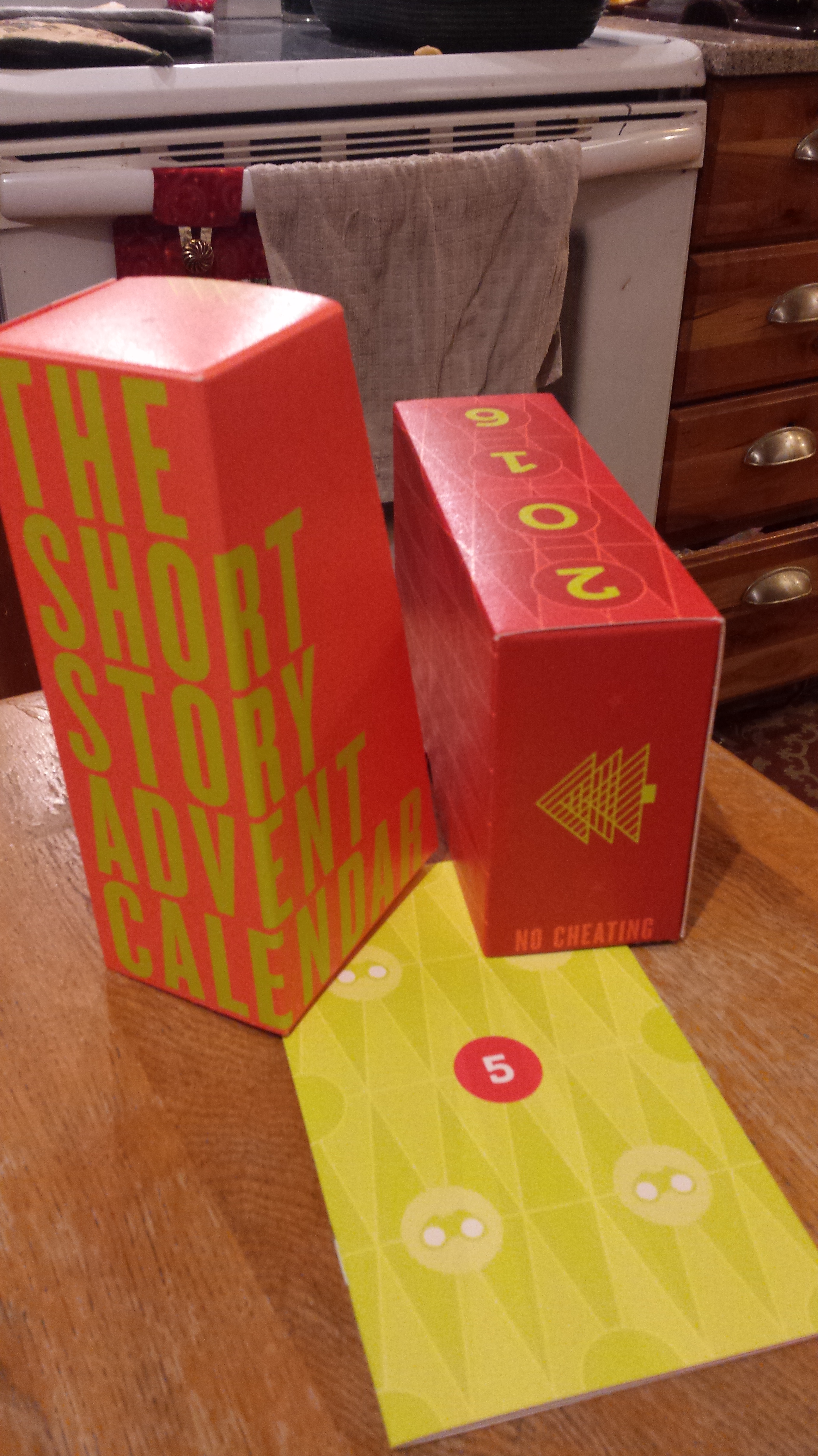
Near the end of November, I found out about The Short Story Advent Calendar. Which is what exactly? Well…
The Short Story Advent Calendar returns, not a moment too soon, to spice up your holidays with another collection of 24 stories that readers open one by one on the mornings leading up to Christmas. This year’s stories once again come from some of your favourite writers across the continent—plus a couple of new crushes you haven’t met yet. Most of the stories have never appeared in a book before. Some have never been published, period.
I already had plans for what to post about in December, but since this arrived I’ve decided to post about every story on each day.
I have read this story before (and I’m pretty sure one of the Sherlock shows did an episode of this story). It’s probably one of my favorite Holmes stories.
But first thing’s first: For this story, carbuncle is not the first definition: an abscess; but the second: a bright red gem (except this one is blue).
The story opens with Holmes sitting in his room two days after Christmas. Watson arrives and they look at a hat on the hat rack. Holmes says that he can tell around ten things about the hat wearer. It’s one of the best examples of how Arthur Conan Doyle was able to make Holmes seem so smart. And I have to wonder how he thought of all of these things:
The man was intellectual (a faulty belief that head size indicates intelligence, but still); he was well-to-do within the last three years, but has fallen on hard times (it was a top of the line hat three years ago, but is less so now); the obvious fact that his wife has ceased to love him (she did not brush his hat recently).
This story also leads us on a couple of wild goose chases, literally.
Holmes possesses the hat because a man wearing the hat and carrying a goose was attacked by thugs. A policeman happened upon the scene and everyone fled. The man dropped his hat and the goose. The policeman brought it all to Holmes. And Holmes let the policeman keep the goose as it was about to spoil.
Some time later, the policeman comes back with a blue gem and says it was lodged in the goose’s throat. It proves to be the Countess of Morcar’s blue carbuncle stolen a few days ago.
A man was arrested for the crime, but Holmes believes he is innocent.
So Holmes sets to work. First to find out if the owner of the hat knew anything about it. It seems obvious the way he figures out he had nothing to do with it, but it still very clever. And, Holmes learns where the goose came from.
He follows a few other leads. My favorite part is where he bets a man to get information. He tells Watson afterward: if he had given the man £100, he wouldn’t have gotten as much information as he received through a £1 bet.
The actual capture of the criminal is fairly anticlimactic, but the ending is a great twist and a fun surprise.
It’s a wonderfully told mystery and a fun Christmas story to boot–full of Christmas charity at the end.

 I Just Read About That...
Leave a comment