 SOUNDTRACK: JOHN CONGLETON AND THE NIGHTY NITE-Tiny Desk Concert #551 (July 22, 2016).
 John Congleton is a music producer (and a really good one at that–he’s had his hands on great albums both obscure and really poplar). But he is also a musician. And a pretty weird one at that. Here, as the blurb says, “he creates haunting tension with just acoustic guitar, brilliant electronics from Jordan Geiger, and words passionately sung.”
These songs are interesting because Congleton plays a very traditional sounding acoustic guitar. His songs are typical folk chords. But the lyrics are pretty dark and confrontational and those keyboards are often really creepy or disturbing (appropriate for the lyrics)
The first song, “Just Lay Still” is a rollicking track with the guitar playing quickly and the keyboards playing off-kilter and deliberately creepy chords. Lyrically, the song is about the subject that Congleton seems to be exploring on all of these songs–what it is like to be human. “I love you like a lion loves its kill / I will touch you like a doctor, just lay still. Let the implements molest you in your sleep / You belong to me… We’ve got you surrounded (creepy chord). We’ve got you surrounded.”
Congleton says “Your Temporary Custodian” is a devotional song about indifference.” It opens with crazy siren-like sounds over Congleton’s acoustic guitar. The blurb notes that the song addresses “what it means to face the fact that we are flesh-and-blood ‘temporary custodians’ in vessels that will inevitably return to the earth and decay.” It’s got lyrics like: “You phenomenal nominal nominal nominal nothing” and “we will not be saved / we went looking for the sublime / we found only the inane” and “what an extraordinary thing it is to be this ordinary thing.”
Before the final song he thanks everyone (he’s very polite given his lyrics) and then jokes, as taxpayers we expect a full tour [of the NPR building]. “Animal Rites” is also a fast song with more great lyrics: “I’d love to hold you but I need to hold my own.” Or “Biology kicks virtues’ ass every time” or my favorite: “When you’re crazy at 20 you’re sex to be had / when you’re crazy at 50 you’re not sexy, you’re sad.” And then the crux of the matter: “You’re with an animal / you’re with a warm body, carbon contents, atoms and proteins.” This song is much longer than the other two. It has two parts separated by a solo is a bunch of noise and mayhem from the keyboards. The second half slows down but eventually comes back to the main thrust of the song.
These songs were definitely unusual, and strangely catchy. I’m curious to hear what this album sounds like (assuming he produced it himself–I expect impeccable work.
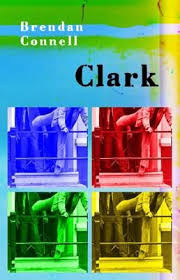
[READ: November 30, 2016] Clark
One of the things that I admire about Brendan Connell as an author is the astonishing depth and detail work he puts into his books. Connell is an amazing polymath, with books that fully bring to life such diverse topics as food, religion, philosophy, violence, sex and now, Italian cinema.
Clark is the story of Eric Clark a devoted actor who rarely refused a role. We watch his introduction to the world of film, his embrace of said world (and its embrace of him) and his subsequent decline. This book also shows an amazing amount of detail about the Italian film industry–a topic I know nothing about. Now I realize that Clark and his films are made up, but I have to assume that everything else that Connell says about the industry, its ability to make movies quickly and for 10% of the price of American films is all correct. And if it isn’t, then he’s done an even more remarkable job of making it all up.
Eric Clark was born José Fernando del Torres in Paraguay. As a teenager, he acted in some local theater productions, but he was more interested in revolution–he sided with the workers and read Marx. He even took part in demonstrations.
When he was 19, his father, concerned about his son’s left-leaning politics, encouraged him to go to America to live with his cousin Pablo who taught in New York. With dreams of living in the big city, he was rather disappointed to find himself (in the early 1950s) in Ithaca.
After seeing an ad for The Actors Studio, he set off for Manhattan. He auditioned for Lee Strasberg. Strasberg was not impressed.
And then in November 1955, he was visited by a spirit who handed him something important. Talent. (James Dean died at the end of September 1955, could it have been from him?).
The way that José Fernando del Torres gets back in touch with Strasberg is outstanding–it was such a memorable scene.
He studies, he does well and through a chance meeting with a French movie maker, he flies to Paris. En route, the filmmaker changes del Torres’ name to Eric Clark. Why? Because no one will take a man named José seriously, and because Clark is a very beautiful name.
And then he was off to Italy and a remarkable career. Each film that Clark appears in is mentioned in the novel and each has a footnote with some information about its release, for this is a scholarly biography of the man.
Clark gets involved with a few women–with less than stellar results. They way he divests himself of them is cold but brilliant (the second, in particular). And soon he is devoting his life to acting. He made between 3 and 5 films a year for five years in the late 1960s. Most of the films were terrible (although some did make money), but he was often singled out as a consistent high point. His acting was great. And he knew it.
So we follow the trends in cinema: historical films (togas and sandals) begat Westerns begat gangster films, (he played an excellent bad guy). Soon enough, he was agreeing to do films without even reading the scripts. Not for the money (although that was nice) but because he wanted his face to be on-screen all the time.
While his career takes him around the world, we meet some of the people whose lives he touched. Bob Anthony, actor and bodybuilder. Momi, the elastic-faced non-actor who hit it big as a comic actor with Clark’s help. And the women who Clark married, hurt and then worked with. We see his brief stint in China (and the staggering number of films he apparently starred in. As well as his trip home to Paraguay, where it seemed no one was impressed with him as an actor, or as a person.
The 1980s were a time of drugs and the decline of Italian cinema. He refused to do TV, the soul sucking corporate destroyer of talent. What can Clark do but try to find spirituality? Connell’s take on the spiritual guru is funny and spot on, and the way Clark’s quest ends is great.
Near the top of his career he was in a film that many people believed was a snuff film. In fact, it was believed that he was murdered in the film. The fact that no one could find him (including the police who were trying to bring him in for t he trial of the film director) only aroused more suspicion. I loved this whole scene. Similarly, the end of Clark’s life is shrouded in mystery (despite the deliberateness of everything else).
I suppose that knowing something about Italian cinema in this time period might make this book more enjoyable. However, I knew nothing about it and enjoyed it as Connell created a complete world. One that I will believe to be completely real. And should I ever see a movie on late night TV that is dubbed from the Italian, I will look for the genius actor at the center of it.

 I Just Read About That...
[…] review at Ijustreadaboutthat […]