 SOUNDTRACK: THE BEATLES-Live at the Hollywood Bowl (2016).
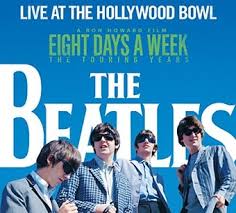 This disc was released this year. It is technically the soundtrack to the film Eight Days a Week: The Touring Years. But regardless of the film, these are newly mastered recordings from two Beatles concerts at the Hollywood Bowl in 1964 and 1965 (which were released in 1977). This disc has 7 songs from 1965 and 6 from 1964 (not including the four bonus songs).
The concerts were legendary for the shrill screams that the audience made during these shows–so loud that the recordings were practically inaudible and, apparently, even the band members had a hard time hearing each other. Sounds like a nightmare, frankly.
Well, George Martin’s son has used some technology to make these recordings listenable. They have reduced the shrill screams to a kind of low-level, high-pitched sound and, even better, they have fleshed out the band so they don’t sound like they are playing in a tin can.
Here’s some fascinating things about that Hollywood Bowl Concerts. Tickets cost $5.50 in 1964 and $3 in 1965. WHAT? In 1965, the band played for 33 minutes. That’s it–not sure how long they played in 1964.
The band had no monitors on stage–those things that musician are always pointing at and asking the mixer to turn up. So on many shows they couldn’t even hear themselves. The fact that their harmonies are so good is really impressive. The notes suggest that the open roof of this show meant that the shrill crowd noise was somewhat dissipated allowing them to hear each other a little better for these shows.
Evidently the track listing for this disc consists of the best original recordings from the two shows. I’m not sure why they’re not played in sequential order, but whatever. Perhaps the energy of the opening “Twist and Shout” (all 90 seconds of it) is a pretty great way to start. While the band is spot on in their playing (sometimes it’s easy to forget that they are laying instruments as well as singing, since the voices are the big thing) you can hear Paul’s voice straining on “Can’t Buy Me Love” (which is cool). Or John saying he thinks the next song “Things She Said Today” is on the new album over here. This song–quieter and less dancey sounds pretty great and you can kind of hear the audience paying attention to it, so that when the band gets to the loud part the crowd really erupts.
I’m surprised at how many covers the band plays. I realize these songs are picked from two set lists, but there are dozens of serious hits that they could have played instead of say “Roll Over Beethoven” or, and this is the most surprising thing to me, ending their 1964 set with “Long Tall Sally” rather than one of their huge hits.
It’s funny how crazy the crowd goes for Ringo when he sings lead on “Boys.”
I enjoy hearing them talk about their films–one we made in black and white, the other in color. “Hard Days Night” sounds great but even more impressive is “Help!”. John intros the song by saying, “we’d like to do another film song from a different film–coz we’ve made two.” “Help!” is really impressive the way the band launches right into their harmonies on that first note–it sounds incredible all the way through the song. Even when John strains hard at the end.
There’s not a lot of stage banter, but I did enjoy this one from 1964: “This next song is an oldie, some of you older people might remember it. It’s from last year. It’s called “She Loves you.” I like hearing the rocking guitar line more prominently and the fact that they don’t go “ooooh” during the first time it’s supposed to appear, but when they do the next time, the crowd goes nuts.
As the disc ends, Paul asks, “We all hope you enjoyed the show. Have you enjoyed the show?” Apparently they have.
I’m not sure why the final four songs are listed as “bonus tracks.” The inclusion of “I Want to Hold Your Hand” can’t be a bonus! But the four songs (two from 1964 and two from 1965) also sound great. The harmonies on “Baby’s in Black” are fantastic.
John Lennon said the fans didn’t come to listen, they came to love. Regardless, the band played wonderfully and gave a great performance. It’s nice to be able to hear it.
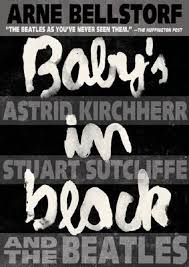
[READ: March 10, 2016] Baby’s in Black
This story is about The Beatles before they became THE BEATLES.
I didn’t know all that much about the early Beatles. I knew that they were in Germany (although I don’t really know why, and I still don’t). But I didn’t know about all of the trials and excitements that happened to them there.
What I loved about this story is that while it is about The Beatles, it’s actually about Stuart Sutcliffe and his girlfriend Astrid Kirchherr and their impact on the nascent Beatles.
The story begins with Astrid’s ex boyfriend Klaus Voormann running to Astrid to tell her about this band that he just heard down at the Reeperbahn. He said they all dressed the same and they really rocked (or whatever they would have called it back then).
The Reeperbahn was sketchy place at the best of times, so it was unlikely that anyone other than sailors and thugs would have seen this band iinitially. But Klaus was so insistent that Astrid agreed to go. And she was mesmerized by them. She was especially taken with bassist Stuart Sutcliffe (although none of the fans knows their names at this point). The band consisted of John, Paul, George, Pete Best on guitar and Stuart on bass.
Astrid has very short, close-cropped blonde hair and she really stands out in this crowd and the band notices that she comes several times.
Finally one night Klaus talks to John and shows him a hypothetical album cover that he designed. John says that Klaus should show it to Stuart because he’s the artistic one in the band. Astrid goes with him and there’s a nearly instant attraction between Astrid and Stuart.
Now mind you, they are in Germany so Asrtrid and Klaus speak German, and The Beatles can get by sort of (they mostly speak in English and at one point in a show, they make a joke at the crowd about winning the war which no one seems to notice).
Astrid offers to take their pictures for promotional purposes (and her mom makes them gives them a proper English fry up). Her photos are really good and the guys befriend the family. Later she wants to take a pictures of just Stuart. And that’s how the romance begins. They become inseparable and Astrid’s mother is quite taken with him as well.
He starts to show that he is more of visual artist than a musician. She also began making suggestions to their look and their visual style.
At around this time (unrelated to Astrid) the band starts getting into some trouble. They were in Germany illegally. And when they tried to break their contract at the club where they were exclusive, the club owner reported them to the police. George was even underage, so he was sent home and then Paul, John and Pete were deported. Stuart (for reasons briefly touched on) seems to have been safe because Astrid’s family vouched for him (or something).
While the band was gone, Stuart began to paint more and more and then was accepted into art school and even given a stipend.
His work was good and he began to work harder and harder. When the band returned to Germany he played with them a bit but he was getting exhausted. The doctors told him to take it easy–lay off the pills and cigarettes and get some rest.
Astrid and her mom took care of him as he grew sicker and sicker.
In the meantime, The Beatles worked as a backing band for Tony Sheridan (where they were called the Beats). Incidentally Klaus offered to play bass for them but they thought that Paul would like to take over duties (word was that Stuart wasn’t very good anyhow). Turns out that Klaus bought Stuarts bass and learned how to play and became an influential musician in hos own right. He played Manfred Mann and John Lennon’s Plastic Ono Band and did a lot of session work too.
Astrid is still alive but doesn’t talk much about The Beatles anymore.
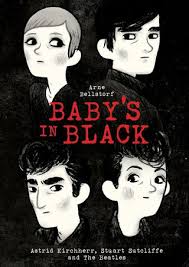 I really loved the look of this book. It’s in black and white and the illustrations are soft and rounded and they look very distinctly British. I couldn’t always tell the guys apart in some of those early scenes, but they are almost superfluous to the main story of Stuart and Astrid.

 I Just Read About That...
Leave a comment