 SOUNDTRACK: MITSKI-Tiny Desk Concert #467 (August 31, 2015).
 Some recent Tiny Desk Concerts have been running long, but Mitski Miyawaki plays 3 songs in 8 minutes.
Her songs are simple—three chords at most. And she is unaccompanied here (her recorded versions are much more fleshed out)–just her voice and her electric guitar. But it’s the intensity of her lyrics and her delivery that really dominate the show.
“Townie” is the most rocking song The way her voice rises and almost breaks as she sings “I’ve tried sharing and I’ve tried caring and I’ve tried putting out” is really heartbreaking. And the follow-up “but the boys keep coming on for more, more, more.” It’s all of 2 minute long but it packs a punch.
“Class of 2013” is almost a capella. She plays a chord and lets it fade away while she sings.
Mom, am I still young? / Can I dream for a few months more? / Mom is it alright if I stay for a year or two…and I’ll leave once I can figure out how to pay for my own life too.
Interestingly, se plays an open-stringed guitar (it must be a special tuning). One loud chord that rings and fades. Even in the most unsettling moment, when she plays a chord and then screams the lyrics into the pick-up of her guitar–giving it a far-away and tinny quality as the chord echoes to a close.
The final song “Last Words Of A Shooting Star” has some simple opens string finger picking (again, must be an alternate tuning). As she sings quietly she seems to be exposing every ounce of herself.
One would be concerned for her psyche and yet she seems pretty happy and smiling when the show is over.
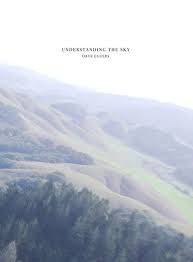
[READ: October 19, 2016] Understanding the Sky
This book is a long-format version of a short article/essay/something-else-entirely that was published in Afar in 2015.
This book reminds me of the publication of David Foster Wallace’s This is Water in that it is a brief essay/story spread out over hundreds of pages. Most often with one line per page. The difference between this and Water is that Water felt like a weird cash grab and this feels like a chance to show off more of Egger’s photos (there are not many in the article).
There is a photo on each page–most often with text–but sometimes without. And it works rather well.
The narrative is structured as a dialogue–each “person” is on a facing page, so the right page answers the left page. And it is done in a kind of removed third person. Thus it begins: “Who is this man?” “He wants to fly.” In this opening section the pictures are presented very thin–less than an inch wide in total but stretching from top to bottom of page in the center of the spread.
“Where is he going?” “He is driving to Petaluma to fly.” “Has he told his wife he will do this?” “He will tell her after he has done this.”
And in this removed way, we see third person perspective of Eggers taking a flight “On a two-seat open-air flying machine called an ultralight or Air Creation trike.” “It looks like a hang glider carrying a three-wheeled motorcycle.” He is being flown by Michael, a French Canadian.
We meet Michael and we hear Michael’s reservations about the way Eggers’ is dressed (it will be very cold up there and he is dressed poorly). But then he sees Eggers’ resolve and his determination to fly, cold be damned. Why? “Because he has wanted to fly on a machine like this for twenty years.”
here was the realization of man’s dream to fly as birds fly. The ultralight seemed to offer the liberation humans had always sought—to be able to choose when and where we flew, and to fly alone, and to be able to swoop low and bank tightly around a copse of trees, or to hug the coast, looking below for dolphins or whales.
Slowly the pictures get wider and we see the plane gets on the runway “it is like driving a golf cart.” And ten they are airborne.
“Will you describe the takeoff?”
“It is almost vertical.”
“How can it be almost vertical?”
“There is the airstrip. It is about 1,200 yards long. Michael positions the machine and begins taxiing. After about 100 yards, just as the plane is picking up speed, you are aloft…. After a few hundred yards!”
And then we see full-page photos of Eggers’ view from the air.
Eggers describes what he sees: flying over farms and schools and mountains and the ocean.
The pictures are not “great” nor are they “art” exactly. As he describes: “The man has been taking pictures, just holding down the shutter on the camera and shooting randomly.” So these photos aren’t artsy, but what they are is real–blurriness, parts of the plane in the way, and lots and lots of footage that isn’t interesting, but is interesting in its own way of seeing things from a new perspective. Like aerial footage of California from 200 instead of thousands of feet up and beautiful vistas uninterrupted by window edges or glare.
And then he describes the experience of flying in an ultralight–flying 200 feet above people and being so quiet they don’t even look up. And then flying up to 2500 feet over mountains (but not out over the ocean because he can’t land in water).
Seeing elk–elk!–wandering the grasses.
And for me the most delightful thing is the rolling green hills of the mountains in California–something topographically unique to the West Coast.
He does add some minor drama when their intercom indicates “traffic.” He explains there is no radar, there are no instruments, “you can look around and see if you see another aircraft.” Although they see nothing. And then the hour is up and they head back to the airport rapidly descending.
The essay thing ends with a joke–a book of the same title by David Pagen–that I found very very funny, especially given the sedate but wide-eyed tone of the whole book.
This is an easy read–30 minutes at most, but the whole journey is wonderful. The real take away comes from this statement though:
Everyone says they want to be in the sky or in the sea but they’re actually all on land. Humans are land creatures, like the cows and the sheep, and we rarely do anything we say we want to do. We say we want to fly the way a bird flies, but there are these machines that fly much like birds fly, and no one cares.

 I Just Read About That...
Leave a comment