 SOUNDTRACK: RAQUEL SOFIA-Tiny Desk Concert #395 (October 11, 2014).
 Raquel Sofia has been a backup singer for Juanes and Shakira and has no come out front to make really catchy songs about breaking up with people.
She sings in Spanish (although her English is excellent) about love and loss and the blurb correctly notes “it’s hard to believe that feeling bad can sound this good. ” Her songs are all acoustic, but with a fiery punk flair (to match her partially shaved head).
Of the first song, “No Me Importas,” she says she wrote this song about a guy who didn’t call me. It is a rollicking fun song which starts out with a big HEY! before rocking out. Her voice is awesome–loud and powerful and for this blow off song, she’s got a great sense of bite in her voice. And again, for a break up song it’s really fun and even has a with a clap along section
“Agridulce” (which means Bittersweet) is a more mellow ballad. She says she was in a relationship and was about to get dumped. Too much damage had been done to say she was sorry so she had to write a song. She says it’s her next single. It’s a pretty song and at he end, she says that the look on his face when she told him she wrote the song made the trouble worth it.
She says she wrote “Te Amo Idiota” which means “I love you, Idiot” in the darkest, darkest hour of her life. It’s an impassioned song. Not quite as fun as the others, but really good. The end is really great.
She wasn’t expecting to do a fourth song, but they ask her to and she plays “Hombre Como Tú.” She says she was mad at a guy and was sure she was never going to see him again. So she wanted to make sure he knew exactly what she thought about him. We never find out what he thought of that one. She says it’s her next single (even though the other song was also her next single). It’s incredibly catchy and even if you don’t know what she’s saying.
Hearing how great her songs are, it make me want to have a bad break up with her so she can write some more great songs (especially since I wouldn’t know what she’s saying).
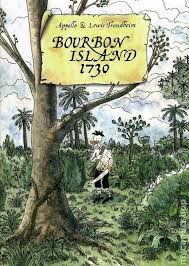
[READ: June 11, 2016] Bourbon Island 1730
I joked with Sarah about the disclaimer at the beginning oft his book which says that “Bourbon Island 1730 is not intended to be a historical account. It is a fictional narrative, freely inspired by historical events.” And I joked because one of the main characters is a bird and the other looks like a dog or something. So clearly not historically accurate.
But I soon learned that this is a more or less accurate account of piracy and slave trading around Bourbon Island in the 1730s.
Although as with a lot of Trondheim’s books I found this one to be lacking focus somewhat.
I wasn’t always sure exactly what was happening. And one of the problems to me especially was that the book deals with racism and slavery, but it wasn’t always clear who was who because the characters were animals–how do you depict racism with animals if the animals don’t seem to conform to a race?
But I’m ahead of myself. The book opens with a ship sailing on the ocean. The dog-like creature (Chevalier Despentes) is talking to the bird creature (Raphael) about the (actual) birds that he wants to study again. The character being a bird does not seem to be relevant to the bird watching, which is a little confusing as well. The dog is an ornithologist who works at drawing birds (well, killing them, and then drawing them). Raphael is his apprentice. They are mostly in search of the elusive dodo bird in the island of the West Indies.
As soon as they land on the island, Raphael notices volcanic rock. Swept up by the tales of pirates that have been on this journey he informs Despentes that he will be leaving him to his birds and going off to join the pirates, his true brethren. What’s confusing is that a few pages later Raphael is still with him searching for birds in the jungle.
The inhabitants of the island say no one has seen a dodo for ten years.
Then a new figure comes along, a grouchy looking guy named Theodore. He reveals that they have caught the dread Pirate Buzzard. He also says that there are lots of former pirates on this island.
The second chapter is called The Maroons. There are a number of end notes at the back of the book which are quite helpful for contextualizing the story. I wish the book had drawn our attention to them earlier simply because it really would have given the story more gravitas. The notes explain that the maroons were probably named for the Spanish Cimarron (mountaintop dweller) not related to color. The word describes people and animals who lived there. It also gave rise to the word marooning. Maroons quickly became slaves to the forces around them.
This section begins with a young bird woman in a dress. Her name is Virginia and she tells her servant Neneh that she wants to get away–she wants to traipse through the woods across the island to meet Captain Cafre, the chief of the maroons. Neneh dismisses her and say “they’re brutes.” Then Neneh sneaks out to meet Laverdure–a maroon who escaped slavery (you can tell because his ear is half off–the punishment for escaped slaves).
Laverdure is convinced that the maroon hunters are after him so they flee for many many pages. Until they meet up with the rest of his people. They are off to rescue Buzzard from prison, because Rapier told them to–against strict orders from Laverture. But they say that Rapier spoke to Mafate and Mafate agrees (Mafate is the spirit of the island).
Rapier is a grizzled old pirate (no idea what kind of creature he is supposed to be). It’s here that we learn about the value of the coffee crop grown on Bourbon island. The notes explain that it was mandatory for everyone to grow coffee and that anyone caught damaging crops would be executed.
Next comes “The Pardoned One” where we see Virginia’s father buying slaves and gunpowder. Meanwhile Neneh returns home to see that Vriginia has vanished. She tells Laverdure to make it looks like she (Neneh) was knocked out to explain Virgnia’s absence.
Then we jump to a jail cell. A prisoner who speaks the same language as Rapier (none of the other prisoners do) asks Rapier for help. He won’t help him, but he throws him a knife and says to use it on any white person he can.
The Young Lady lets us see the mayor of the Island. He approves of the raping and killing of maroons as well as the destruction of their villages. Meanwhile on the other side of the island the ornithologist discover Virginia, unharmed, in the woods.
Raphael and the ornithologist return Virginia to her father. Along the way Raphael and Virginia talk blot about pirates. She said her father was a pirate and he shouldn’t romanticize them. As payment, Virginia’s father lets Raphael take Virginia to the pirates’ ball. The ball is fun but Virginia wants nothing to do with Raphael. At the party Raphael gets to talk with Theodore. Theodore is dismissive of him until he mentions Libertalia the possibly imaginary free city set up by pirates. This makes Theodore smile and he tells Raphael to come along where they talk about the fantasy and reality of Libertalia.
After the party Raphael walks Virginia home where she talks about her love for the maroons and her desire to join them.
The book ends with a failed pirate coup and Raphael inadvertently running into Rapier where a lesson is learned.
The end of the book bookends the beginning in an interesting way.
I found this book rather confusing. The back cover of the book shows everyone in color and perhaps things would have made more sense in terms of telling characters apart or in keeping them straight if it had been in color. There’s also a lot going on in the book and I definitely got lost a number of times. Browsing through it a second time clarifies some plot points but I’m still not entirely sure what happened in a lot of places, especially the mountain scene.
The art is very interesting though–the characters look rather cartoony, but they convey the story very well–even if racism and speciesism aren’t exactly the same thing.

 I Just Read About That...
Leave a comment