 SOUNDTRACK: WILCO-Tiny Desk Concert #168 (October 17, 2011).
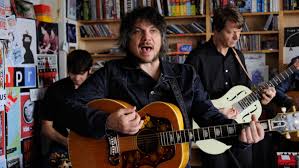 Wilco is virtually the only band to have been asked back for a second Tiny Desk Concert. I’ve listened to this concert a bunch of times but didn’t realize I hadn’t posted about it here.
There is a huge crowd for this show and as it starts, everyone shouts WILCO!
The band sounds great with all the members crowding in behind the Tiny Desk. Tweedy plays his big acoustic guitar, Nels Cline plays all kinds of interesting sounds in the corner. The drummer is on a small computer thing that seems to be made up of all manner of small percussive items. There’s a bassist and keyboardist and a second guitarist all making a great sound.
“Dawned on Me” starts the set and sounds great in this setting—I love the walking bass throughout the song and of course Nels Cline plays a wonderfully insane noisy solo amid this simple and catchy folk song
Before the second song, “Whole Love” Glen’s got to get some things out of his toiletry bag. This is another great song with Nels playing high notes to complement the rumbling bass. No idea what the drummer is playing this time—a book? Tweedy sings in falsetto for much of the song.
Tweedy says “this next song requires a certain amount of tuning—quiet please.”
He asks if anyone has any questions and when Bob says “I’m speechless,” someone on staff says “That’s a first,” which gets everyone laughing. Bob asks if Jeff likes his bag of toys and Jeff says anyone who would make fun of his bag of toys is an idiot. Sadly we never see the bag or the toys.
“Born Alone” has another great bass line that opens the song and the drummer is hitting lord only knows what. This was the song by Wilco that made me really fall in love with the band. Cline’s slide guitar is very cool. But there’s something about the end of the song when the whole band plays a series of chords–the steps keep going lower and lower, and each time you think they’re going to stop, they just keep going. It’s very fun.
After that song Tweedy admits to breaking a sweat–Tiny Sweat!
The final song is “War on War.” He says they played it about ten years ago in the city possibly for the first time. They messed up the ending the other day, but they hope it doesn’t mess them up this time. Cline goes berserk on his guitar. The whole band rocks this song. There’s some really cool harmonies on this track, too. The keyboardist even has a little cow sound maker (that you can just barely hear, until the very end). They get the ending right and Tweedy shouts “Nailed It!”
There is much applause as Bob asks, “Pretty good for a Saturday, huh?” And as the applause dies down, someone yells, “Now lets trash this dump!”
It’s a great set.
[READ: March 25, 2016] “Hallelujah!”
I wanted to finish up all of the Harper’s pieces by Rivkla Galchen. I had no idea what to expect from this piece.
It is one of those pieces in Harper’s that has images in the background–in this case musical notes and a portrait of Handel–to go with the story. And it is broken up into many little sections labelled 1. Sinfonia (Overture) 2. Accompagnato. 3. Air, etc up through 53 (!).
So this is obviously about Handel’s Messiah and the Hallelujah Chorus.
Each named section is about a different topic although the contents don’t necessarily correspond to the title (that I can see).
The first part (of two) is about the piece itself. While the second is about Galchen’s various exposures to the Messiah (a piece she has seen many times, which is especially interesting as she is someone who doesn’t really like music.
She starts (1. Sinfonia) by saying that Messiah is played most often at Christmas and Easter (true). Although recently she says that a group gathered outside of Berlusconi’s offices in Rome to sing it when he resigned.
Then there’s a brief bio of Handel himself (2. Accompagnato). And then there’s the story of how it premiered in Dublin (which was like premiering something in modern day Baltimore) (3. Air).
The man who wrote the libretto, Charles Jennens, appears to have collected phrases from the Old and New Testament (5. Accompagnato) and seems to be annoyed by just about everything (7. Chorus). So when Handel played the piece in London he changed the title from Messiah so that it wouldn’t be seen as a religious piece performed in a theater. Jennens was a devout man (9. Air & Chorus) and this piece is full of very funny, bitter quotes from him.
We learn that Handel wasn’t really that into opera (10 Accompagnato) but once he was hired by the Royal Academy of Music he really got into them and wrote more than forty!
But the Messiah isn’t an opera it’s an oratorio.
When it was performed in Dublin, it was lavishly praised (12. Chorus): “Words are wanting to express the exquisite Delight it afforded to the adoring crowded Audience.” Galchen wonders if Jennens was pleased. Proceeds went to release men from debtors prison. (14a. Recitative).
It’s not all about the music though. She mentions a dream (14b. Accompagnato) in which she wonders if the new season of Louie is streaming on Netflix yet.
When Handel went to Dublin, Jonathan Swift (yes that one) was dean of St Patrick’s Cathedral, a protestant church. Apparently he agreed and then didn’t agree to let his musicians perform with Handel (15. Recitative).
The Messiah was composed in just 24 days (17. Chorus) About this brevity, Jennens wrote: “His Messiah has disappointed me, being set in great hast[e], tho’ he said he would be a year about it, & make it the best of all his Compositions. I shall put no more Sacred Words into his hands, to be thus abus’d’.” And a few days later Handel was at work on Samson.
The second part of the essay concerns Galchen’s connection with Messiah in different places.
She saw a performance at Trinity Wall Street church (22. Chorus), then she went to Christmas services in Dublin (23. Air). She met a woman who told her that most churches no longer have their midnight masses at midnight because there are too many drunks (24 Chorus). She went to a midnight mass at 9:30 (32. Air), where the priest asked people not to dip their wafer in the wine because of people who suffer from celiac disease. The only thing open on Christmas night is a chain of kebab shops called Abrakebabra (25. Chorus).
She talks about how when you are by yourself at Christmas, people will reach out to you. Like the woman above and the Canadian family staying in Dublin who shared a dinner with her at the Clarence Hotel “which is owned by a member of one of Ireland’s oldest and most esteemed families–that is to stay the Clarence is owned by Bono” (26. Chorus).
Galchen gives a bit more history, speaking of the Bank of Ireland building. And then later of going to the bell-ringing after the performance of Handel’s Messiah (37. Chorus).
She speaks of the average income in Dublin after taxes is €24,316 which fell a bit over the last few years although in 2000 it was €13,772 (34. Recitative). Then she says she met a man at the bar of the Shelbourne Hotel who invited her to eat with his friends (41. Chorus). She did and learned that he owns three apartments in Dubai (which have lost 75 percent of their value) and also several Pig n Whistle bars in New York. They even paid for her meal. The Shelburne Hotel was a big part of the Easter Rising of 1916. (42 Recitative).
Then she returns to her childhood. She is not a Christian but she spent many Christmases with people who were. She recalls a family of part Cherokee who lavished her with presents like a T-shirt that said Custer Had it Coming.
The Third and final part travels to Jim Thorpe, PA, where the Bach and Handel Chorale is located. She explains how the town got its name (45. Air). Basically the town where he was from wouldn’t put up a monument to him and the town of Mauch Chunk and East Mauch Chunk, PA were looking to change names anyhow. The Chorale is doing an Easter Concert (47. Accopmpagnato) with a 30-minute line (in a town of 4,000). Median income in Jim Thorpe: $32,380.
Galchen concludes: “One might say Christmas is about finding accommodation and Easter is about leaving one’s accommodation, though both holidays are stories of the same man.”
I learned a lot about this famous piece and really enjoyed Galchen’s take on it.

 I Just Read About That...
Leave a comment