 SOUNDTRACK: HOLLY MACVE-“Sycamore Tree” NPR’S SOUTH X LULLABY (March 16, 2016).
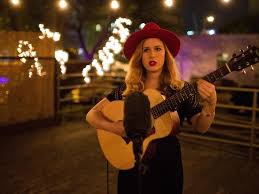 Holly Macve (pronounced Mac-vee) is a 20-year-old songwriter from County Galway. At the time of SXSW she only had some demos available.
For this Lullaby, it’s just her and her acoustic guitar. Her low notes seem surprisingly low somehow (I ‘m guessing she plays very cleanly so her notes stand out).
But the thing that stands out most is her voice. The song’s melody is pretty standard, but she often jumps octaves and nearly creaks her voice while getting there–it’s unsettling and charming at the same time. She sounds very old school country to me.
Also notable is the length of this song. It seems like a simple folk song with a pretty standard verse structure. In good Irish tradition, it also tells a story. But the slow pace seems to really stretch out the music. The chorus seems a few lines longer than one might expect (I do love the past and future mixed together in the lyrics). When she gets to a third part, which takes the song in a rather unexpected direction with very high notes, it’s unclear how long this song might just wind up being.
Macve has a lovely sound, and I enjoyed this song as a lullaby, but I think she’s too far into the country realm for my liking.
[READ: February 10, 2016] “Notes on Some Twentieth-Century Writers”
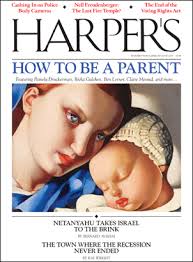
The August 2015 Harper’s had a “forum” called How to Be a Parent. Sometimes these forums are dialogues between unlikely participants and sometimes, like in this case, each author contributes an essay on the topic. There are ten contributors to this Forum: A. Balkan, Emma Donoghue, Pamela Druckerman, Rivka Galchen, Karl Taro Greenfeld, Ben Lerner, Sarah Manguso, Claire Messud, Ellen Rosenbush and Michelle Tea. Since I have read pieces from most of these authors I’ll write about each person’s contribution.
I have enjoyed Rivka Galchen’s works. Indeed, I have tried to write about everything she’s written. One of the things I especially like about her is that she always defies expectations. So, in this Forum, while everyone else is writing about being a parent, Galchen writes about writers who were or were not parents.
She lists dozens of writers and states their parental status. I will not go through them all because it would be exhausting (and would basically just duplicate what she wrote).
However, a couple of noteworthy people that she talks about include Doris Lessing who said there was “nothing more boring for an intelligent woman than to spend endless amounts of time with small children.” Rebecca West had a child with H.G. Wells. She tried to convince the boy that she was his aunt and not his mother. The child then wrote a novel in which he condemned his mother and then later wrote a laudatory biography of his father
The final person she mentions is J.G. Ballard–drank every day, was very productive and called all his children “miracles of life.” Of course he “also wrote with fondness about his time as a child in the internment camps of Shanghai.”
Writers are usually not the best people, so it’s interesting to see this list of them.
Here’s a little chunk of Galchen’s list:
Flannery O’Connor: No children.
Eudora Welty: No children. One children’s book.
Katherine Anne Porter: No children, many miscarriages.
Hilary Mantel, Janet Frame, Willa Cather, Jane Bowles, Patricia Highsmith, Elizabeth Bishop, Hannah Arendt, Iris Murdoch, Djuna Barnes, Gertrude Stein, Virginia Woolf, Katherine Mansfield, Mavis Gallant, Simone de Beauvoir, Barbara Pym: No children.
Jean Stafford: No children. Three husbands.
Alice Munro: Two husbands. Raised three children. First book of stories at age thirty-seven.
Toni Morrison: Two children. First novel at age thirty-nine.
Penelope Fitzgerald: Three children. First novel at age sixty. Then eight more.
John Updike: Many children. Many books.
Saul Bellow: Many children. Many wives. Many books.
Shirley Jackson: Four children.

 I Just Read About That...
Leave a comment