 SOUNDTRACK: SOFA-New Era Building 7″ [CST001] (1997).
 Sofa was a band that is notabkle for being the first band released on Constellation Records. They had some releases before that but then guitarist Ian Ilavsky started Constealltion where they released their final 7″ and CD before disbanding.
This 7″ has two songs, “Canyon (Fade)” and “With It” which do not appear on their CD Grey. if you know the band, these songs fit in perfectly with thie sound–low throbbing bass, noisy buzzy guitars and spoken/sung deep vocals.
“Canyon (Fade)” opens with tribal drum beats and a low rumbling bass (which reminds me a bit of early Cure and other goth bands), but with a bit of a heaver edge. The singer has a deep speaking style of singing. I’m not really sure what he’s singing, but it adds a great tone to the song. About midway through the song the guitar (which has been mostly scratchy and noisy) breaks out with some harsh feedback squalls that kind of overpower the song. But then the bass fights back.
Of the two songs, I prefer “With It.” The bass rumble is super cool, low and wicked sounding. And the drums a are bit more spare. The guitar is playing some occasional notes while the singer mumbles his way through whatever he’s talking about. It’s a totally atmospheric piece—you can just picture where this noir thing is happening.
Just before the chorus comes in, his voice gets louder, the guitars start squalling and feedbacking and a rather high pitched “withit” punctuates the noise, after which the deep voice seems to moan. It’s pretty cool.
I really enjoyed how the bass doesn’t really change for the whole song except in a couple of places where it places a similar yet distinct bass line. It’s neat and changes the tone of the song briefly. At 2 and a half minutes the song stops abruptly and then the guitar notes resume to get the song started again. Groovy noise.
Shame the band disbanded.
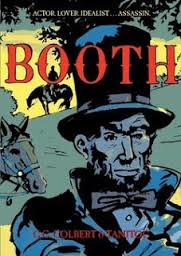
[READ: February 6, 2015] Booth
Here’s another First Second book for February #10yearsof01. And what better day to post a book about John Wilkes Booth?
I really didn’t know much about John Wilkes Booth except for the obvious–he shot Abraham Lincoln and shouted sic semper tyrannus.
Well, this book take a relatively sympathetic look at the life of the world’s most famous assassin. This is not to say that the book endorses what Booth did or anything like that–no hate letters please. It just looks at Booth as a human who had opinions and acted on them.
Thankfully, Colbert does not show Booth’s life in a vacuum so we get proper context for what he did and we also hear the opinions of the people who were also opposed to him. But it is fascinating to see the things he believed and what forced him to act on his beliefs.
John Wilkes Booth was the son of a popular actor (strangely, his father’s name isn’t given in the opening). Both Booth boys became great actors as well. John and his brother Edward were unparalleled on stage. But when the war broke out in 1863, they were divided. Edward was firmly in the North side while John, complete with his reb friends, were firmly for the South (and speak some horribly racist things, which I suspect was common, but is rather shocking to see).
Booth fell in love with a woman who was, unfortunately for him, pro-union. And seriously pro-union. Lucy Hale was the daughter of an abolitionist senator.
But soon enough Robert Hale Lincoln finds Lucy attractive too. John already hated the anti-slavery ideas of Lincoln and now his son is hitting on his woman? Talk about even more reason to dislike a family! So John takes up with a call girl (or something like it), named Ella. (and there’s some mild nudity, which surprised me–this book is for adults, clearly). But he still writes to Lucy and does eventually win her over with his charming words..
Meanwhile, Edwin’s success on the stage has been rising. But when he gets the news about his wife’s death, he quits the stage and vows to never return. This allows John’s star to rise even higher and since his views are quite well known, he is taken into the confidence of the conspirators.
Booth and his men vow that Lincoln will not win re-election and if he does they ensure that he will not live out the term.
And as we know, he does and he does not. The details are fascinating, and it seems as though he acts of his own volition for the final act,
I liked that she followed Booth for the two weeks or so that it took to capture him. And I’m shocked that he wasn’t grabbed immediately
To be sure this is a fictionalized account of history, with Colbert, a historian, filling in gaps as needed. But I didn’t know enough about the story to know what was true and what wasn’t.
This was a story I didn’t know an I was really interested in it. And I found the telling to be interesting, although I would have liked it to be a little cleaner both in story and in art. That definitely made it a little confusing. Also, it seemed to jump ahead a few times–I had to check to see if I’d missed a page.
I also really don’t like the drawing style at all. Tantioc’s style is what I call sloppy/ugly. And while it is effective–especially since he has most of the people wearing the same clothes throughout, I never really found it satisfying. And there are a lot of men who look an awful lot alike. Worse was the lettering, which feels like it was written really quickly and with very little care. (Ever since reading that good lettering can make a story better, I have been very observant about lettering styles. This one looks like I wrote it, and I feel like a story with this much work deserves better.
I did like that the chapter headings also included small descriptions of what was to come in the chapter–an old fashioned thing that leads to spoilers but also helped to elucidate some of the more confusing scenes within.
But it does make me want to read more about Booth, so that’s a good thing.

 I Just Read About That...
Leave a comment