 SOUNDTRACK: BLACK DUB-Tiny Desk Concert #89 (November 8, 2010).
 Black Dub is the collaboration between Daniel Lanois and Trixie Whitley (daughter of Chris Whitley).
I think I might have been more excited about this if I hadn’t seen Daniel Lanois’ other performance on Tiny Desk, where he came across as kinda jerky. I also had not heard of Whitley (who was 23 at the time).
Whitley has a huge voice (especially given how tiny she is). It’s big and brash and bluesy in a Janis Joplin sorta way. And she’s really passionate about what she’s singing–look at her face, for crying out loud). But it’s actually too bluesy for my liking. And it almost seems over the top given Lanois’ simple acoustic guitar strumming.
They play four songs, “Surely” which pushes five minutes; “Silverado” which has a nice duet between Whitley and Lanois to start (and then I feel like she adds too much during her section); “I Believe in You.” For the final song, Whitley straps on an electric guitar and plays a rocking riff (I enjoyed the accidental feedback that Lanois created). Her voice works a little better with the extra volume of the guitar. Although the song builds and buildups and never really goes anywhere.
I just never got into this Concert.
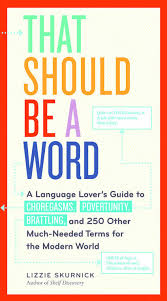
[READ: July 1, 2015] That Should Be a Word
I heard a big hyped review of this book, so I was really excited when Sarah brought it home. But I wound up being a little disappointed by it.
I imagine that since these items come from her newspaper column, it might be more fun to read a few at a time rather than all at once. Because while I enjoyed the premise, I got tired of the punny schtick after a few sections. And that’s a shame.
The one major gripe I have is that nowhere in the book does it ever acknowledge the pioneering work of Rich Hall and Sniglets, the guy who really spawned the idea of creating words for every day things. Skurnick does things differently of course, but I feel like at least a nod to the man would have been nice (especially since she is–admirably–so into the whole retro thing).
The premise behind this book (and the column is that Skurnick (and readers, I gather) create words for things that don’t exist. But the real premise is that the newly created words are sort of punny based on two other words (which Sniglets didn’t do).
I found the very first section about babies to be the least enjoyable. I don’t know why but it just seemed a bit irritating.
In this book of hundreds of words I’d say there were a dozen that genuinely described something new and in which the pun was very funny. I enjoyed Palbatross: a friend you’d like to drop and Denigreet: pretend to never have met someone.
Chewsy: (likes or dislikes certain foods for texture alone) was very funny but impractical to actually use ofcourse. While “reliabail” (always canceling) might be the best one in the book.
But other things seemed like she had the idea for the column and was going to have something every week regardless of how good it was like “oughty” (guilty but lazy anyhow) the sensation is real but the pun doesn’t work. Or plassitude (laziness without guilt): same problem.
Or something like “wirgin” (one who has yet to cuss). That’s pretty funny but are there really enough people like that that someone thought of it?
Something like “gafftermath” (fallout from a scandal) seems redundant– as does “poutrage” (anger by way of whining) or “cubicull” (laying off staff). Or even “twitcule” (makign fun of someone on twitter_–I think we’ve all decided that that’s just called bullying. Even “shoverdose” (to binge watch a TV series) is more complicated than “binge watch.”
I realize I am taking this too seriously, and that these are supposed to just be funny little one offs, but I love language and I like to see it played with in better ways.
The more I read, the more I got the sense of just exactly who the audience for this book was: See definitions for things like : one on an out-there diet, those who eat only exorbitantly priced foods, online shopping spree, guilt over unanswered emails.
By the end of the book things moved away from consumption to more relatable things like “umigrate” (walk into a room and realize one has no idea why one went there), and that’s a good way to end.

 I Just Read About That...
Leave a comment