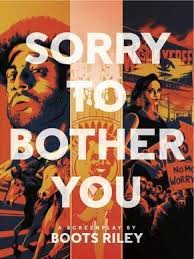
 SOUNDTRACK: THE COUP-Sorry to Bother You (2014).
 On the inside cover of this book it says that you can download The Coup’s new record online. Evidently that was a limited time only because the link no longer works. Every time I tried recently, the download failed. I was therefore unable to follow the request:
Let it be known that the editors will look favorable upon those who listen to the soundtrack and read the script at the same time.
Which I would like to have done, since I like The Coup and have Party Music.
You can listen to some of their songs (which are quite dancey even when they are subversive) on their website. (and streaming as well).
I have been listening to the disc online while writing this post and I like the way The Coup makes their songs catchy and the way Riley’s rapping is fast but clear. “Violet” which is rapped over a lovely violin and strings piece.
My one gripe about the album is a consistent gripe with a lot of rap albums–there’s too many guests. I don’t listen to The Coup to hear other singers, I listen for Riley and his band. If I can get the download to work I’ll review the album properly in the future.
[READ: August 15, 2015] Sorry to Bother You
Sorry to Bother You came with McSweeney’s Issue #48. I have just gotten around to reading it and I’m bummed that I waited because this screenplay is fantastic.
Boots Riley is the creator of The Coup and an activist in general (I love the quote that “a Fox contributor (whose name I simply don’t want to appear on my blog) called his work ‘a stomach-turning example of anti-Americanism disguised as high-brow intellectualism.’ Boots was surprised and elated by the compliment”).
The opening of the screenplay is a note from Boots himself in which he explains that “every scene, every character, every word–is true.” And that McSweeney’s has forced him to change the names of those mentioned.
And then the screenplay begins. Cassius Green (known as Cash) lives in a garage bedroom (in which the garage door opens some time unintentionally). He has just scored a job at a telemarketing office (his faked resume was hilarious). His girlfriend, Detroit, is an artist. She wants what’s best for him, but also doesn’t want him to suck up to the man. But at the same time, they do need some money.
In their neighborhood there are billboards everywhere for WorryFree. There’s also a TV ad that plays during the movie in which we learn that WorryFree “guarantees you employment and housing for life” (the TV shows six bunk beds, like a prison done up by a hip interior decorator). The concept of WorryFree permeates the movie.
Cassius does poorly at his calls until an older black man named Langston teaches him to “use your white voice.” When he channels his white voice, he starts doing very well. This would be hilarious to watch in a movie as I try to imagine what voiceover they would use. His sales are great and he is soon groomed to be a Power Caller. Power Callers get a plush elevator ride to the top floor (in which the elevator compliments everything from their appearance to their sexual prowess) where they make mad money.
At the same time, someone is going around defacing the WorryFree billboards. This begins to get people angry. And soon the folks at the telemarketing job begin agitating for decent working conditions (they don’t get them at the moment). There are protests outside WorryFree as well, as people are basically realizing that the WorryFree contract is akin to slavery.
Cassius wants to join the protests, but his Power Caller status leaves him somewhat immune to what’s going on. And then he crosses the picket line. In a dramatic moment that will come back to haunt him (hilariously a video of it appears on the popular TV show I Got the Shit Kicked Outta Me!), he is hit in the head with a can of coke.
Meanwhile, Detroit has been creating her pro-African-American/anti-corporate art and getting a gallery show. Cassius is too wrapped up in his Power Caller world to spend enough time with her. And he misses her show set up because he is at a party at Steve Life’s house. Steve Lift is the president of the telemarketing company which we see has ties to WorryFree.
So Cassius is torn between the success and money he is making and the major sell-out he is becoming (by the middle of the movie half of Cassius’ lines are overdubbed by the white actor). And then, while at the party, he learns about something incredibly disconcerting about what Steve Life has planned. And when he sees the evidence of said plan, he is understandably freaked out. How can he possibly convince anyone that what he saw was real?
The screenplay was quite funny and I would absolutely love to see this as a movie. No idea if Riley is really trying to get this made, but I sure hope he does.

 I Just Read About That...
Leave a comment