[LISTENED TO: August 2015] The Organist Season 1
 Given my love of the McSweeney’s empire, it seems logical that I would have listened to The Organist sooner than this. But I didn’t. It has been on for a couple of years, so i assumed I’d never catch up. But then I saw that there were only 50 episodes and most of them were quite short. So it was time to see what it was all about.
And, since it is more or less in conjunction with The Believer, it should come as no surprise that it is sort of an aural equivalent to that magazine–longish pieces about esoteric subject, but geared specifically to “radio.”
The Organists first season was done as a monthly podcast starting on Feb 1. Each episode was about 50 minutes long and covered a variety of subjects with fun guests and other ephemera.
Episode 1: (February 1, 2013)
 The inaugural episode kicks off with Nick Offerman spouting some hilarious nonsense about podcasts. The rest of the show includes an interview with George Saunders talking about the voices of his fiction; Greil Marcus discusses the impact of the first Bikini Kill EP now that it is reissued. Perhaps the most unusual and interesting piece is when Amber Scorah tells the story of her defection from the Jehovah’s Witnesses while working as a missionary in Shanghai; In short pieces, Brandon Stosuy editor of Pitchfork, presents five five-word record reviews of interesting new guitar rock and then musicians Matmos take a song from their new album apart, piece by piece, revealing its brilliant, pulsating innards. Basically they used thought control to get people to “create” a song for them. It’s a really neat process even if the final result doesn’t really sound like the sum of its parts.
 Episode 2: The Rhetorical Bed (March 7, 2013)
With the second episode, they were given titles. David Cross opens with a nonsensical piece about his aura-sniffing powers. Incidentally the speakers did not write these pieces, you’ll have to listen to the episodes to find the authors. Musician Devendra Banhart gives a fascinating interview about thinking in Spanish, and wanting to write a song called “Jim Carrey, Alone.” In a great non-fiction piece, Andrea Silenzi’s discusses the absurd copyright of “Happy Birthday” and plays the results of her request for people to make a new birthday song. There’s some great entries at the Free Music Archive. Thomas Rogers has an amusing investigation into the origins of “gay voice,” And in a follow-up to a piece in The Believer, we get to listen to what’s at the end of toll-free ogres phone numbers. Author Sam Lipsyte reads :”old news summary ” about the Obama/Romney debate which is pretty funny
 Episode 3: Tween Anxiety (April 9, 2013)
Sarah Silverman talks about her virtual pet owl. There’s the first of two pieces from Jack White’s Third Man Records. In this one he interviews Conan O’Brien (who is hilarious). Shane Carruth’s first film in ten years, Upstream Color, which is bizarre and fascinating. Rachel Kushner is interviewed about her then new novel, The Flamethrowers, which I have yet to read but really want to. There’s also a great discussion about a guy finding a tom of ancient and perhaps one of a kind vinyl that was being thrown out. And, The Blob has just been released by The Criterion Collection.
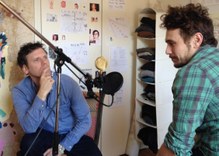 Episode 4: Richard, The Angel of Death (May 3, 2013)
James Franco performing a new radio drama by the playwright Will Eno. It’s perhaps my least favorite of these introductions and it seems quite long. Jonathan Coulton made a fun, light-hearted cover of Sir Mix a Lot’s “Baby Got Back” and then amazingly, Glee used his cover in one of their episodes but gave him no credit–because a cover version gets no official recognition. This was a fascinating indictment of Glee and a fascinating look at hoe musical copyright works. Author Tao Lin, who I’d never heard of is interviewed (he talks so slowly that they speed up his speech and he doesn’t sound weird!). There’s also a rap battle between Kitty and Kool A.D. reading his first page. The artist Nick Cave (no not that one, a different one) made horse costumes who danced in soundsuits throughout Grand Central Station. And there’s a fascinating piece about The Source Family, a vegetarian cult from the 70’s who had a successful vegetarian restaurant and made music too. (Learn more about them here).
 Episode 5: Tempest Storm and Andy Kaufman (July 5, 2013)
Jack White is back, this time interviewing the oldest working burlesque dancer in the world, Tempest Storm as part of Third Man Record’s Green Series. Also, you can hear some never-before-released cassette recordings by comedian and performance artist Andy Kaufman. Drag City is releasing the recordings as an LP/CD called “Andy and his Grandmother” and they are weird and uncomfortable, just as Andy would have wanted. Director Harmony Korine, who I’m no fan of plays some of his songs and pranks from when he was a kid. There’s a skit from the comedy troupe Sunset Television, which I found mildly funny. There’s also a look at fighting beetles with sound–learn more about that here.
 Episode 6: The Pyramid Club (August 5, 2013)
Edgar Oliver performs “Son of Rex” a weird radio drama by Nick Antosca that I liked some of. Then Grantland‘s Hua Hsu investigates unsolved mystery of hip hop sampling in Mobb Deep’s “Shook Ones.” Sam McPheeters talks about shoplifting hardcore punk 7-inches in 1980s Manhattan (and feels kind of bad about it, especially since he got practically nothing for his troubles). French percussionist David Langlois on how he began his career by stealing his grandmother’s fondue pot. There’s a great discussion with Dawn of Midi, a band I knew a little, but whose album, Dysnomia, I have since bought and fallen in love with. Max Tundra offers several five second song snippets.
 Episode 7: Against Lineage (September 9, 2013)
Comedian Thomas Lennon reads a very funny audio drama about apprehending shoplifters at Urban Outfitters. There’s an interview with Kathleen Hanna, for those of us who wondered what happened to her after Bikini Kill. Information about a Harvard study that tests the unconscious racial prejudices of three-year olds. There’s a lengthy, rather shocking and sad story about Chris Stroffolino, formerly of The Silver Jews. He went from being a Shakespeare scholar, to a musician, to a homeless guy living in a van with a piano retrofitted in the back.
 Episode 8: Kittens in a Basket (October 7, 2013)
Jesse Eisenberg in a funny piece about branding written by Ben Greenman. Mac Barnett talks about his favorite children;’s book series by Russell and Lillian Hoban called The Brutes (they did the Frances books too). It is a funny look at morality in childrens’ books with excerpts read by Catherine Keener. He talks about how the first book was so obvious, but the follow up was weird and delightful. There’s a remembrance of artist Mike Kelley, who I didn’t know. Alexis Georgopoulos of the band Arp who talks about composition.
 Episode 9: The Sonic Barber’s Pole (December 13, 2013)
Sunset Television is back with a funnier group of skits about Canadian medical marijuana from the 1970s. There is a fantastic story about art forgery and selling art on eBay (when eBay was just getting underway). It’ an interview with Jonathon Keats who wrote the book Forged: Why Fakes are the Great Art of Our Age. There’s a cool story about aural illusions (which are optical illusions for our ears). There’s an interview with Lars Iyer, who has written three novels Spurious, Dogma and Exodus as well as non-fiction about philosophy, literature, and the internet. He’s an interesting gadfly.
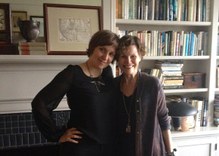 Episode 10: Thundershirt (January 7, 2014)
A conversation between Lena Dunham and Judy Blume, in Blume’s Manhattan apartment. It’s the audio version of the print item that I talked about here. I think it was more fun listening to it than reading it.
I really enjoyed this season of The Organist. It as very much like reading The Believer, but you know, with sound. A couple of the pieces were a bit too long and there was a tendency to follow a very specific kind of down and out artist, but overall it was a great listen.

 I Just Read About That...
Leave a comment