 SOUNDTRACK: SONGHOY BLUES-Tiny Desk Concert #455 (July 17, 2015).
 Songhoy Blues are from Mali. They play an interesting style of rock/blues that follows rock conventions but subverts it as well.
“Sekou Oumarou” is a pretty straightforward bluesy number. Until the vocals come in and you realize that they are not singing in English. I think they are singing in French, but I’m not exactly sure.
It feels like the main instrument on “Al HassidiTerei” is the drums which, while keeping pretty steady beat, don’t keep a simple 4/4. This is not to say that the guitar and bass do nothing, because they play a cool riff and rhythm. But they tend to keep the music pretty steady while the song plays on. That is, except for the massively cool fuzzed out guitar solo at the end.
“Soubour” has a great classic rock style riff and when the guitarist stars going it sounds like it could be coming from the late 60s. It’s a stellar track with a groovy psychedelic sound and wailing solo.
It’s tempting to want to like Songhoy Blues because of the politics and story behind the band (which is pretty intense), but they are so good that you don’t need to know anything about them to really get down to their great songs.
[READ: May 17, 2015] Essex County
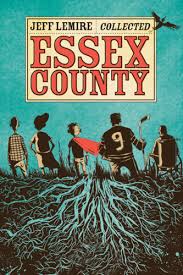
I saw this book in the library. I was intrigue by the hockey player on the cover (okay and that it was 500 pages). When I saw that it was a 2011 selection in Canada Reads, I knew it had to be at least worth a look.
This graphic novel looks at several generations of people living in Essex County, Ontario, Canada. It collects the three books Tales from the Farm, Ghost Stories and The Country Nurse as well as some other odds and ends.
The introduction by Darwyn Cooke is really great for contextualizing this piece, although i wish he hadn’t spoiled the scene with the hockey players (so maybe for maximum impact, don’t read this before reading the book itself–actually, read the whole thing except that 8th paragraph).
“Tales from the Farm” starts in summer. We see a boy, Lester, in a mask and cape, flying. Until his Uncle Ken tells him he has to feed the chickens, then he comes back down to earth. After some chores they go to the gas station. Lester asks if he can get a comic book. The guy at the counter Jim, who is big and kinda scary, gives him the book for free.
The man is Jimmy Lebeuf. He is a local guy who excelled at hockey and even made it onto the Maple Leafs for one game. But he got hurt in the game and has been “kinda slow” ever since.
The kids on the bus tease Lester for wearing his mask and cape, but he doesn’t care. He is also reluctant to talk to his Uncle Ken about anything. It’s only when Jimmy runs into him that he feels comfortable around someone. They even build a fort to fight aliens. But when Uncle Ken hears about this, he tells Jimmy to leave the boy alone.
We eventually learn why Lester is living with his Uncle Ken and exactly what playing with the Leafs was like for Jimmy (he scored a goal but no one remembers that).
Book Two is significantly longer. And it focuses on Lou LeBeuf. He is an old man about to go into a nursing home. And most of his story is told in flashback. Like when his brother Vince (and Vince’s girlfriend Beth) come to the city (away from the farm in Essex County) so that Vince can try out for the Toronto Grizzlies. We meet the team and see some games (in the 1950s) and we watch as Vince, the bigger tougher brother dominates on the ice.
In the present, we see a nurse coming to visit Lou. She tries to help him–she even kinds of likes the incorrigible old man, but there’s precious little she can do for him.
Lou pulls out a scrapbook with lots of photos and articles about he and Vince on the team. We see their success, we see them win impossible games and come back from an embarrassing start to the season. And then we see the celebratory party–where Lou and Beth do something that they will regret for nearly 25 years.
After that season, Vince and Beth moved back to Essex County and the farm. And Lou was alone. He tries to make a living in the city. But once he shoots out his knee, he’s done with hockey too. We see him and his brother living parallel lives miles apart.
When Lou’s mom dies he travels back to Essex County for the first time in 25 years. He finally meets his niece Mary, but Beth is not friendly about his arrival. Then he and Vince get into a fight and Lou leaves.
We find out what finally brings them back together and what ultimately brings Lou to the farm again. And we learn that Jimmy Lebeuf is the son of Mary (and hence Vince’s grandson). And we flash back with the two brothers as they watch Jimmy score his goal! We also learn that in the present, Lou lives just up the road from where Jimmy works.
The third book, “The Country Nurse” looks at the nurse who was talking care of Lou. She lives by herself with her son Jason, a disgruntled teen or twenty something.
She tries to get Jimmy to visit his Uncle Lou. And we see her visiting with Lester briefly (he no longer wears his cape and mask). She tells Ken that he owes it to Lester to tell him the truth (which she doesn’t say but Lester overhears her talking about it).
Then it flashes back to 1917 and an orphanage. The nun in charge is cross with the caretaker Charles. We learn why a little later. But when he rescues a child from the burning school, all is forgiven between them. We eventually learn how that story fits into this whole book.
It is a powerfully moving account. Hard to believe that at 21 Lemire he could write so eloquently about these older people.
Some of the shorts included are the Essex County Boxing club. A short piece about two friends who create the titular club as a way for the men in town to get out their boxing needs, and how it got huge and then fell apart.
There’s also “The Sad + Lonely Life of Eddie Elephant Ears” about a boy who was in a terrible accident. His story was meant to be part of the greater Essex County, but was cut and was turned into a short instead.
And then there’s all kinds of cover shots and original sketches and everything else that one loves about a collected omnibus.
This story was simply fantastic. I love Lemire’s style–so rough and boxy and yet incredibly subtle. I will definitely look for more books from Lemire.

 I Just Read About That...
Leave a comment