 SOUNDTRACK: ODDISEE–Tiny Desk Concert #451 (June 26, 2015).
 Oddisee is a positive rapper. That photo of him smiling really conveys the tone of his songs–well, that and the fact that the first song is called “That’s Love.” He raps really quickly. He also gets a wonderful call and response going on “That’s Love” where he has the NPR staff sing along to his chorus. (The opening scene shows him practicing with the audience). And he really gets everyone going.
I don’t know what his recorded output sounds like, but in this Tiny Desk, he’s with only a keyboardist and a drummer. The live drummer is a great addition.
“Contradiction’s Maze” has a few sung choruses (he has a good singing voice too). They don’t really modify the keyboard sound for the songs, which isn’t all that interesting. It sets a nice background for all the songs, but it does make things sound a little samey. “Belong To The World” is similarly uplifting, but I honestly had a hard time distinguishing it from the previous song.
Despite that, his positive attitude and generally upbeat personality were quite infectious.
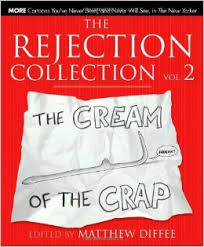
[READ: July 24, 2015] The Rejection Collection 2
The Rejection Collection is back! Presumably the first collection was successful enough that Diffee was prepared to do another one. He gathers many of the same cartoonists (although at least a half a dozen did not return) and he gathered some new folks as well (for a total of 38 this time).
Returning: Leo Cullum, Pat Byrnes, Sam Gross, Mike Twohy, C. Covert Darbyshire, Drew Dernavich, Christopher Weyant, Kim Warp, John O’Brien, Marisa Acocella Marchetto, Danny Shanahan, Mick Stevens, Mort Gerberg, Michael Crawford, P.C. Vey, Gahan Wilson, Glen LeLievre, Alex Gregory, J.C. Duffy, Carolita Johnson, Ariel Molvig, Michael Shaw, Eric Lewis, P.S. Mueller, David Sipress, Jack Ziegler.
New additions include: Paul Noth, Roz Chast, Marshall Hopkins, Nick Downes, Robert Leighton, Julia Suits, Zachary Kanin, Harry Bliss, Jason Patterson, J.B. Handelsman, Sidney Harris, Jack Ziegler, Robert Weber.
The introduction is Diffee’s opportunity to show what a New Yorker cartoon request is not (it’s not editor Mankoff asking for a theme or specific idea for a cartoon). Diffee shows some Venn diagrams of what he thinks is funny and what the editors might thing is funny and if they ever overlap. He also says that at the end of the book he’s going to show some of his own rejections with an idea of why he thinks they were rejected.
Each artist this time had a photo montage page. It includes a head shot, a foot shot (I like that the first one is actually his dog’s feet in his shoes), what’s in the fridge, the work station and a drawing. It’s fun to see what each person does with these ingredients. Then there’s another damned questionnaire. Some people had a lot of fun with this, while others decidedly did not.
There’s a kind of mad lib about the person’s history, some more questions and a pie chart to fill in. There’s more ranking of things and more things to circle. It gets a little tiresome to read everyone’s in a row, but that’s the reader’s problem since each one is pretty funny in its own way.
He throws in some lines and asks people to make a doodle out of it (amazingly, many people made faces out of them). I am also really interested that the doodles and drawings people do on the questionnaire often look nothing like the ones they do for the New Yorker.
I liked that Marshall Hopkins’ “fridge” was the veggies on a grocery store shelf. (His toons are very very dark). A loved that Alex Gregory had the pie chart crushing himself–that was very original. And I loved his Anal Sex joke. I love that Ariel Molvig pasted a picture of Mona Lisa over the lines that you were supposed to doodle on. Eric Lewis loves his cat and Harry Bliss loves his dog, Penny. Drew Dernavich’s feet picture (one foot is a drill), is very funny.
And then there’s all the cartons.
I feel like in this book the cartoons were a bit more sexual than in the previous. Whether it was just the addition of the new cartoonists or what, there seemed to be a bit more nudity.
I’m certainly not going to describe them to you but suffice it to say that most of them are really really funny. I particularly enjoyed the man with the sign that says “Ass-Head Please Help.” I love John O’Brien’s twisted take on toys for tots I also love Pat Byrne’s Keister Island.
One of the questions in the questionnaire is “If you could ask Bob Mankoff, the New Yorker cartoon editor, one question, what would it be?” It’s fun to see all the crazy nonsense people ask him–almost none of them ask why they weren’t chosen. But it’s even funnier that at the end of the book Mankoff answers them all equally nonsensically.
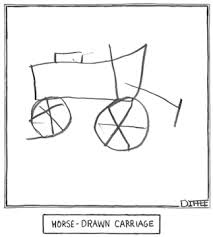 The appendix gives Diffee’s reasons for rejection which include: too lowbrow; too politically incorrect; too dark; too weird (that one is pretty weid); too politcial (although Diffee doesn’t do politics); too difficult to get (I liked that one–a group of geese flying in the shape of a Nike swoosh and the other geese saying “Sellouts.” Too Bad (a cheap puns); too dirty (the magazine does sex jokes, but won’t touch some topics). And Too Dumb (I liked this one a lot). See left. It makes me giggle.
I enjoyed this collection very much, and learning even more about these mostly anonymous cartoonists was really cool. I also enjoyed the way the cartoonists gave Diffee a hard time in the questionnaire. It was pretty funny.
Another top-notch collection.

 I Just Read About That...
Leave a comment