 SOUNDTRACK: CAMANÉ-Tiny Desk Concert #441 (May 15, 2015).
 Camané is a Portuguese Fado singer. The NPR blurb says that fado, “which means “fate” in Portuguese, emerged from the gritty barrios and docks of Lisbon in the early 19th century and has evolved in fascinating ways. Think of it as the Portuguese blues.”
The songs are sung in Portuguese and I don’t know a word of what’s he’s saying, but as the blurb continues: “[The songs] flow with an ineffable mix of longing, loss and melancholy, framed in resignation. It’s a kind of glad-to-be-unhappy feeling the Portuguese and Brazilians call saudade.”
The most interesting part of this to me was what I thought was a bouzouki but which I see is actually a Portuguese guitar–12 steel strings, played in very fast runs. While Camané’s voice is clearly the focus (and it is amazing), José Manuel Neto’s Portuguese Guitar is pretty darn awesome. And the accompaniment by Carlos Manuel Proença on guitar is lovely too.
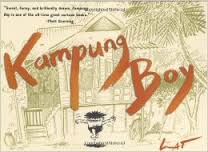
[READ: January 7, 2015] Kampung Boy
This book was written (and drawn) in 1979. First Second books had it translated and published in 2006.
This is the story of a boy growing up Muslim in rural Malaysia in the 1950s. Evidently it was serialized in Malaysia back in 1979 (it does feel kind of episodic, but it holds together very well).
It is a charming story of a simple life in the village that is slowly being changed by progress.
It starts with Kampung Boy’s birth and the simple way he was born (midwifed by his grandmother for which she was paid $15) and how he slowly grew from a baby into a naked toddler running around the village. His aunt worked at the local rubber factory (his parents owned the rubber plantation) where they removed latex rubber from the rubber trees.
He had a good childhood as long as he stayed nearby, but the persistent sound of the tin dredge–the machine that sounds like a monster–was always a tempting thing. Of course, the one time he did sneak off to spy on it, he was soundly beaten by his mother.
His father on t either hand was a joker–he was a lot of fun and the kids in the village all liked him and his jokes. But he was also very devout and he took the boy to his formal education: “Dad handed over to Tuan Syed a bowl of glutinous rice, a fee of $1 and a small cane and then said, ‘Twan, I am handing my son over to you in the hope that you’ll teach him the Koran. Treat him as if he is your own child… if he is stubborn or naughty don’t hesitate to punish him with this cane–as long as you don’t break any of his bones or blind him.” Yipes.
He made friends with three boys who were kind of trouble makers. But they knew all the best places to go swimming and fishing. It is idyllic and peaceful at school. And there is promise ahead as his father shows hm that their plantation will one day be his.
The book ends with the circumcision of the boys in the village (at 10!). The scene is quite amusingly drawn, even if it is presumably very realistic.
T he end of the book is bittersweet as the boys grow up. He graduates from school which is very exciting, but at the same time learns that the tin company (the owners of the fearsome dredge) is interested in buying their property.
I loved Lat’s drawing style–distinctive and exaggerated but sweet and funny. It is very comic strip style–economical and effective–without it feeling too much like a punchline is always coming. And I’m really looking forward to the sequel.

 I Just Read About That...
Leave a comment