 SOUNDTRACK: LAURA VEIRS-Tiny Desk Concert #49 (March 1, 2010).
 I have decided to contradict myself. I simply cannot keep up with the regular release of Tiny Desk Concerts (sometimes 3 a week), so I’m going to focus on these older recordings for a while and occasionally devote a week or two to new ones. we’ll see how that works out.
I only know Laura Veirs’ name, but not really anything she’s done. So I wasn’t really sure what her “solo” work would sound like. Well, she has a delightful voice and she writes really pretty songs.
She also offers one of the most dramatic screw ups I’ve seen in a live performance. She opens her song “Carol Kaye” with this lovely melody–just her and her guitar. And then after about a minute, her band comes in with a beautiful harmony–in the wrong key! The introduction of their voices is so dramatic (to go from her gentle voice to this huge chorus) was really amazing. So much so that I didn’t quite realize they were in the wrong key at first. Turns out that Laura put her capo on the wrong fret and it wasn’t until the keyboardist played the right note that they all sounded off. And his mouth drops opens as he stares at Laura. She laughs and says “you looked like this terrified Muppet.”
They play the song again, this time perfectly–and the harmonies are truly lovely. As is the violin that swirls throughout the song.
“When You Give Your Heart” is another lovely song in which Viers’ voice and the violin play the same lilting melody.
“Sun is King” has some more lovely (that’s the word to describe her, clearly) harmonies–she has picked a tremendous backing band. And they sound great in this small setting.
It’s hard to believe that the whole set (miscue and all) is only ten minutes long.
[READ: May 1, 2015] House of Leaves
I read this book when it came out in 2000. I had the “2 Color” edition which the t.p,. verso explains has as features: “either house appears in blue or struck passages and the word minotaur appear in red (I had the blue version). No Braille. Color or black & white plates.”
The Full Color edition (which is the same price, amazingly) differs in this way:
- The word house in blue, minotaur and all
struck passagesin red - The only struck line in Chapter XXI appears in purple
- XXXXXX and color plates
So basically the full color edition isn’t really that big a deal although the three or four full color plates are much nicer.
Why do I have both? Well, I bought the two color when it came out and then I won a free book at the library and there was this full color edition, so I brought it home. I was amused to find that the previous owner had deciphered a clue in the back of the book (the first letters of sentences spell out a secret message). She (it looks like woman’s handwriting) wrote out the secret message, which I appreciated as I didn’t feel like figuring it out.
ANYWAY.
This book had a huge impact on me when I read it. Although I forgot a lot of the details, the overwhelming effect of the book has stayed with me an I never forgot the central conceit of a house that opened secret passages and expanded or contracted at will. For, make no mistake about all of the accolades, this is a horror story. One accolade, from Bret Easton Ellis: “One can imagine Thomas Pynchon, J.G. Ballard. Stephen King and David Foster Wallace bowing at Danielewski’s feet, choking with astonishment, surprise, laughter awe.” [Ellis will not be bowing apparently, and actually I can’t imagine Pynchon bowing before anyone]. It’s a very cool horror story with all kind of textual experimentation and twists and turns, but it’s still a pretty damned scary story.
The experiments are many and varied and they begin right from the start, as the title page lists Mark Z. Danielewski’s House of Leaves by Zampanò with an introduction and notes by Johnny Truant. The forward from the editors notes: “The first edition of House of Leaves was privately distributed and did not contain Chapter 21, Appendix II, Appendix III or the index.
This is all nonsense of course.
The introduction, written by Johny Truant is in a typewriter font. It explains how he came to possess House of Leaves by Zampanò. His friend Lude brought him to Zampanò’s apartment (Lude lived in the same building) after Zampanò died. Zampanò was an interesting guy in the building. He was blind, but he walked in the courtyard every night and all kinds of stray cats walked with him. When he died the cats disappeared. When Lude and Johnny go into the apartment they find clawmarks in the floor and a chest that contained all of Zampanò’s notes which became House of Leaves.
Zampanò’s “House of Leaves” was a book length investigation of a film called The Navidson Record. Johnny explains that he can find nothing about this film in his reality. He can’t find any copies of it, he can’t find any records of it. Nothing. Despite the fact that Zampanò references dozens and dozens of real people who have commented on the film, whenever Johnny tries to contact them about it, they say they have no idea what he is talking about.
Johnny’s introduction was written October 31, 1998 (which is the same date as the final notes in that recently-found chapter 21).
And then the first chapter starts. In Appendix 1 (pg 540), there are possible chapter titles for the book. The chapter begins talking about The Navidson Record and that many people call it a hoax. On the second page of the text proper, there is a footnote from Johnny Truant in his typewriter font. The rest of the book is in a pretty standard book font. And Johnny’s footnote talks both about the book and about himself. And soon enough, his footnotes take over large chunks of the text. And his life (which parallels the book some \what) starts gaining prominence in the book.
But back to The Navidson Report. This is a film created by Pulitzer Prize winning photographer Will Navdison. He and his wife (technically not his wife, but the mother of his children whom he has lived with for years) have been drifting apart because of his intense work schedule. They decide to move to Virginia to bring them closer.
Navidson wired their entire house with Hi 8 cameras. He says that he wanted to create record of “how Karen and I bought a small house in the country and moved into it with our children. ..Which is how I got the Guggenheim Fellowship and the NEA Media Arts Grant.” It is meant to be a documentary about a family settling into a new life.
Since David Foster Wallace was mentioned earlier, it’s a little weird to see his that the wife of Will Navidson is named Karen Green (which is the name of DFW’s widow–artist and author Karen Green). I am quite certain it is a total coincidence.
The second chapter has the first of Johnny’s super long interruptions. And while I’m not going to keep talking about them, I’ll give a little summary of what’s going on with Johnny. Basically he is unhappy with his life–he and Lude go out regularly, do drugs, sleep with women (their pick up style is pretty great), act like fools, that sort of thing. Johnny works in a tattoo parlor (no idea what Lude does). Johnny has the hots for a stripper he has nicknamed Thumper. She comes into the tattoo store regularly but he cant get the nerve to talk to her.
Each chapter has an epigram (often times in a foreign language which Johnny may or may not be able to translate–if he can’t, the editors do). Zampanò is extremely well versed in, well, just about everything. In his own note, Johnny says that since Zampanò was blind, he had people come and read to him all the time). And there are dozens of bibliographic references in every chapter as well. Like (pg 60) Drew Bluth’s “Summer’s Passage” in Architectural Digest v. 50 n. 10 in Oct 1993 p. 30.
By chapter three though, the plot (of the movie and the book) has begun. Navidson comes into his house one day and finds that a door has been installed in his hallway. It wasn’t there yesterday, so why is it there today? Would someone break in and do this? Of course not. And there’s no evidence on any of the cameras so what the hell?
The doorway presents a hallway. When he measures it, it proves to be 1/4″ BIGGER than the outside of the house. Will calls his brother Tom (twins) to check it out. He and Tom have been cold to each other for a while but Tom is happy to help (and the whole experience brings them close together). Neither one can figure out what the heck is going on. And Karen is getting more and more upset that Will is spending so much time on this investigation (they are supposed to be spending time together).
The footnotes, most of which are numbered, also come with symbols some times (I’m unsure why) . Even Johnny’s footnotes start to get distracted by the text–he yells at Zampanò’s writing as well–why does nobody that he cites know what he’s talking about? This, in addition to his rantings about himself and Thumper and his increasing inability to forget about this house and movie show that his mental state is deteriorating.
Will and Tom enlist the help of some other folks who run various tests that prove that this hallway cannot possibly exist. And then, after Title credits which reads Exploration 1, they discover that the hallway is much bigger than it was the other day. Then it was just a few feet, but it is now at least 100 feet long. And it is dark, pitch black. As he walks down it, there is a doorway which leads to a room that is impossibly big–there is no visible ceiling. (This leads to the first of many footnotes which are utter nonsense–two pages of names concerning “the history of rooms.” After reading the two pages it ends in a note from Johnny which says that one of the people who read to Zampanò confirms that “this list was entirely random.”
We learn that the explorations occur in August of 1990. And that they have invited Holloway Roberts, explorer extraordinaire to come and investigate the house. This is largely from Karen’s insisting that Will have someone else do it or she is leaving him. Roberts is a brash tough guy unafraid of anything. And he soon lords himself over Will and Tom.
And that’s when things get interesting. Roberts and his team go into the hallway and they are shocked by what they see–room after room of total darkness. It goes on for hours until they find a staircase. They soon learn that the staircase goes down for miles. What the hell?
Oh, and by the way, there’s a s deep growling intermittently rending the air.
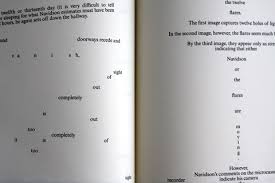 And as things gets weirder in the house, they get weirder in the book. Chapter IX (The Labyrinth) starts to resemble, well, a labyrinth. On page 119 a box appears in the middle of the page. It has a footnote (or box note) in it and on page 120, those words are in the box backward. There’s also a side note–another impossibly long list of architects and buildings that you need to flip the book upside down to read. There are blank spaces and text blocks going in different directions. And then as you enter Chapter X, the book starts mimicking the passageways that Navidson experiences. So maybe there’s text only on top or only on the bottom or even one or two words per page. It is as effective as it is disconcerting
Also disconcerting is that this “plot” of Navidson in the house is interrupted. Zampanò assumes you have seen the film, so for him there is no urgency. Rather, he jumps back to Karen’s story. She has edited some of the footage that she has and shows it to people. So we get comments from Camille Paglia (yup hard to write in the late 1990s and not include her) Anne Rice, Harold Bloom even Stephen King himself . And Johnny interrupts with Lude’s story (the number of women he slept with in a a month (and the a sadder look at the problems those women might have had that cause them to be so free with themselves). There’s even a series of academic papers explaining theories about Navidson’s behavior (too big to reproduce, so Zampanò summarizes them.)
 Later in chapter XX Navisdon returns to the house and the text is even more Topsy turvy with the text utterly following the story–going up and down, spiraling, sitting in a corner. You have to physically turn this book to read everything.
You know things must be somewhat okay because there are interviews with some of the people, but we also no that some people do not make it out alive.
The book also plays with us when Johnny explains that in one section of the book, holes from ashes were burnt into the paper. And there are bracketed areas in the text where he couldn’t salvage the text
By the way, Johnny Truant hits some really hard times. He is so obsessed with this book that he stops eating, stops going to work, he is terrified of sleep and the outside world in general. His story actually becomes as compelling as Navdison’s. And nothing is more unexpected than when the note about this being the second edition of the book actually proves to be, well, useful.
And remember how there was that note about the Appendices. Well thee are six “exhibits.” Each one explains what the text will be, but they are all missing. Then there is Appendix I which includes quotes from Zampanò and others as well as full color scraps of paper–the actual work from Zampanò–charred pieces, scraps, typed and handwritten notes an even diagrams. There’s also poems (which are referenced in a footnote).
Then comes Appendix II which has drawings and sketches of the house, collages of Zampanò’s materials and the Attic Whalestone Institute Letters. These letters are from to Johnny from his mother after she had been institutionalized. And again, the text follows her descent into insanity. It is disturbing to say the least.
Appendix III contains “contrary evidence” and then the book ends with an Index–extensive and elaborate and kind of pointless actually.
It is an astonishing piece of work. To come up with this story (well, two or more stories) and then to come up with intellectual theories about the story and then to come up with pop culture ideas and rebuttals to these ideas. Danielewski really put a ton of work into this. And while the page turning may be gimmicky, it is really effective.
This is clearly a love or it or hate it kind of book. You can tell as you read it that people will thing it is form over function or just not worth the work. But I found the story compelling, scary, fascinating and really interesting I even found Johnny’s story to be interesting even though he was not a very good person–and his early exploits were crass and crude.
I feel like when I read the book the first time (when I was younger obviously) I was a bit more sucked into the story (which is why I retained it so well). Although as I realize now I didn’t remember all that much about it. This time, I really absorbed it more, and found it really quite entertaining.

 I Just Read About That...
Leave a comment